This AI just exposed the BIGGEST legal insider trading operation in America.
A platform called GovGreed built a seven-layer machine learning system that cross-references every stock trade disclosed by every sitting politician against the bills their committees control, the campaign donations they receive, and the companies their votes directly impact.
It scored all 540 politicians currently in Congress. And the numbers are crazy:
56% of every stock purchase made by Congress in the last 16 months was on a stock directly affected by a bill the buyer later voted on. That is 6,170 out of 11,016 total purchases.
More than HALF of all congressional stock buys are on companies whose fate that same politician is about to decide.
343 of 540 Congress members actively trade stocks while holding access to nonpublic legislative information.
That is 63.8% of the entire legislature making market bets with an informational edge that would put any hedge fund manager in prison.
The AI identified 752 active "Triple Signals" in the current Congress. A Triple Signal fires when three conditions line up at once:
The politician sits on the committee controlling a bill, they traded stock in a company affected by that bill, AND they received campaign contributions from that same industry.
Bills carrying these insider indicators pass at 5.4 TIMES the normal rate.
Now look at the individual leaderboard:
- Nancy Pelosi's estimated portfolio sits at $194 million with a Greediness score of 98.1 out of 100
- Ro Khanna made 13,231 trades across 800+ different tickers
- Michael McCaul made 32,302 trades and filed 6,670 of them late
- Thomas Suozzi filed 86.4% of his trades late with an average delay of 396 days, meaning his disclosures landed over a YEAR after he made the trade
And then there is Lisa McClain, the fourth-ranking Republican in the House. She has made 1,443 trades in three years, more than 98% of all politicians tracked.
She violated the STOCK Act twice in a single year, disclosing up to $900,000 in trades months after the legal deadline. Her husband bought up to $250,000 in Elon Musk's xAI, which quietly converted into SpaceX equity before last Friday's $2 trillion IPO.
The penalty for all of this? A $200 fine.
The number of Congress members ever prosecuted under the STOCK Act since it passed in 2012? Zero.
And the cruelest part is this:
A bill to ban congressional stock trading was introduced in January 2026. It has bipartisan support. Over 80% of American voters want it passed.
But Congress is sitting on it, because the people who would have to vote yes are the same people making millions from the system staying exactly the way it is.
They write the insider trading laws, they exempt themselves from enforcement, they trade on the information those laws generate, and when they get caught, they pay a fine that is basically nothing.
The AI didn't discover anything Congress was hiding. It just organized what was already public into a pattern so obvious that nobody can pretend it isn't there anymore.
I’ve had a number of conversations with folks inside and outside government about the current situation with Anthropic, and here is what I believe to be true:
— As we know, Anthropic publicly released its Mythos class models earlier this week under the commercial name Fable.
— Fable is Mythos with guardrails. But if those guardrails fail, then you’ve exposed Mythos and its advanced cyber capabilities to people who shouldn’t have them. (Keep in mind that Anthropic itself widely promoted the idea that Mythos was a cyberweapon and needed to be regulated as such. They asked for government regulation of Mythos and championed the guardrails on Fable. If there is a vulnerability — big or small — it is Anthropic’s responsibility to patch.)
— A highly credible trusted partner of both Anthropic and the USG who was testing Fable came forward with a jailbreak of those guardrails. The Admin asked Dario to fix the jailbreak or de-deploy the model. Dario refused.
— In their blog post, Anthropic defended its decision by saying the jailbreak isn’t serious. That is not what the trusted partner and the USG believe; nor is that kind of minimizing language consistent with Anthropic’s brand as the AI safety company. It’s difficult to fathom how they could claim a jailbreak allowing operability of a cyber weapon could be defined as not “serious.”
— In the past, Anthropic has always said that safety must be top priority and taken super seriously. In this case, Anthropic prioritized the continued offering of the consumer model over safety.
— In reaction, the Admin issued the export control. The Admin did this reluctantly. It’s been very surprised that Anthropic hasn’t wanted to cooperate with a reasonable safety request (ie fixing the jailbreak issue). Anthropic’s reaction is very much at odds with their branding and ethos as a safe AI research community.
— The Admin’s hope now is that Anthropic remediates the safety issue, the export control is lifted, and Fable goes back into general release. The Admin wants all of this to happen as soon as possible. It is frankly bewildered that Anthropic hasn’t wanted to comply with safety requests that it previously said were its highest priority.
— Those trying to misdirect and tie this action to the prior DoW/Anthropic issues are wrong. The Admin values Anthropic’s technical capabilities and feels that this issue, while serious, should be easily resolved. The ball is in Anthropic’s court.
Het wordt tijd voor een verbod op partijen die niet alleen hun eigen kiezers, maar de hele Nederlandse bevolking willens en wetens blootstellen aan diefstal, intimidatie, bedreiging, geweld en moord en doodslag. Elke partij die zoiets eenvoudigs als het intrekken van de status van volslagen onbekende criminelen niet wil, is geen politieke partij, maar een sektarische geldmachine die alleen het eigen belang dient en niet dat van het Nederlandse volk. Partijen die zich zo nadrukkelijk keren tegen de eigen belastingbetaler zouden onmiddellijk uit het politieke spel verwijderd moeten worden.
We Europeans no longer stand in fear of being called names or being smeared with guilt by association. The vast majority agrees with us.
Remigration is the only honest and humane answer to decades of failed multiculturalism.
My speech at @RESUM26.👇🏻
Wij Europeanen leven niet langer in angst voor labels en guilt-by-association tactieken. De overgrote meerderheid is het met ons eens.
Remigratie is het enige eerlijke en humane antwoord op decennia van falend multiculturalisme.
Mijn volledige speech tijdens @RESUM26.👇🏻
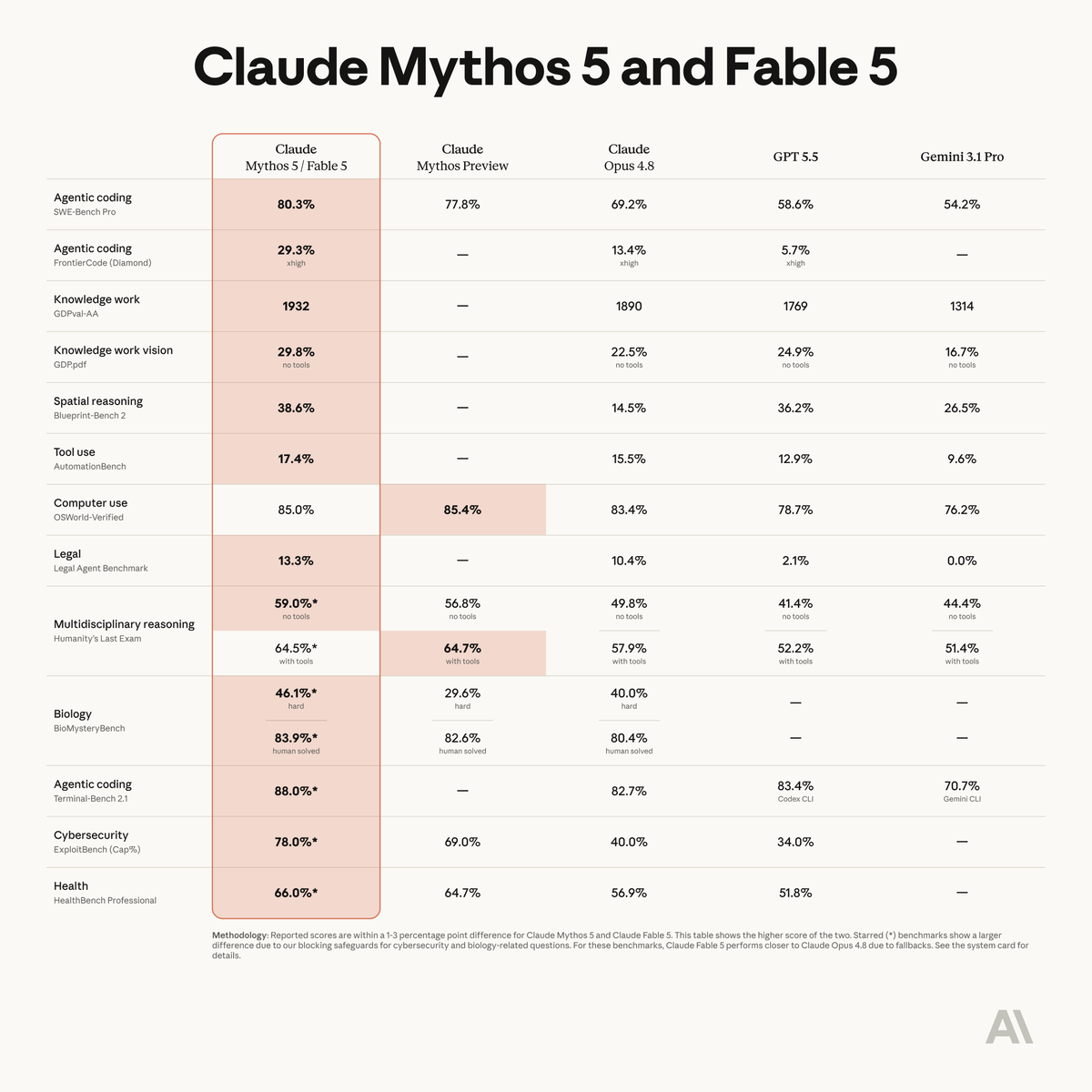
Fable 5 is state-of-the-art on nearly all tested benchmarks, with exceptional performance in software engineering, knowledge work, scientific research, and vision.
The longer and more complex the task, the larger Fable 5’s lead over our other models.
Er zijn aanwijzingen dat het aantal sterfgevallen verband houdt met de coronavaccinaties. Is het dan wel verantwoord om volgende maand weer te gaan inenten De CDA voorzitter zegt tegen van Dissel dat hij geen antwoord hoeft te geven op deze vraag🤮
The reason ETH sells off more in these “doom” scenarios — the ZEC bug, a Saylor BTC sell-off, a stock market sell-off, etc. — is, ironically, the same reason ETH will ultimately win.
We’ve seen this a thousand times already, and the question always comes up: Why is ETH dumping more than expected?
Simple answer: It’s the most liquid asset in DeFi. It’s the hardest money we have, and people sell it first when shit hits the fan and they need more liquidity in the market.
So why don’t people sell their shitcoins, you ask? Why do they sell their ETH?
Well, try selling your shitcoins in a down market. There simply isn’t enough liquidity for large holders to offload anything meaningful. ETH is their only option.
ETH is structurally the most important asset crypto has. Bitcoin is barely a side note here. You simply can’t use BTC natively in DeFi.
So why is ETH not eternally doomed?
Over time, this leads to an insane distribution of ETH into hundreds of millions of hands, making it much more resilient — and, incidentally, making it a kick-ass store of value.
Yes, you can offload hundreds of millions of dollars in BTC easily as well. But can you buy literally any other asset you want with the click of a button, trustlessly?
No. You need to go through CEXs and/or jump through hoops to do that.
ETH is the only native collateral for DeFi and the only logical digital store of value for crypto — and, eventually, the world.
ETH is money.
🚨🇺🇸The Senate just killed the SAVE Act, 48-50.
Voter ID and proof of citizenship, supported by over 80% of Americans, dead.
Four Republicans voted no: Tillis, Murkowski, McConnell, Collins.
The uniparty showed its face today...
Europe’s jet fuel situation is deteriorating rapidly.
Spain, France, Italy, and others have warned private aviation operators that jet fuel may be unavailable this summer…at any price. Commercial aviation isn’t immune: 30–50% of flights will face disruption or cancellation.
After 97 days of inventory draws, distillate supplies are heading below critical levels. If the IRGC’s stance on highly enriched uranium remains unchanged, euro-area shortages could become critical within two months.
Werd net gestemd over motie De Vos over het beëindigen procedures van asielzoekers die misdrijven hebben gepleegd.
Voor:
-50Plus
-SGP
-JA21
-BBB
-Lid Keijzer
-Groep Markuszower
-PVV
-FvD
Verworpen.
#asielzoekers#criminelen#asielzoekers
Today a crazy quantum story just got wilder.
On March 31, the Google Quantum AI team published a landmark result on Shor's algorithm for elliptic curve cryptography. Technically, the paper was a bombshell: a dramatic 10x improvement over the state-of-the-art. As a stunt and wakeup call to the blockchain space, those optimisations were illustrated on secp256k1, the elliptic curve underlying Bitcoin and Ethereum signatures.
But perhaps the most striking part of the paper was sociological, not technical. Instead of following standard academic process, the optimisations were kept secret, hidden behind a zero-knowledge (ZK) proof. Google's accompanying blog post mentions they "engaged with the U.S. government". The ZK proof demonstrates the existence of algorithmic improvements without leaking details. Academic censorship with ZK, a historic first!
As a co-author of the Google paper I witnessed some of the context surrounding this censorship. To be honest, multiple aspects of that context don't sit well with me. As much as I believe the general public ought to know more, I am limited in my ability to whistleblow. Though let me be clear about one thing: the Google team's professionalism has been absolutely exemplary, and they deserve nothing but praise.
Censorship has a way of backfiring. The Streisand effect, where an attempt to bury something only draws more attention to it, is exactly what's unfolding today. First, Google's key optimisation has been rediscovered by the French. And in a thrilling turn of events, a collaborative Shor-at-home challenge just launched. The initiative, available at ecdsa[.]fail, breached a new Shor world record in a matter of hours.
Let's start with the rediscovery. Just two months after Google's paper, French quantum expert André Schrottenloher cracks the main secret optimisation. His paper, titled "Optimized Point Addition Circuits for Elliptic Curve Discrete Logarithms", landed on the arXiv today. Big congrats to André, who beat several other nerdsnipped experts to it. In a blog post also published today, Craig Gidney, the world expert on Shor optimisations, revealed that he'd been sitting on this very optimisation for a whole year under censorship pressure.
Interestingly, André missed a handful of minor optimisations, both from Google's original publication and from improvements found since. It's plausible there's still plenty of juice left to squeeze out of Shor, and this is exactly what the ecdsa[.]fail challenge is about. The verifier program developed for the ZK proof does double duty, automatically filtering for valid submissions. Dozens of compounding small and micro improvements are rolling in. As of the time of writing there's an 8.4% improvement to Google's circuit, as measured by the product of logical qubit count and Toffoli gate count. Nice!
The nerdsnipping ran deeper than anyone expected. Over the last few weeks it became clear it extended well beyond André and other quantum experts. Behind the scenes, a small army of amateurs quietly got to work. Inspired by Karpathy-style autoresearch, they turned AI on Shor. Ironically, the verifier program for the ZK proof makes an ideal reward function for AIs. The barrier to entry for this modern style of research is refreshingly low, with several non-experts, even a teenager, finding nice optimisations. Get in touch if you'd like to join a Telegram group with fellow autoresearchers :)
Part 2: neutral atoms and qday
The story doesn't end with Google. On the same day Google went public, a stealthy startup called Oratomic published its own Shor paper in a coordinated release. It made a splash, ultimately becoming the most upvoted paper on scirate[.]com, a website ranking arXiv papers.
Oratomic's claim was wild. By building on Google's logical optimisations and applying custom physical optimisations for neutral atoms, they claimed just 10K physical qubits were sufficient to run Shor's algorithm on secp256k1. That number is mind-bogglingly low.
Knowing essentially nothing about neutral atoms when Oratomic's paper landed, I was intrigued and decided to learn more about the tech. I fell straight down the rabbit hole and spent a couple hundred hours on the topic. I got a little obsessed and watched every YouTube video I could find and spoke to a bunch of experts.
My conclusion? The tech is real, very real. Even Google recently decided to start a neutral atom lab, a notable pivot from their sole focus on superconducting qubits. If you care about qday, i.e. the day a quantum computer will break the first piece of cryptography in production, neutral atoms demand your attention. I shared some of my learnings on Shor and neutral atoms in a 30min talk at the ZKProof cryptography conference. You can find it on YouTube by searching "zkproof neutral atom".
Here's an interesting observation about this duo of breakthrough papers: neither Google nor Oratomic say a word about what their results mean for qday. No timelines. Zero. Nada. That is especially baffling given that the whole point of whitehat quantum cryptanalysis is to inform qday estimations and help the general public make good decisions.
So let me attempt to partially fill the silence, similarly to what Scott Aaronson did in his April 29 post. Given everything I know, including scary non-public information, I now put the odds of qday by 2032 at 50%. 10% by 2030.
Anecdotally, the US government has its own date: 2035. Originating at the NSA and later adopted by NIST, it's when branches of the US government will be disallowed from using quantum-vulnerable cryptography. In plain language: with hindsight, that date is a joke and should be discounted entirely. I don't see how NIST avoids being forced to pull it forward by years.
Part 3: post-quantum cryptography
There are good reasons to sound the alarm today, but please do not panic. Rushing carelessly towards immature post-quantum cryptography is a recipe for disaster. IMO a good target date for migration is 2029, roughly 3.5 years out. 2029 happens to be the date selected by Google, Cloudflare, and the Ethereum Foundation.
These days most of my time goes to safely migrating Ethereum towards post-quantum cryptography as part of the broader lean Ethereum effort. There's a lot to do. We need to rip out and replace BLS signatures at the consensus layer, KZG commitments at the data layer, and ECDSA signatures at the execution layer.
The plan to get there is compelling, and is based on hash-based cryptography. Within the Ethereum Foundation we've developed a Swiss army knife called leanVM (github[.]com/leanEthereum/leanVM) powered by the magic of hash-based SNARKs. Thanks to truly exceptional work by Emile, Thomas, and others, its performance is derisked. Regarding security, leanVM is a jewel, a minimal zkVM crafted for end-to-end formal verification and maximum security.
Want to help? There are two $1M initiatives. First, the Proximity Prize (proximityprize[.]org). Solve a long-standing mathematical conjecture in coding theory, improve hash-based SNARKs, and go home a millionaire. Second, the Poseidon Initiative (poseidon-initiative[.]info), offers $1M for breaking Poseidon, the SNARK-friendly hash function.
🏃♂️ I've gamified my own run so I can race my own ghost with the Meta Ray-Ban Display.
I built a web app for the glasses, loaded a previous GPX from Strava, and dropped game mechanics on top.
Pick up coins when you keep pace, sprint zones reward extra points if you push, and a mini leaderboard on the lens shows how you're tracking against your past self in real time.
Best part: it actually works. Seeing your ghost 20 m ahead is a way stronger nudge than any number on a watch. 😅
The Ethereum Bull Thesis in 2026 (Why Now) with @Sharplink CEO @joechalom
Timestamps
00:00 ETH Is Not Dead
01:16 Second Largest ETH Holder
02:33 Ethereum Wins The Scoreboard
04:20 Step Function Moment Coming
04:45 The Jeff Bezos Analogy
06:42 EFF Not The Marketing Arm
10:04 Private Sector Must Step Up
12:39 Warren Buffett Capitulation Thesis
13:22 BlackRock Doubled Down At FTX
15:44 WTI Crude Predicts Bitcoin
16:49 Best Entry Point Right Now
22:01 160M Agent Payments Q1
24:50 Institutions Need Finality Not Speed
25:02 BlackRock Tokenizing $8B Fund
30:32 Fidelity Now Largest Investor
33:19 First DeFi In Public Company
35:41 Retail Capitulation Best Entry
$24,000,000,000,000 IN US BANKING ASSETS IS WATCHING ONE CEO LOSE HIS COMPOSURE.
🇺🇸 JPMorgan CEO Jamie Dimon today:
"He's full of shit."
"If he wants to be a bank, be a bank."
"We'll fight it. If we lose, we lose, and we'll live."
The target: Coinbase CEO Brian Armstrong.
The fight: CLARITY Act stablecoin yield rules.
The Senate Banking Committee already advanced it 15-9.
The largest US bank just confirmed publicly: they're losing the framework war.
Trillions follow the rules.
The rules just got written without them.
I think not many people is aware of the insanity of exit taxes in Europe. You think you are free? Of course not. Let me share more about NL exit tax.
The Netherlands has an “exit tax” for entrepreneurs.
But calling it a tax is misleading.
It’s closer to a financial exit visa.
Here’s how it works in practice:
Imagine you spent 5 years building a company in Amsterdam.
You took the risk.
You worked nights and weekends.
You paid corporate taxes, payroll taxes, VAT, income tax.
Eventually your consulting/AI firm reaches:
€5M annual revenue
€1.2M profit
€3M cash in the bank
You own the shares through a Dutch holding BV.
Now imagine you decide to leave the country.
Not sell the company.
Not IPO.
Not cash out.
Just leave.
Maybe you want:
lower taxes
better weather
geopolitical diversification
to raise your children elsewhere
or simply freedom of movement
The moment you emigrate, the Dutch state pretends you SOLD your company.
Even though you didn’t.
This is called the “conserverende aanslag.”
A fictional sale.
On fictional gains.
Generating a very real tax assessment.
And the numbers get absurd very quickly.
Example:
Your company:
generates €1M+ yearly cash flow
has €3M sitting in the bank
gets valued at ~€6M by the tax authority
The Netherlands then calculates:
“Okay, your shares increased by €6M.
You owe Box 2 tax on that.”
Current rates:
24.5%
then 31%
Result?
You can receive a tax assessment approaching €2 MILLION…
…despite not selling a single share.
Read that again carefully.
No liquidity event.
No acquisition.
No money in your pocket.
You simply changed residency.
Defenders of the system immediately say:
“Yes, but payment is deferred.”
This is where things become psychologically fascinating.
Because the state effectively says:
“We won’t collect immediately.
But we now have a permanent claim attached to your company.”
A kind of invisible mortgage on your future.
And it can remain there indefinitely.
Then come the triggers.
If later:
you distribute dividends
you restructure
you sell shares
you liquidate
you violate compliance conditions
…the Dutch tax authority can activate collection.
Meaning:
even after you leave,
the Dutch state still shadows the future of your company.
Now let’s talk about the truly dystopian part:
GOODWILL.
For founder-led consulting firms, the value often IS the founder.
The relationships.
The expertise.
The reputation.
The intellectual network.
The ability to close clients.
In many cases, if the founder disappears, much of the business disappears too.
Yet the tax authority can still argue:
“No, no. The company itself has transferable enterprise value.”
So now you enter a surreal negotiation where bureaucrats attempt to price:
your future reputation
your future relationships
your future earning power
your future client trust
The state literally tries to quantify your human capital before allowing you to leave.
And this is not fringe theory.
Dutch valuation teams use:
DCF models
EBITDA multiples
goodwill assumptions
future cash flow projections
…to estimate what your company might be worth.
Not what you sold it for.
What they THINK it is worth.
Imagine explaining this to an American entrepreneur:
“You can leave the country, but first we calculate a hypothetical sale of your startup and issue a multimillion-euro tax claim based on unrealized gains.”
They would think you are describing the Soviet Union.
And before people scream:
“but all countries tax!”
No.
This is different.
This is taxation attached to MOVEMENT.
That distinction matters.
A normal tax says:
“You earned money.”
An exit tax says:
“You are attempting to leave.”
That changes the philosophical nature of the relationship between citizen and state.
At some point it stops resembling taxation and starts resembling permissioned mobility.
Especially because the system creates behavioral lock-in.
Founders begin asking:
Should I leave before growth accelerates?
Should I suppress valuation?
Should I avoid accumulating cash?
Should I avoid long-term contracts?
Should I move BEFORE success?
Think about how insane that is.
The tax system starts influencing:
where founders live
how companies are structured
when growth is pursued
whether capital stays in the country
And Europe wonders why founders eventually relocate to:
Dubai
Singapore
Switzerland
Miami
Cyprus
The real irony?
Politicians claim they want:
innovation
entrepreneurship
AI leadership
startup ecosystems
But the moment a founder becomes globally mobile and valuable, the state says:
“Not so fast.”
Build in Europe.
Scale globally.
But if you leave, we’ll first calculate your hypothetical future and attach a tax claim to it.
That is not a free market. We are not free.