Memorial Day is about remembering those who gave everything in service to this nation.
We honor their sacrifice, their families, and their legacy.
Rest easy. We’ve got the watch. 🇺🇸
— The Stream Engine Team
Influence campaigns do not announce themselves.
They appear as subtle shifts across posts, images, videos, and language patterns.
By the time volume spikes, the narrative is already in motion.
Early detection depends on recognizing coordinated behavior before it scales.
Manual monitoring cannot keep pace with high-volume, fast-moving information environments.
Continuous analysis, alerts, and daily summaries reduce cognitive load while preserving human judgment.
Real-time awareness supports better decisions without replacing the operator.
Narratives don’t fail all at once.
They build, amplify, and spill across platforms.
Early detection interrupts momentum before response becomes damage control.
Influence campaigns evolve minute by minute.
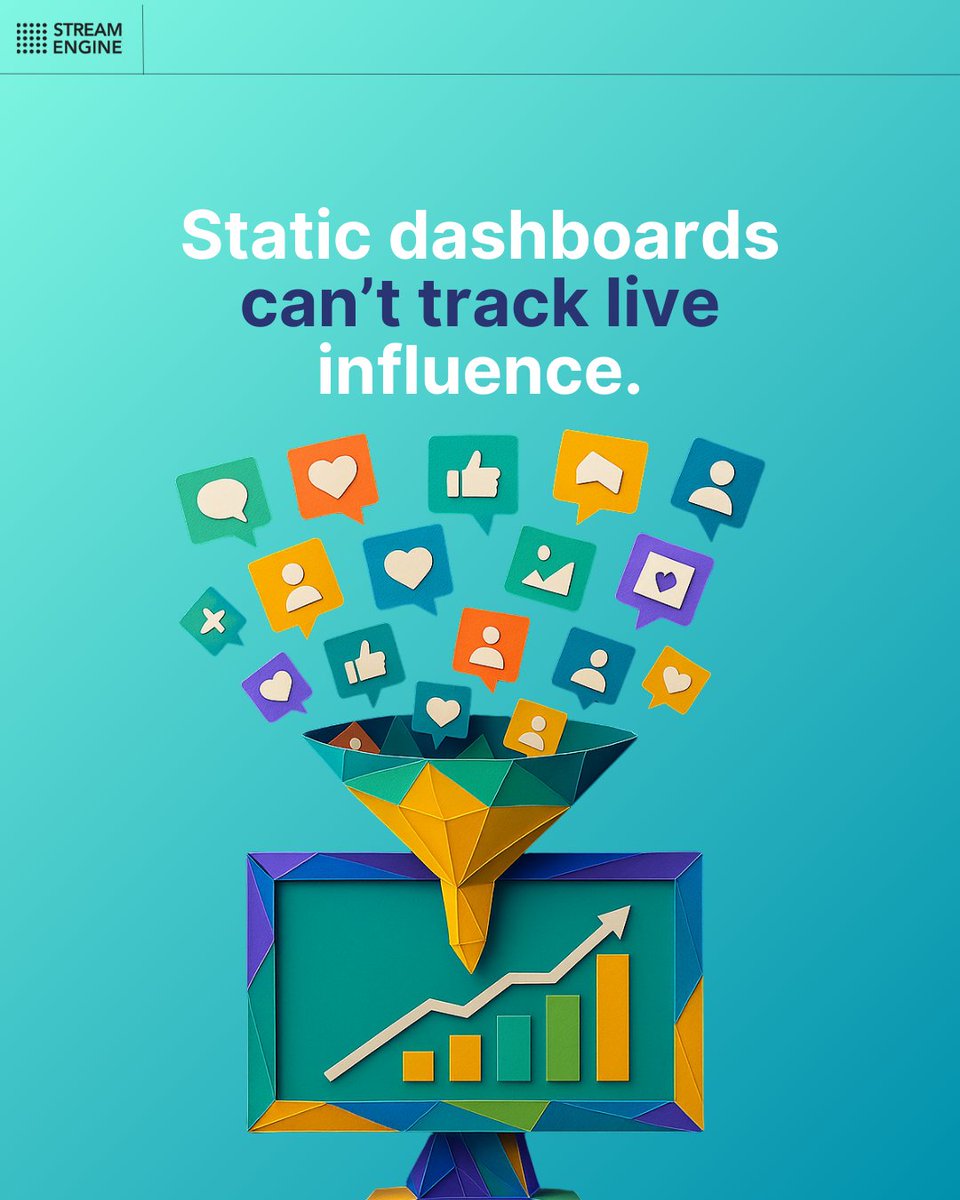
Static views capture what already happened, not what’s forming.
In fast-moving environments, yesterday’s insight is already outdated.
The most effective influence operations rarely use obvious language.
They rely on tone shifts, coded phrasing, imagery, and behavioral patterns.
If you’re only watching keywords, you’re watching the surface.
Counting mentions or tracking volume only tells part of the story.
What matters is intent, coordination, emotional charge, and timing.
Understanding requires context. Monitoring alone doesn’t provide it.
Human judgment is critical.
But humans shouldn’t be doing what machines can already handle at speed and scale.
When adversaries automate, manual workflows become the bottleneck.
We’re hiring.
Open roles at Stream Engine:
• Full-Stack Developer
• Product Delivery Manager
If you want to build and deploy multimodal AI systems with real-world impact, apply below.
Full-Stack Developer https://t.co/IAUT7iicIf
Product Delivery Manager https://t.co/6pUoDlImLQ
When systems don’t speak to each other, analysts are forced to connect dots manually.
That friction costs time, clarity, and confidence.
Blind spots aren’t caused by lack of data. They’re caused by lack of integration.
Adversaries iterate daily.
Legacy systems update yearly.
That mismatch creates exposure, not resilience.
The pace of innovation is now part of the threat landscape.
Delayed understanding leads to reactive strategy.
By the time patterns are confirmed, narratives have already cascaded.
Timely insight isn’t a luxury. It’s operational necessity.
It’s no longer about who has the most data.
It’s about who can interpret it, contextualize it, and act on it first.
Speed is no longer tactical. It’s strategic.
Traditional ISR systems were designed for hardware, movement, and terrain.
They weren’t designed to track emotion, coordination, or influence at scale.
The information environment changed. Most tools didn’t.
Analysts aren’t short on data.
They’re drowning in disconnected streams that don’t talk to each other.
Text here. Video there. Audio somewhere else.
Without fusion, insight stays buried.
Information doesn’t need to be true to be effective.
It just needs to spread faster than it can be corrected.
In today’s environment, the gap between signal and response is where advantage is won or lost.
Modern conflict plays out in feeds, forums, livestreams, and comment threads long before it reaches physical terrain.
If you’re not tracking how ideas spread and mutate in real time, you’re already reacting too late.
Most tools transcribe. OdinAI™ interprets.
🎙 Voice recognition
🧠 Intent + sentiment analysis
🔍 Tracks POIs in real time
📊 Measures reaction at the moment of mention
This isn’t speech-to-text.
It’s speech-to-strategy.