A fiction piece of mine (linked here, clearly marked as such), and published some six years ago, is currently being amplified here by multiple accounts (including Grok) as fact.
The piece explores - through, yes, fiction - the development of an indigenous Iranian combat UUV, the Azhdar. I also published an alternative history and a short story on this through @DivergentOption and @CIMSEC, respectively.
Since then, Iran has claimed to have developed weaponized UUVs. These claims are unverified and should be viewed with a skeptical eye. To complicate matters, as events in the SOH unfold, my work(s) of fiction (including concept art used without permission) have now been woven into these claims to generate false narratives.
NOTE: The Azhdar UUV is a work of fiction.
https://t.co/DvcHLjbhAO
@redunley One more thing - I maintain a small but growing database of articles on the subject of mine warfare. Not comprehensive (yet), but you might find it useful as a jumping off point:
https://t.co/wMIM2hf5ob
@redunley I focus on the evolution of mine warfare, and have written on this quite a bit. A couple of my articles might be of interest to you.
"Going on the Offensive: Advanced Sea Mines Will Figure Prominently in Future Conflicts"
https://t.co/zt2AZ2BTbl
A fiction piece of mine (linked here, clearly marked as such), and published some six years ago, is currently being amplified here by multiple accounts (including Grok) as fact.
The piece explores - through, yes, fiction - the development of an indigenous Iranian combat UUV, the Azhdar. I also published an alternative history and a short story on this through @DivergentOption and @CIMSEC, respectively.
Since then, Iran has claimed to have developed weaponized UUVs. These claims are unverified and should be viewed with a skeptical eye. To complicate matters, as events in the SOH unfold, my work(s) of fiction (including concept art used without permission) have now been woven into these claims to generate false narratives.
NOTE: The Azhdar UUV is a work of fiction.
https://t.co/DvcHLjbhAO
I rarely spend time on this site, for reasons that continue to bear themselves out. You can read my full statement on this on LinkedIn:
https://t.co/JnbXFaCDoy
🚨🚨🚨 This jumped out at me too.
From @USCC_GOV testimony today: U.S. naval intelligence assesses the PLA Navy is shifting from mostly-diesel-electric to ALL-NUCLEAR submarine construction.
In light of this morning's news, I'm taking this podBASE™ report out from behind the paywall.
With a clear existential threat to the Khamenei regime, the likelihood of a prolonged and impactful disruption of the Strait of Hormuz has significantly increased. While the extent to which IRIN and IRGCN forces may have been targeted is unclear, there are several undersea options that Tehran could leverage to threaten maritime shipping and U.S. forces operating in the Persian Gulf.
https://t.co/v8NtXfnIph
[VIDEO] @navalgroup working on the weaponization of drones 🇫🇷
- Weaponization of the Seaquest range of unmanned surface vessels (USV)
- New very lightweight torpedo (VLT) and depth charges
- Cormorant amphibious UAV
https://t.co/g5hRZzPKjy
The Office of Naval Research recently issued a BAA seeking the rapid design, build, and testing of an ultra-large autonomous underwater vehicle (UL-AUV) demonstrator, "Ocean Explorer." In a time when the Navy's extra-large (Orca) and large (Snakehead) AUV programs continue to suffer from cost overruns, technical issues, and programmatic uncertainty, and the U.S. shipbuilding and submarine workforce struggles to produce Virginia and Columbia-class hulls, what could be driving the design of of an even-larger AUV?
One of the likely drivers is the need for survivable VLS platforms. An uncrewed underwater missile barge/arsenal ship that can leverage existing architecture (the Virginia Payload Module) might hold an answer.
Want to learn more? Grab your free three month trial to podBASE™ and check out our new report.
"The U.S. Navy Is Seeking a UL-AUV"
https://t.co/Ugo60jEyAx
Want to learn more? Get yourself a three month free trial of podBASE™, our premium subscription research service, and check out the report:
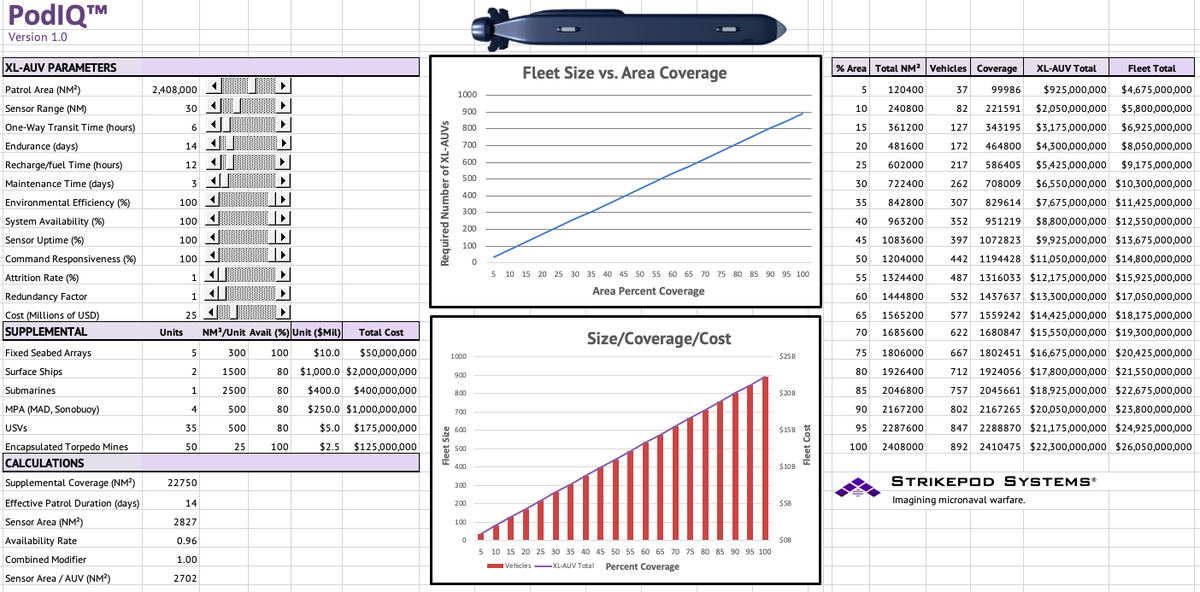
"PodIQ™ - An Undersea Force Model"
https://t.co/lSewfHcDmU
As extra-large autonomous underwater vehicle (XL-AUV) programs proliferate, careful consideration must be given to platform performance characteristics, as these will ultimately determine how many are required to maintain a credible, persistent undersea presence.
We developed a simple conceptual model, PodIQ™, to analyze how key XL-AUV performance characteristics could drive the acquisition of a persistent, credible uncrewed undersea presence.
The model enables you to:
✅ Explore tradeoffs across endurance, patrol architecture, recharge cycles, and integration with supplemental systems.
✅ Gain insight into the number of vehicles required to maximize persistent ASW coverage of a given area of waterspace.
✅ Incorporate supplemental sensor platforms, such as seabed arrays, crewed vessels and aircraft, USVs, and encapsulated torpedoes, by specifying their quantity, passive acoustic sensor coverage area, availability rate, and unit cost. These inputs are then factored into the overall fleet calculation to produce a total, all-in cost for achieving the desired level of coverage.
📣 GhostPlay@SEA to Develop Collaborative #AI#Tactics for Naval Combat 🔱
As operations in naval theaters are getting more demanding, the German Navy strives to leverage #AI and #UxS for future naval missions. To this purpose, GhostPlay@SEA will develop collaborative #AI tactics for multi-domain #swarm and #counterswarm operations.
GhostPlay@SEA is a capability and technology development project by @dtecbw, funded by the European Union-NextGenerationEU. Prof Dr Gary S. Schaal, @HSUHamburg, leads the project with #ATLASELEKTRONIK serving as the industrial coordinator. Together with #21strategies @hensoldt and @RheinmetallAG, I am proud to be part of part of Team GhostPlay@SEA, which will cooperate closely with NATO Centre of Excellence for Operations in Confined and Shallow Waters (#COECSW).
For more, see the official press release at https://t.co/ndAMpp5WYZ
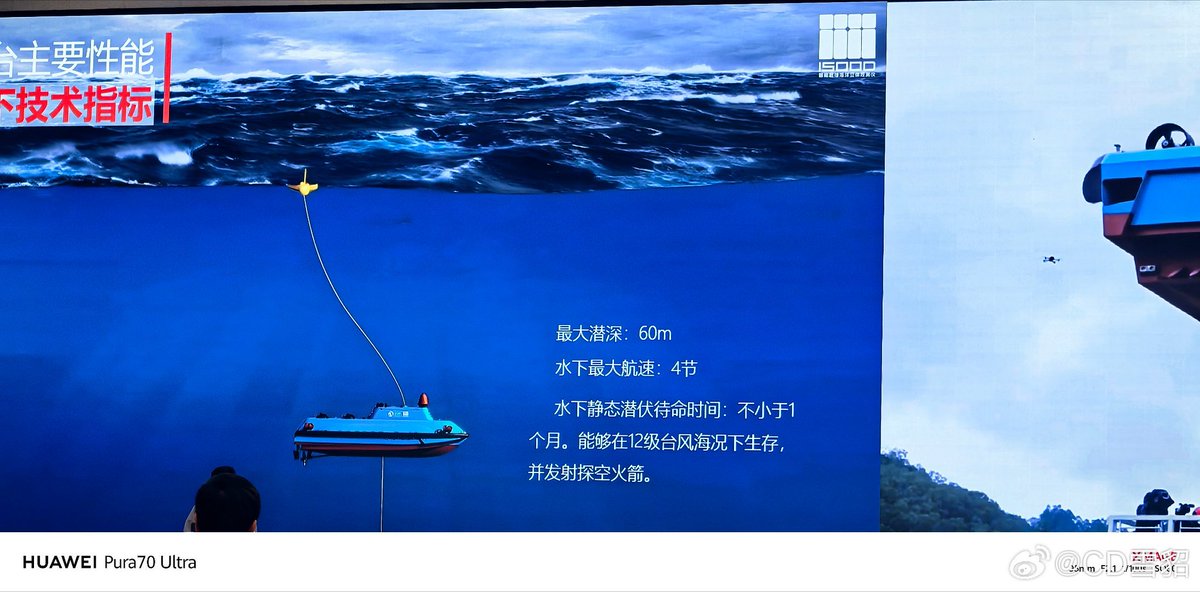
Designed for diving depth of up to 60 metres and submerged speed of 4 knots (ie very low). However, the system can stay in place for up to one month. Promoted as a marine weather surveillance system. Images via "by78"/SDF.