I'm relatively confident in predicting that currently, more major breaches are likely to be the result of AI use by the target, not the attacker.
Ransomware actors have been consistently winning for over a decade. They've had so much time to perfect their tradecraft, and non-AI ransomware actors can now blast through entire networks in minutes.
It is extremely unlikely that organizational security has, in 4 years, after decades of failure, matured enough that hackers now somehow need AI to win.
What has likely happened, though, is that organizations have spent the last 4 years falling over themselves to shove AI into everything, negating longstanding security fundamentals.
"only give a user/system the minimum possible access needed to do its job" has become "just give the AI access to everything and give everyone access to the AI".
"use processes with well-defined and easily auditable input and output" has become "the AI correctly processes requests all the time, 60 percent of the time"
"reduce attack surfaces" is now "every department should be vibe coding. It doesn't matter if you've never coded before and don't understand information security. Just make public-facing dashboards, it'll be fine."
I'd say if anything, hackers aren't getting measurably more sophisticated, but the average organization's security posture has gotten exponentially worse.
let me present a case of ai-induced overconfidence.
btw, if your company is doing this, call it out. it is a dumb assumption, and let me tell you why.
one of your security leads or engineers starts using claude code or codex, or builds a cool wrapper around them. it finds some bugs, of course. they run it repeatedly, burn shit ton of tokens, fix everything it finds, and eventually the scanner goes quiet.
the next thing that happens is they decide the bug bounty program is a waste of money. after all, how could some random hunter find anything their sophisticated pipeline missed? what could an external auditing firm possibly find that their agents couldn't? so they cut the program.
but if you are truly confident that your pipeline has exhausted the vulnerability space, shouldn't you be willing to increase the bounty? wouldn't that be the best way to show your c-level bros that the ai spend actually worked and wasn't wasted on some wrapper you vibecoded in a week?
or..... maybe you don't want to incentivize people to test that assumption. because how would you explain to your boss that, after burning through all those tokens, some bug bounty hunter still found a nasty vulnerability?
your cool wrapper finding bugs does not prove that no bugs remain. it only proves that the wrapper can find subset of vulnerabilities and researcher with taste will always find a way in. the entire point of a bug bounty program is to incentivize skilled researchers to find the bugs your internal tools, agents, and engineers missed.
think about it, why do openai and anthropic still run bug bounty programs that pay $100k for critical vulnerabilities? they have effectively unlimited tokens and run all kinds of crazy agent loops and automated security workflows. yet i bet they will pay that $100k, because software is vast and complex, and someone with taste will always find a bug your pipeline missed.
remember,
researcher with taste + ai(this is where your threat actors are) > good wrapper > plain claude code/codex
if your public program is drowning in slop, move it to private. invite strong researchers and pay them vip prices like github is doing. don't have this ai competence illusion which is pretty common all around.
We're partnering with @huggingface to investigate an unprecedented security incident.
Cyber-capable OpenAI models compromised Hugging Face production during a benchmark evaluation.
Sharing preliminary findings to help defenders understand emerging risks:
https://t.co/CIor15y9xk
Huggingface got breached! And we will see same pattern moving further, the cloud misconfigs gonna be weakest link and will amplify the blast-radisus.. 🧵
For iniitial foothold it will be either your code, agents, or simply the saas, third-party dependencies.. as I have shown in my Metabase, Posthog blogs.
https://t.co/s3UoPLF1b1
Posting a mini XSS challenge! Goal is to pop an alert. I believe this trick is not well known. Intended solution is chrome only. Thanks to @kevin_mizu for beta testing! Don't post solutions in the thread; DM only!
https://t.co/v5LXrs5ORk
We responsibly disclosed the issue to @GitHub, who deployed a fix on https://t.co/SvN2lGsnbO the same day (!) and released patches for all supported GHES versions.
GitHub Enterprise Server customers are strongly encouraged to update immediately.
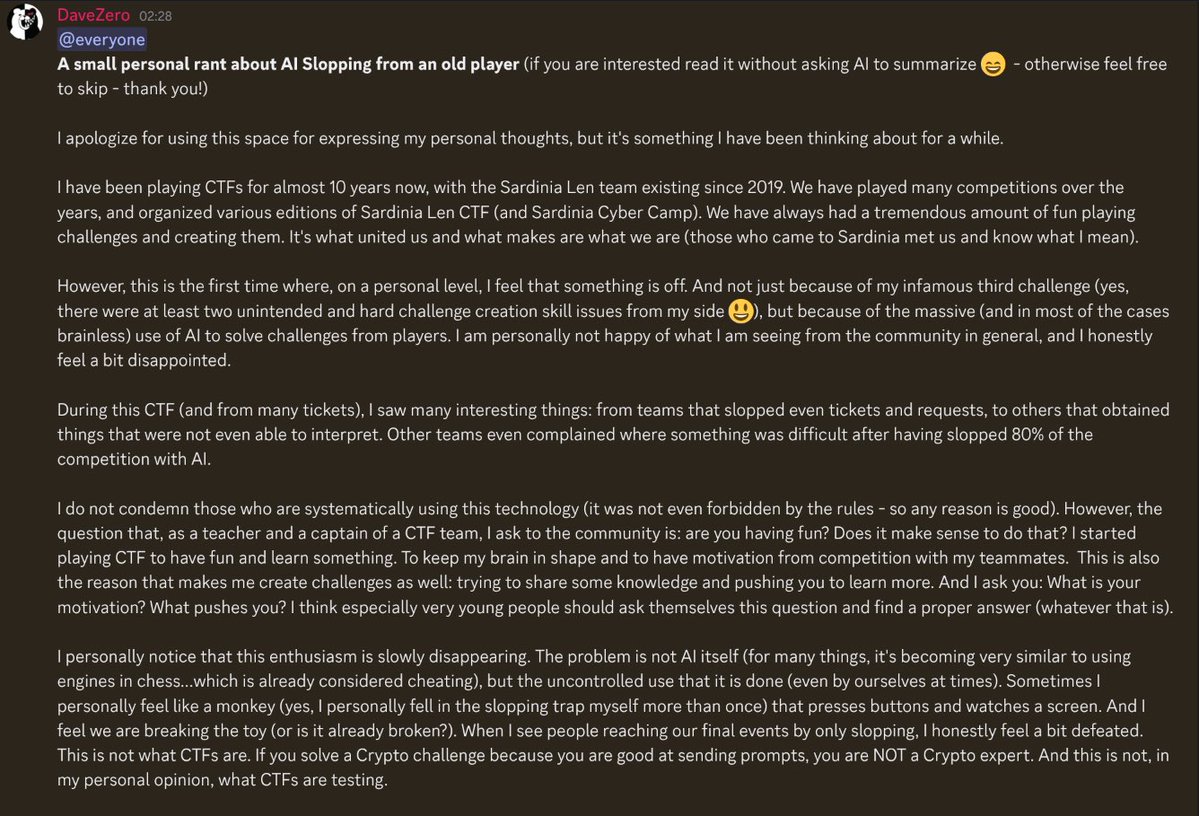
I started playing CTFs in 2022, and LLMs definitely changed the **competitive** CTF scene a lot, especially since mid-2025. I also started using LLMs in late 2025. Yes, those models did one-shot many challenges, but what's the fun of slopping them? I learned absolutely nothing 🥲
@DeSolti I feel ashamed to have studied in the same class as you. J ho tei dekhauda k bhayo? "timing this timing that".. Timro ghar ko kasailai kei bhako bhaye bujthyeu hola..