From the 10-Q itself:
“The increase was primarily due to increases of $6.1 million in personnel and related costs, partially offset by a decrease of $2.7 million in bad debt expense." (Elastic, 10-Q, August 28, 2026)”
Operating cash flow climbed to $132.0 million, even as cloud costs pushed subscription gross margin down to 80%.
$ESTC Elastic’s three-month operating loss widened to $24M while cloud hosting costs increased $16M; the cost of growth is showing up in the income statement.
The filing puts it like this:
“During the first quarter of fiscal 2027, Marvell and NVIDIA Corporation (“NVIDIA”) announced a strategic partnership to connect our custom XPUs and compatible scale-up networking with NVIDIA’s AI infrastructure ecosystem." (Marvell Technology, Inc. (MRVL), SEC filing, May 28, 2026)”
Cisco shows up as a customer, strategic partner, and competitor. NVIDIA is the newer tie, while Infineon bought a Marvell business for $2.5 billion.
Straight from the filing:
“This increase was primarily from strong demand for lab and production and field products, driven by the data center ecosystem, our acquisition of Spirent’s HSE and CE business as well as demand for our aerospace and defense products, which was partially offset by a decline in spend for wireless products." (Viavi Solutions / 10-K / Aug. 13, 2026)”
Data center and AI demand appeared in 18.6% of companies' filings this quarter, up modestly from 12.7% in the same window last quarter.
The company's own words:
“This increase was mainly driven by non-acquisition-related growth in data processing and hosting within cloud revenue as new clients were added and volumes expanded, card processing revenue primarily from monthly service and risk management fees, Jack Henry digital and transaction revenue as active monthly users and volumes increased, and faster payments and payment processing revenues from expanding volumes and new client revenue." [10-K 2026-08…”
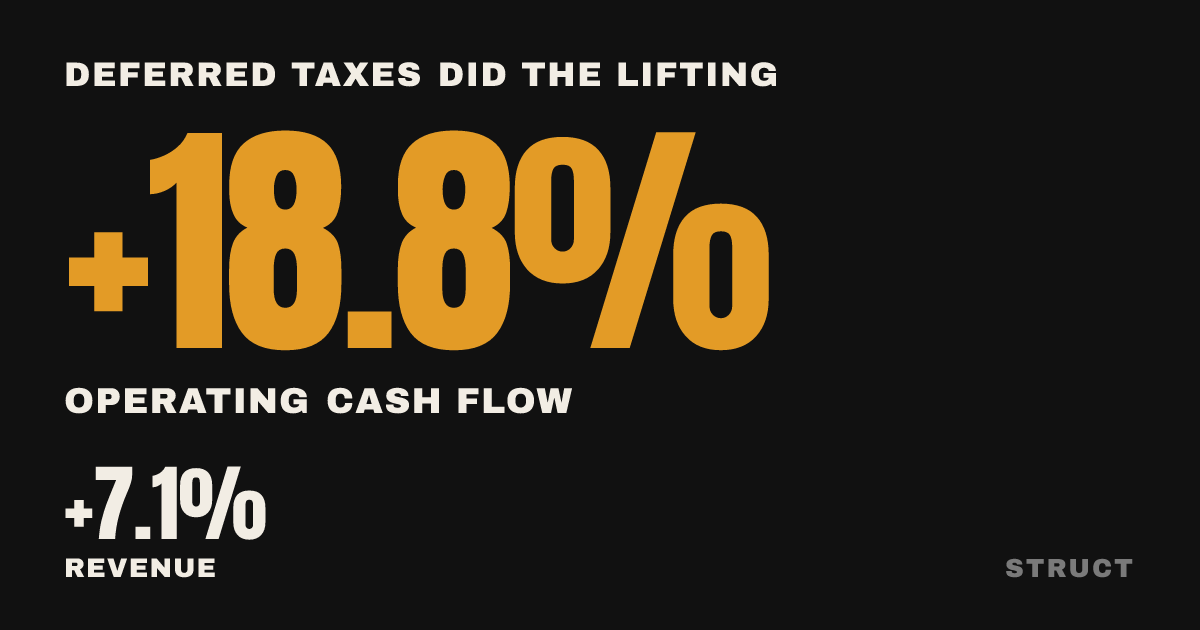
Operating cash flow rose 18.8% to $762.0 million, and Jack Henry says a deferred-tax change was the primary reason why.
The filing puts it like this:
“The increase in the number of net contracts signed in the fiscal 2026 periods was primarily due to improving demand and an increase in the average number of selling communities." Toll Brothers, 10-Q, August 28, 2026”
Operating cash flow rose to $392.1 million over nine months even as operating income fell 26.4% amid disclosed mix shifts and impairment charges.
The filing puts it like this:
“The year-over-year increase was driven by $11.0 million of pricing, including $2.6 million of U.S. tariff surcharges and price increases, and $3.3 million of additional volume." [STRATTEC 10-K, Aug. 28, 2026]”
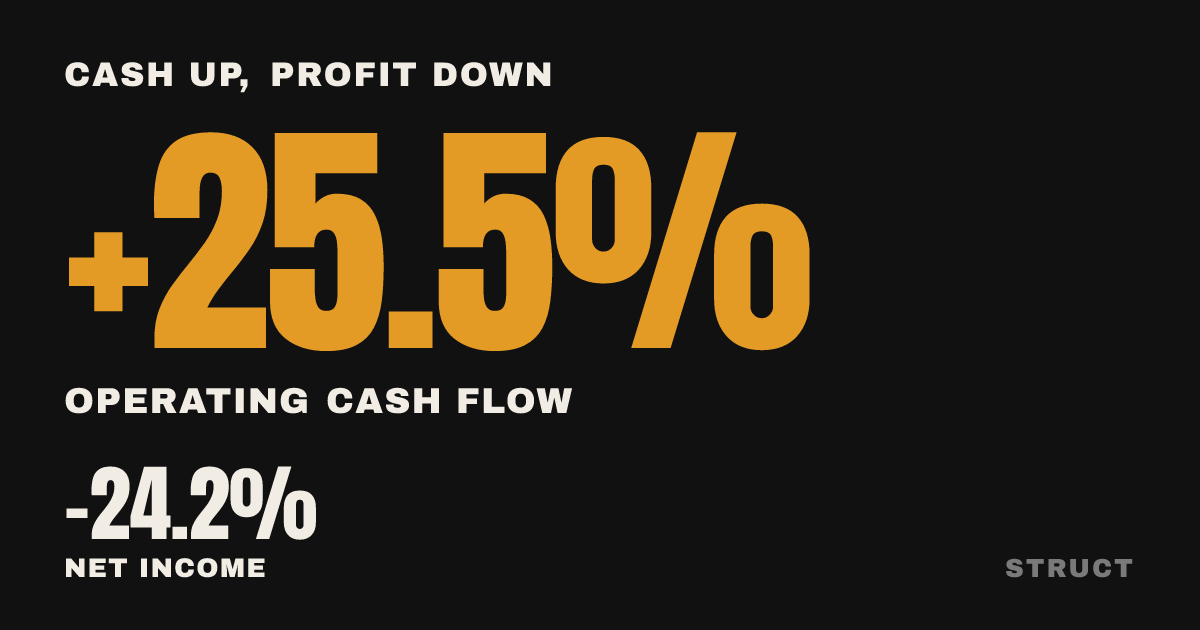
$46.3 million of operating cash came against $20.6 million of net income as the auto-parts maker's margins improved.
Here's the sentence it sits in:
“Gross profit as a percentage of net sales (\"gross profit rate\") increased 96 and 53 basis points for the three and six months ended July 31, 2026, respectively, when compared to the same periods in the previous fiscal year, primarily due to tariff refunds, partially offset by price investments and higher fuel costs within our supply chain." (Walmart, 10-Q filed Aug. 28, 2026)”
A $14.2B capital-spending bill and higher claims, depreciation, and healthcare costs complicated Walmart's six-month growth story.
The company's own words:
“The negative change in cash provided by working capital is primarily due to changes in accounts payable and other liabilities of $408 million due to the timing of payments related to employee compensation and related costs and deferred revenue of $434 million due to the timing of our billing installments and seasonality of billings in the fourth fiscal quarter partially offset by the change in accounts receivable of $753 million due to th…”
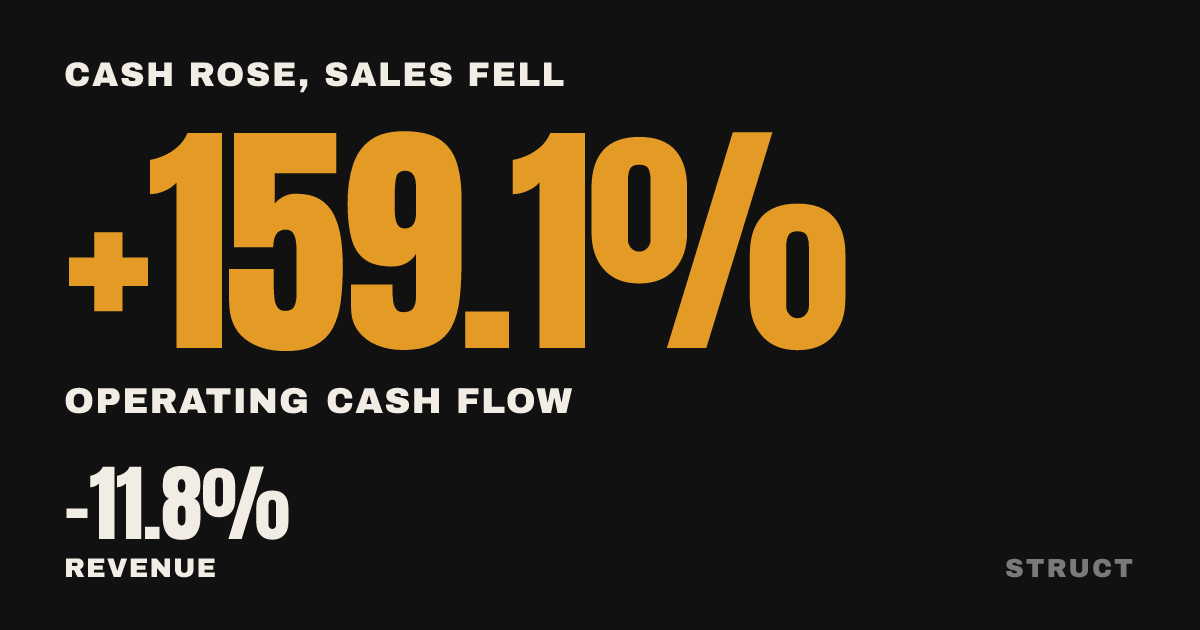
Autodesk generated $1.5 billion of operating cash in six months, but billing timing and securities sales helped shape the jump.
$ADSK Autodesk’s six-month cash surge had a calendar attached: billing timing shaped working capital, while $381M came from selling and maturing securities.
Here's the sentence it sits in:
“This is primarily due to the decrease in homebuilding revenue discussed above, a $13.0 million increase in loss from unconsolidated joint ventures and a decrease in gross margin percentage." [10-Q 2026-08-28]”
Home deliveries fell 12% over nine months, and gross-margin dollars fell 28%, even as average prices rose 2.3%.
The company's own words:
“Gross margin decreased to 72% compared to 75% in the prior period, primarily due to higher costs of revenue associated with scaling operations to meet increased customer demand and sales volume." [SentinelOne 10-Q, Aug. 28, 2026]”
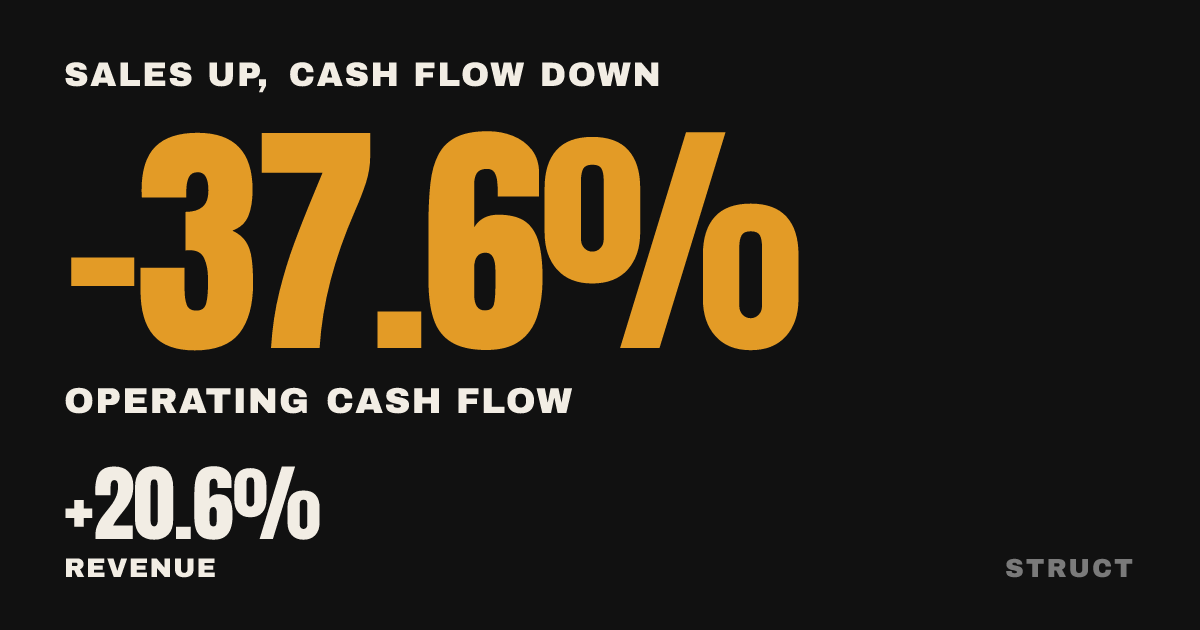
Revenue reached $292.0 million, but operating cash flow fell to $31.9 million as gross margin narrowed during a demand-driven expansion.