CEO of @JoinTwine, connecting companies to expert creative/tech freelancers. We also help companies build AI/ML training datasets. 2x founder. @9others host.
SpaceXAI and @cursor_ai are now working closely together to create the world’s best coding and knowledge work AI.
The combination of Cursor’s leading product and distribution to expert software engineers with SpaceX’s million H100 equivalent Colossus training supercomputer will allow us to build the world’s most useful models.
Cursor has also given SpaceX the right to acquire Cursor later this year for $60 billion or pay $10 billion for our work together.
linkedin outreach is good.
but it's 10x better when you use AI.
i went from 45 to 103 meetings every month just by implementing a new AI system I built.
reply "system" & I'll give you access for free
Chat is no more sacred than my eyeballs or ears which get shoved full of ads daily
Google, written content and socials (particularly TikTok/IG) made ads very opaque. As part of the tech world, we're all far more attuned to what an ad is. Most people don't care.
If the ad is semi-useful by being interesting/entertaining, it will thrive. Medium doesn't matter at all.
at some point you’re gonna see a slow drip pr push from the non ad ai companies trying to warm people up to ads in chat. the conditioning cycle has already begun in some ways.
the interesting part is that ads have never actually worked in a chat interface. like, name a single chat product that figured it out. facebook’s been holding the whatsapp/messenger bag for a decade & still can’t monetize them well.
this is because chat is deeply intimate. borderline sacred. once a product is living in your linguistic cortex, the ux tolerance goes to zero. any hint of bias or intrusion feels like a parasite. contrast that w/ google, maybe the most elegant business model ever constructed where ads felt native, even helpful, because they were aligned w/ the search intent.
ai chat is the opposite because it’s personal. it’s porous. it’s a weirdly confessional interface. stuffing ads into that space is a high wire act.
the ads layer for ai is gonna be one of the hardest synthesis problems in the whole stack. you have to nail relevance without feeling manipulative, integrate commerce without violating trust, & somehow keep the model from steering you toward whoever pays. will be fascinating to watch this all play out. i have posted a lot about ads for ai before.
Should you build or borrow?
The default founder mentality is to build everything custom. Feels safer + better.
We did it at Twine. Admin panels, upload media processing, even HR systems. The dumbest thing we built was a kind of CRM system
Essential Q, so you don't waste team time:
Build your edge. Borrow the rest.
Backlogs make or break startups. Ours was breaking.
Knowing what to work on next in a startup is a massive challenge.
We started with Jira as the backlog. It was effectively siloed to engineering and too expensive for the whole team to live in it.
We added a spreadsheet so sales, marketing, and CS could add ideas.
We used effort/impact to prioritise since the “RICE” methodology skewed toward the freelancer side of a two-sided marketplace (reach biased the scoring).
This worked for a bit, but customer feedback and bugs still weren’t getting the priority they deserved. And it felt kinda weird having our backlog on a spreadsheet.
We pushed more of that into Jira, but things continued to get lost.
So we moved the source of truth to Notion.
What changed and how:
1. A single “Backlog” database in Notion. Each ticket tracks an owner, discussion, the What, the Why (user story), the How (including “Appetite” from Basecamp’s Shape Up), assumptions around effort and impact, rabbit holes to avoid, and links to the relevant Objective and KR.
2. A dedicated “User Feedback” Notion database.
Every feedback item links to a Backlog ticket, and a roll-up/SUM field shows which tickets have the most customer signals so patterns surface quickly.
3. Helpdesk integration.
When a tag is added in support, a record is created in User Feedback with type (bug, product feedback, feature request), a GPT summary of the thread, and useful context like browser, device, and location for debugging. We use Crisp Chat and n8n for this automation.
4. An “Experiments” Notion database.
We migrated an experiment spreadsheet to track product and marketing tests with hypothesis, expected result, actual result, and links back to the related Backlog tickets.
5. One priority view everyone can see.
Product, marketing, sales, CS, and engineering all look at the same ordered list.
6. Delivery stays where it belongs.
Engineering still runs sprints in Jira/GitHub, while Notion is the front door for ideas, evidence, and decisions. (An integration here is next on our list)
Why this helped us:
- A true single source of truth for “what’s next.”
- Customer weighted prioritisation that’s hard to ignore.
- Clear ownership and OKR alignment across teams.
- Fewer status meetings and faster commits.
- A simple structure that doesn’t need some crazy expensive tool.
I hope this helps anyone else going through the pain of what to work on next, and doesn’t want to fork out £s on bloated software.
And of course, if you need help with n8n, Notion, or automation in general, we’ve plenty of consultants who can help you.
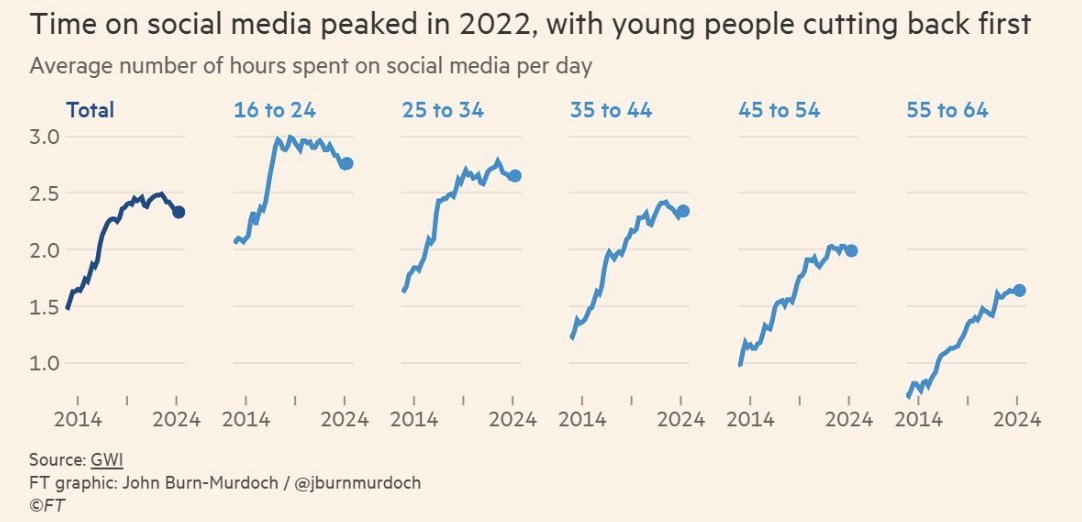
THIS chart is the CLEAREST signal of where the internet is heading.
social media time is SHRINKING for the first time in HISTORY, and young people are leading the pullback.
Brainrot is OUT.
they grew up online, saw the full cycle of social platforms, and learned early that endless scroll doesn’t make you happier or smarter.
they’re the LEADING indicator. their parents will follow in 3-5 years.
AI slop is the nail in the coffin.
every feed feels synthetic familiar faces, identical voices, recycled ideas. the “factory smell” of it all finally broke people’s curiosity.
but there’s an upside. every trend creates its anti-trend.
attention is shifting back to things that feel real, slow, and intentional.
people are paying for spaces that make them feel grounded, informed, and connected again.
the next $100M+ companies will engineer density, trust, and time well spent. they’ll build containers for meaning, then use AI to keep them organized, not optimized.
the internet’s oldest assumption that more engagement equals more value is breaking.
the white space i think is...
• "slow media" formats: weekly briefs, serialized content etc
• private groups that operate like clubs with applications and rituals
• provenance and identity layers that verify real creators and sources
• brands with offline gravity like real events, real belonging
• curated directories and vetted marketplaces
• paid memberships that deliver depth
• note: we share business ideas around this on @ideabrowser
• IRL anything - dinners, meetups, shared experiences
young people are abandoning social media faster than their parents are discovering it.
If you understand what that means, that's a big deal.
i can't stop thinking about this FT/GWI chart.
brainrot is OUT.
meaning is IN.