LLMs struggle with performance in Retrieval Augmented Generation (RAG) when many documents are retrieved.
Prior studies did not isolate if this is due to document quantity versus context length.
This paper investigates how the number of documents affects LLM performance, while keeping context length constant.
→ The paper creates custom datasets from a multi-hop Question Answering dataset.
→ Document count is varied while context length and relevant information positions are kept constant.
→ Distractor documents are removed, and remaining documents are extended to maintain fixed context length.
→ Evaluations using Llama-3.1, Qwen2, and Gemma2 models show that increasing document count often degrades performance by up to 10 percent.
→ Qwen2 model is less impacted by document count.
→ Adding random, unrelated documents improves performance, unlike adding related but distracting documents.
----------------------------
Paper - arxiv. org/abs/2503.04388v1
Paper Title: "More Documents, Same Length: Isolating the Challenge of Multiple Documents in RAG"
Major AI breakthrough: Diffusion Large Language Models are here!
They're 10x faster and 10x cheaper than traditional LLMs.
Here's everything you need to know:
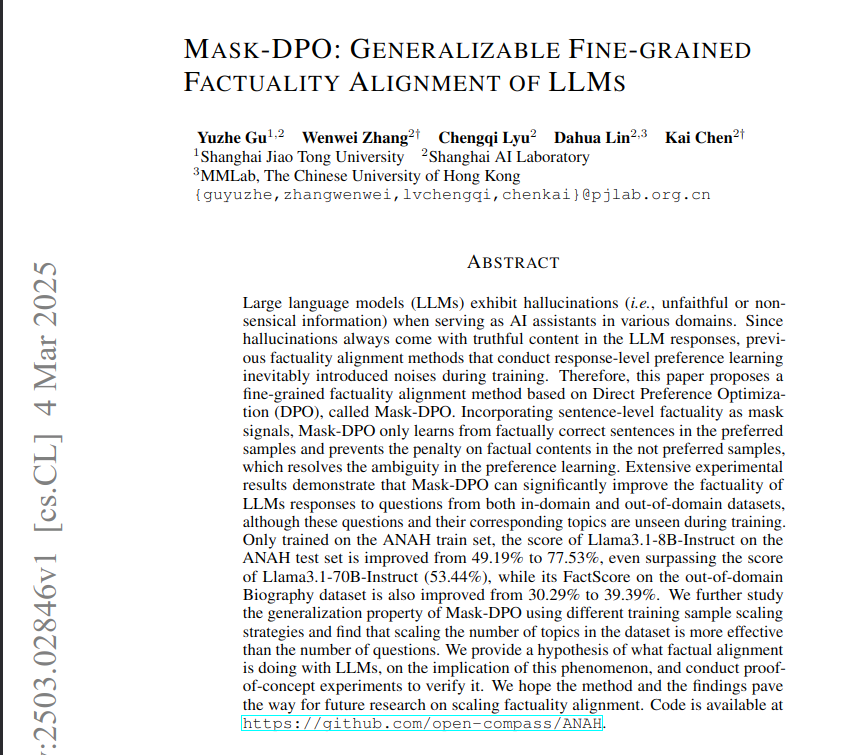
LLMs hallucinate, mixing truthful and false information.
This makes factuality alignment noisy during training because response-level preference learning cannot isolate factual errors.
This paper introduces Mask-DPO. It uses sentence-level factuality masks during Direct Preference Optimization.
Mask-DPO learns only from factually correct parts of preferred responses. It avoids penalizing factual content in dispreferred responses.
📌 Sentence-level masks in Mask-DPO refine preference learning.
This method reduces noise from mixed factuality responses.
📌 Mask-DPO's fine-grained DPO significantly boosts factuality and generalization. It achieves this by reducing noisy feedback.
----------
Methods Explored in this Paper 🔧:
→ Mask-DPO uses sentence-level factuality annotations as masks.
→ It constructs preference pairs by ranking responses based on their sentence-level factuality scores.
→ During training, Mask-DPO applies masks to the DPO loss function.
→ These masks ignore incorrect sentences in preferred responses and correct sentences in dispreferred responses.
→ This fine-grained approach focuses learning on factual correctness at the sentence level.
----------------------------
Paper - arxiv. org/abs/2503.02846
Paper Title: "Mask-DPO: Generalizable Fine-grained Factuality Alignment of LLMs"
@ThatArrowsmith@elixirlang@elixirphoenix Works fine if you tell it to use the latest versions ans tag the documenation @docs then add phoenix and phoenix live.. uses all the latest syntax.. of course the fifo issue remains so you periodically have to remind it.. the beta featurea to manage the context doesnt really help
Today, we are infusing the power of agentic AI into the GitHub Copilot experience, elevating Copilot from pair to peer programmer 🤖
(1/4)
https://t.co/zr6l3uaTmb
@cursor_ai please;
- display when the limits will be reset in the account page
- make it more intuitive when composer is applying changes or asking for permission (its kind of vague now sometimes)
- any chance of accepting o3-mini-high on byo keys?
@7etsuo@tsotchke Nice job cherrypicking favorable test cases. Factoring in all the messy bits—hardware integration, error correction, scaling up—those numbers don’t add up. It’s smoke and mirros, and it won’t deliver.. #scam
@shaoruu@cursor_ai@ryolu_ Great work! Also more powerful models on composer and multiple agents mode (expert pool) with bring your own keys support , yes please!
@chris_mccord Have you seen it produce unittests for live views with some actual coverage? Seems composer agent mode in cursor had quite some diffculties with those, have you had better results? Sample I tried was a csv parsing form, fully functional, yet quite often vunerable to regression..
New paper outlines the DH method for Quantum Computers, suggesting that there will be quantum demand for Diffie-Hellman Cyrptography in the post quantum world. There are already teams working on post Quantum Cryptography such as the Knot Diffie-Hellman from @quantdotbond which potentially offer a faster platform to secure Web3 transactions in a post Quantum world. The paper follows. https://t.co/hxPQZZjGRP
With the release of $KNOT getting closer, the moment couldn't be better to announce our plan to integrate AI support to $KNOT. With the advent of AI being more present in cybersecurity, this would be essential for real-world implementations.
This would help us during the second phase of $KNOT, that is, optimization of the implementation and further development by detecting security problems and anomalies.
We will aim to use AIs commonly used for cryptographic verification and integration, and also new ones implemented by our team specifically for $KNOT, with the aim to integrate it and avoid vulnerabilities.
The use of AI will be essential to identify potential cryptographic threats that may arrive with the advancement of quantum research.
We're heading to the Quantum Innovation Summit 2025! 🚀
This premier event brings together industry giants like Microsoft, IBM, D-Wave, Nvidia, and more. With @pauloaviana and @VOTSoul1929 representing us, we’re ready to:
💡 Connect with leaders shaping the quantum world
🤝 Explore partnerships and investment opportunities
🌐 Showcase https://t.co/18xdA3VODK to the global quantum community
The future of $KNOT and Quantum DeSci has begun. Stay tuned for updates from the summit floor!