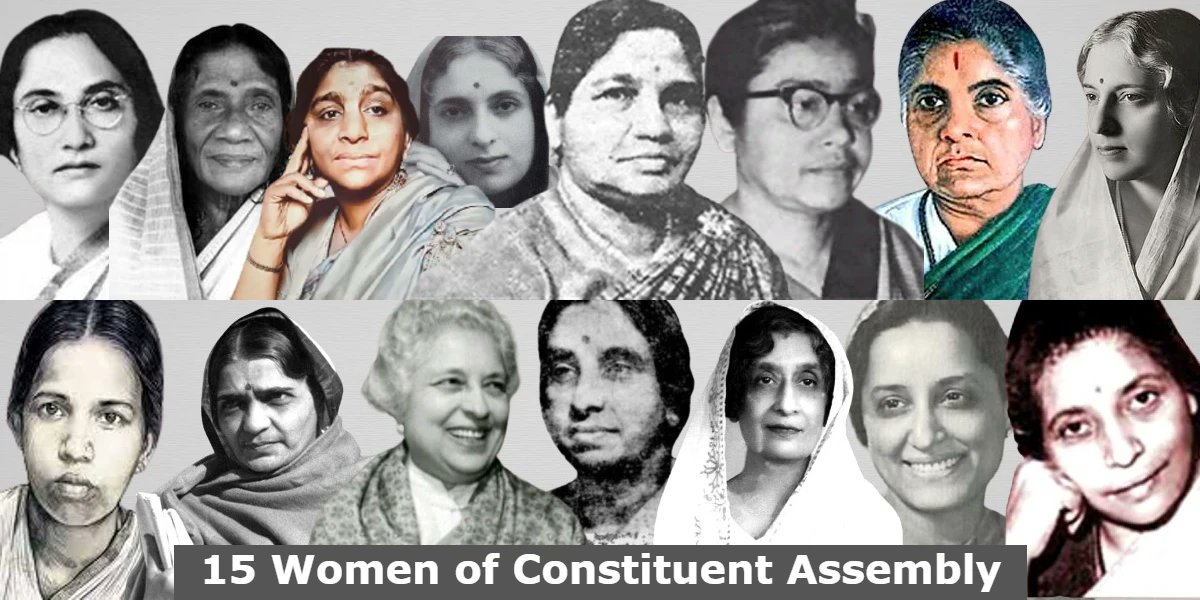
Recently Pm Modi ji in Mann Ki Baat , highlighted Hansa Mehta women member of Constituent Assembly.
So Lets see all 15 Women Member of Constituent Assembly in detail , important for our Exam 👇
1) Hansa Mehta
Hansa Mehta was Born in 1897 to the Dewan of Baroda Manubhai Nandshankar Mehta,
She studied journalism and sociology in England.
It was here in 1918 that she met Sarojini Naidu and thus Mahatma Gandhi.
Mehta joined the national freedom movement after coming into contact with Sarojini Naidu and Amrit Kaur
She married Jivraj Narayan Mehta, briefly the personal doctor of Mahatma Gandhi.
She supported inter caste marraige , herself she Married outside her caste.
She was a part of the Constituent Assembly of India from 1946 to 1949
She was member of several Committees in the Constituent Assembly — including the Fundamental Rights sub-committee — Mehta was against “too many personal laws” and for a progressive common civil code.
She was also part of the group convened to “amend and codify certain branches of the Hindu law
She is also part of Indian delegate to the United Nations Human Rights Commission (1947-1948) Hansa Mehta is credited with making a significant change in the language of Article 1 of the UDHR. “The world can thank a daughter of India, Dr. Hansa Mehta, for replacing the phrase in the Universal Declaration of Human Rights (UDHR). It said, ‘All men are born free and equal’. Now it is changed, ‘All human beings are born free and equal
In 1959, the government honoured her with a Padma Bhushan.
2) Ammu Swaminathan
Ammu Swaminathan born in Palghat district, Kerala. She formed the Women’s India Association in 1917 in Madras, along with Annie Besant, Margaret Cousins, Malathi Patwardhan, Dadabhoy and Ambujammal.
Ammu Swaminathan had been arrested and jailed after she participated in the Quit India movement in 1942.
She fought hard for the Sarda Act or Child Marriage Restraint Act, Age of Consent Act and the various Hindu Code Bills that pushed for a reform in Hindu religious laws.
She became a part of the Constituent Assembly from the Madras Constituency in 1946
She shifted to Delhi when she was elected to the Lok Sabha (1952) and Rajya Sabha (1954).
In 1959 She became the Vice President of the Federation of film societies with Satyajit Ray as President.
She was President of the Bharat Scouts and Guides (1960-65) and the Censor Board.
3) Dakshyani Velayudhan
Dakshyani Velayudhan belonged to the Pulaya community—considered to be the early inhabitants of Kerala, but subject to acute discrimination by the upper caste in the princely states of Travancore and Cochin, in pre-Independence India
She is the first Dalit woman graduate in India
Velayudhan was inspired to enter active politics by her family members’ active involvement in civil disobedience movements against upper-caste diktats.
She emerged as a fierce critic of Congress politics, writing strongly against them in the All India Scheduled Castes Federation’s (AISCF) weekly journal, Jai Bheem. At the same time, she was also critical of the AISCF and B.R. Ambedkar’s politics, specifically their demand for separate electorates for the Scheduled Castes.
In 1942, she was nominated to Cochin Legislative Council seat and in 1946 to the Constituent Assembly becoming the first and the only Dalit woman in the gathering
She formed a women’s organisation, Mahila Jagriti Parishad (1977)
4) Begum Aizaz Rasul
Begum Aizaz Rasul born to a princely family of Maler Kotla, a Muslim state in Punjab in the early 20th century.She was the only Muslim woman member of the Constituent Assembly.
She was against a separate electorate for minorities formed by the colonial government in 1909. Her debates were focused on political rights of minorities in a secular state.
The Begum was a fierce critic of the Zamindari system. Member of the “ Tenancy reform committee”, she was committed to the abolition of the Zamindari System in UP.
She advocated for more rights for the farmers.
She supported India’s membership to the Commonwealth.
She wanted to make sure that fundamental rights and directive principles were observed in all provinces in letter and spirit.
Rasul was deeply involved in popularising Hockey for Indian women. For two decades, she served as the President of the Indian Women’s Hockey Federation. Later, she went on to head the Asian Women’s Hockey Federation.
5)Durgabai Deshmukh
Durgabai Deshmukh was born in Rajahmundry in 1909. She was a freedom fighter and when she was 12 years old, she participated in the Non-Co-operation Movement , she also participated in the Salt Satyagraha movement in Madras city in May 1930.
In 1936, she established the Andhra Mahila Sabha, which within a decade became a great institution of education and social welfare in the city of Madras.
She was also President of Blind Relief Association.
She was elected to Constituent Assembly from Madras Province.
She was the only woman in the panel of chairman in the constituent Assembly.
She was instrumental in enactment of many social welfare laws.
She became member of Planning Commission by nomination and also became first woman to be Chairman of the board.
She was the first one to discuss the need of separate Family Court for speedy justice in familial matters.
6) Kamla Chaudhary
Kamla Chaudhary was born in an affluent family of Lucknow, she joined the nationalists and was an active participant in the Civil Disobedience Movement launched by Gandhi in 1930.
She was elected to the Constituent Assembly from the United Provinces in 1946.
She was a Member of the Provisional Parliament and acted as the Senior Vice-Chair of the 54th Indian National Congress Session.
She entered the Lok Sabha in 1962 after winning from Hapur District in Uttar Pradesh.
Chaudhary was also a celebrated fiction writer and her stories usually dealt with women’s inner worlds or the emergence of India as a modern nation.
7)Leela Roy
Leela Roy was born in Goalpara, Assam in 1900.She graduated from Bethune College in 1921
She became an assistant secretary to the All Bengal Women’s Suffrage Committee and arranged meetings to demand women’s rights.
She was a radical leftist Indian woman politician and reformer, and a close associate of Netaji Subhash Chandra Bose. She worked for educating girls and established a girls school in Dhaka.
In 1923,she founded the Dipali Sangha and established schools which became centres of political discussion in which noted leaders participated.
Later, in 1926, the Chhatri Sangha, an association of women students in Dacca and Kolkata, was founded. She became the editor of a journal, Jayashree.
In 1931, she began publishing Jayasree the first magazine edited, managed, and wholly contributed by women writers. It received the blessings of many eminent personalities including Rabindranath Tagore, who suggested its name.
8) Malati Choudhury
Malati Choudhury was born in 1904 in the then East Bengal, now Bangladesh.
During the Salt Satyagraha, Malati Choudhury, accompanied by her husband joined the Indian National Congress and participated in the movement.
They educated and communicated with the people to create a favorable environment for Satyagraha.
Along with her husband, she organised the Utkal Congress Samajvadi Karmi Sangh, the Orissa branch of the All India Congress Socialist Party. Choudhary founded the Post Basic School at Champatimunda, Orissa.
In 1946, she set up the Bajiraut Chhatravas to educate the children of freedom fighters and became the president of the Orissa Pradesh Congress Committee. She had a significant impact on freedom struggle movements organised on the local levels.
In 1934, Malati took part in M.K. Gandhi’s padayatra in Orissa. She led the Krisaka Andolan to save farmers from exploitation by landowners and moneylenders. She played a central role in the peasants uprising in Orissa in the 1930s and established the Utkal Provisional Kisan Sabha that worked towards the abolition of the zamindari system.
In post-independence She strongly opposed state action during the emergency of 1975 which led to her imprisonment. She won multiple awards for her work including The National Award for Child Welfare in 1987, Jamnalal Bajaj Award in 1988, Utkal Seva Sammaan in 1994, and The Tagore Literacy Award in 1995
9) Purnima Banerjee
Purnima Banerjee was the secretary of the Indian National Congress committee in Allahabad, Uttar Pradesh. She was a member of the Congress Socialist Party and the Indian National Congress.
She was one of a radical network of women from Uttar Pradesh who stood at the forefront of the freedom movement in the late 1930s and ’40s.
She was arrested for her participation in the Satyagraha and Quit India Movement. One of the more striking aspects of Purnima Banerjee’s speeches in the Constituent Assembly was her steadfast commitment to a socialist ideology.
As secretary for the city committee, she was responsible for engaging and organising trade unions, Kisan meetings and work towards greater rural engagement.
Purnima Banerji, was one of those women who became a member of the Uttar Pradesh Legislative Assembly in 1946. She was a part of the Constituent Assembly from 1946 to 1950, who played an important part in drafting our constitution.
She represented the United Provinces in the assembly.
She believed that ultimate sovereignty lies with people, she truly believed that it is the common masses who vest power in the positions elected.
10)Rajkumar Amrit Kaur
Rajkumar Amrit Kaur was born in 1889, in Lucknow, Uttar Pradesh. After an initial period of home-schooling, she was sent to Sherborne School in Dorsetshire, England to complete her school education. She continued her stay in England, graduating with a remarkable academic and extra-curricular record from the University of Oxford.
Once she completed her education, Kaur returned to India aged 20. By 1919, Kaur had begun to grow closer to Gandhi and his teachings.
In the initial years after her return, Kaur committed most of her energy to social causes concerning women such as abolishing the practice of purdah, child marriage and the Devadasi tradition.
By 1927 she had co-founded the All-India Woman’s Conference, serving as its secretary in 1930 and president in 1933. Finally in 1934 she was able to join Gandhi’s Sewagram Ashram, where she remained his secretary for sixteen years
During the Salt Satyagraha, she was arrested for her involvement from Bombay. In 1937, she went to jail again – this time on charges of sedition. Kaur returned to jail in 1942 for taking part in the Quit India movement.
She was elected to the Constituent Assembly from the Central Provinces and Berar province on a Congress ticket.
She was also a member of Sub-Committee on Fundamental Rights and Sub-Committee on Minorities. As a member of the Constituent Assembly, she supported a proposal for a Uniform Civil Code in India
She was India’s first Health Minister and she held that post for ten years
She was the founder of the All India Institute of Medical Sciences (AIIMS) and argued for its autonomy. She was a firm believer in women’s education, their participation in sports and their healthcare.
Kaur was also instrumental in founding the Indian Council of Child Welfare
She was the Deputy Leader of the Indian delegation to UNESCO in 1945 and 1946.
In 1950, she became the first female and first Asian president of the World Health Assembly, and also led India’s delegation to the World Health Organization several times between 1948 and 1953. She was also a founder-member and Chairperson of the Indian Red Cross Society.
Before going further Do Like ,Retweet and Bookmark to save this important tweet in ur notes ❤️🔁🔖😀
11)Renuka Ray
Renuka Raylived Born in 1903
later she went to London to complete her BA from the London School of Economics.
Persuaded by Gandhi’s call for fight against the British rule, she joined Gandhi’s ashram and accompanied him in protests. Later, she went on to obtain a degree from the London School of Economics.
She submitted a document titled Legal Disabilities of Women in India; A Plea for a Commission of Enquiry’ in the year 1934, as legal secretary of the AIWC
From 1943 to 1946 she was a member of the Central Legislative Assembly, then of the Constituent Assembly and the Provisional Parliament.She served on the West Bengal Legislative Assembly as Minister for Relief and Rehabilitation. In 1957 and again in 1962, she was a member of Malda of the Lok Sabha.
She was also President of the AIWC in 1952
She established the All Bengal Women’ Union and the Women’s Coordinating Council
In 1943 she was nominated to Central Legislative Assembly as a representative of women of India. She was also a member of Constituent Assembly of India in 1946-47.
In year 1959 she headed a committee on Social Welfare and Welfare of Backward Classes, which is popularly known as Renuka Ray Committee.
She is author of the book My Reminiscences: Social Development During the Gandhian Era and After
12 )Sarojini Naidu
Sarojini Naidu,also known as the Nightingale of India in her poetic surroundings, was born in 1879, in Hyderabad, India.
She took part in the Congress session in Bombay in 1904. Thereafter, she made associations with Gokhale, Tagore, Annie Besant, Gandhi, and Nehru
She was the first Indian woman to become the president of the Indian National Congress in 1825
Naidu was involved in Non-cooperation movement, Home Rule movement, Salt Satyagraha. She was arrested 5 times during the freedom struggle.
In 1917 she headed the All-India Women’s Deputation and championed women’s suffrage before E. S. Montagu (Secretary of State for India). In the same year, she along with Annie Besant and others set up the Women’s India Association.
When Gandhi was arrested on 6 April 1930, he appointed Naidu as the new leader of the campaign Salt March.
She is the first woman to be appointed as an Indian state governor. Naidu was appointed the governor of the United Provinces (present-day Uttar Pradesh), making her India's first woman governor. She remained in office until her death in March 1949
She was appointed to the Constituent Assembly from Bihar. She spoke about the importance of adopting a national flag in the Assembly.
13) Sucheta Kriplani
Sucheta Kriplani was born in 1908 in present-day Haryana’s Ambala town.
Kripalani began her professional career as a teacher of Constitutional History at Banaras Hindu University till 1939.
She became a member of the Congress Party in 1938 and served as the Secretary, for one and half years, to the Foreign Department and Women’s Section.
She is especially remembered for her role in the Quit India Movement of 1942.
She came to the forefront during the Quit India Movement and was arrested by British. She later worked closely with Mahatma Gandhi during the Partition riots.
In 1946, Kripalani was elected to the Constituent Assembly from the United Provinces. She was a member of the Flag Presentation Committee, which presented the first Indian Flg before the Constituent Assembly.
On 14 August 1947, she sang Vande Mataram in the Independence Session of the Constituent Assembly a few minutes before Nehru delivered his famous "Tryst with Destiny" speech. She was also the founder of the All India Mahilla Congress, established in 1940.
She was elected as the first woman CM of state of Uttar Pradesh from the Kanpur constituency
Kripalani also established the women’s wing of the Congress party in 1940. Post-independence, Kripalani’s political stint included serving as an MP from New Delhi and then also as the Minister of Labour, Community Development and Industry in Uttar Pradesh’s state government.
She was a part of several delegations to foreign countries and organizations. She played a key role in Parliamentary Delegation to Turkey (1954); International Labour Organization (1961), United Nations General Assembly (1949); and the United Nations Seminar on Civic Responsibility and Increased Participation of Asian Women in Public Life (1956). She passed away in 1974.
14) Vijaya Lakshmi Pandit
Vijaya Lakshmi Pandit was born in Allahabad on August 18, 1900, and she was the sister of India’s first Prime Minister, Jawaharlal Nehru.
She played active role in the freedom struggle she was imprisoned by the British on three different occasions, in 1932-1933, 1940, and 1942-1943.
Her political career began with her election to the Allahabad Municipal Board. In 1936, she was elected to the Assembly of the United Provinces, and in 1937 became minister of local self-government and public health the first Indian woman ever to become a cabinet minister.
She was the first Indian woman to hold a cabinet post in pre-independent India. In 1936, she stood in general elections and became member of parliament by 1937 for constituency of Cawnpore Bilhaur. In 1937,
Following the death of her husband in 1944, she experienced Indian inheritance laws for Hindu widows and campaigned with All India Women's Conference to bring changes to these laws.
In 1946, she was elected to the Constituent Assembly from the United Provinces.
1968, she headed the Indian delegation to the United Nations. In 1953, she became the first woman President of the United Nations General Assembly
15) Annie Mascarene
Annie Mascarene was born into a Latin Catholic family of Thiruvananthapuram, Kerala. She was the first woman to be part of the Travancore State Congress Working Committee
1942, Mascarene joined the Quit India Movement and two years later was elected as secretary of the Travancore State Congress
Mascarene represented the Princely State of Travancore and Cochin Union in the Constituent Assembly. In the Assembly, she spoke on the issue of federalism.
She served on the Assembly's select committee that looked into the Hindu Code Bill
In 1949, she became the first woman post-independence to serve as a Minister in the state, when she was appointed Minister in Charge of Health and Power in the Parur T K Narayana Pillai Ministry.
Mascarene was elected to the First Lok Sabha as an independent candidate from the Thiruvananthapuram Lok Sabha constituency in the 1951 Indian general election. She was the first woman MP from Kerala
Do Like ,Retweet and Bookmark to save this important tweet in ur notes ❤️🔁🔖😀
Do follow @factsforupsc for more such tweets 😀
मणिपुर की घटना पर CJI हुए नाराज, कहा,
◆ "मणिपुर की घटना बर्दाश्त के बाहर"
◆ "मणिपुर का वीडियो परेशान करने वाला"
◆ "सरकार को कार्रवाई के लिए वक्त देंगे"
◆ "कार्रवाई नहीं हुई तो हम करेंगे"
DY Chandrachud | #DYChandrachud | #ManipurViolence
व्हीलचेयर पर बैठे पिता द्वारा ड्यूटी से घर आये #सैनिक_बेटे का अनोखा स्वागत!
दुनिया जीतने पर भी वो खुशी ना मिले जो हमारे कर्मों, उप्लब्धियों से माता-पिता की आंखों में खिले "गर्व" को देखकर मिलती है!
Whatever you do, just remember to
#MakeYourParentsProud