Etzanoa & Cahokia seem just incredible, where else should a nerd near St Louis go checkout?
Is the Utz Site at Annie & Abel Van Meter State Park? @mostateparks
Should I go to Danville, MO to visit Graham Cave?
@MoundLore@ill_Scholar@SEACArchaeology@lidarnews
Etzanoa should be as famous as Pompeii or Tenochtitlán.
But there’s no federal protection. No major museum exhibit. No school curriculum.
Just silence.
And yet, it proves something simple and powerful:
This land was never empty.
Have you heard or worked at “The Great Settlement”?
It still boggles my mind how Germany managed to reunify after all this chaos.
Germany as a unified country is much younger than many people realize.
The modern German nation was founded in 1871, when the German Empire was proclaimed after Prussia’s victory in the Franco-Prussian War. Led by Otto von Bismarck, Prussia united most of the German states through a combination of wars, diplomacy, and political maneuvering.
Before then, there was no single German nation-state. For centuries, the German-speaking lands were divided into hundreds of kingdoms, duchies, principalities, free imperial cities, and ecclesiastical territories. From 962 to 1806, most of these belonged to the Holy Roman Empire, a loose political union where the emperor held limited authority and individual states largely governed themselves.
After the Holy Roman Empire was dissolved during the Napoleonic Wars in 1806, the German Confederation was established in 1815, bringing together 39 independent states in another loose alliance. In 1867, Prussia created the North German Confederation, uniting most of the northern German states.
The final step came in 1871, when Prussia defeated France and the southern German states agreed to join the new empire. Their union marked the birth of the first unified German nation-state.
Erling Haaland paid $134,000 for a 430-year-old Viking kings manuscript, then gifted it to his hometown. He said: “I’ve never been a big reader, but I want people to read about those who came from my area.”
Erling Haaland and his father, Alf-Inge Haaland, quietly acquired one of Norway’s greatest literary treasures at auction: a 1594 edition of Snorri Sturluson’s Kongesagaer. Translated by Mattis Størssøn from Old Norse into Danish, it was the first printed history of Norway and helped preserve the stories of the nation’s medieval kings for generations.
Widely regarded as one of the most significant works in Norwegian literary history, the copy purchased by the Haalands was the only complete edition still in private ownership. It sold for 1.3 million Norwegian kroner (about $134,000), setting the record as the most expensive Norwegian book ever sold at auction.
Instead of keeping the rare volume in a private collection, the Haalands donated it to the library in Time Municipality, where Erling grew up. The book is now on public display, and the donation also funded a reading competition to inspire local children and young people to discover Norway’s history and literary heritage.
🏞️🌡️☠️ Anything that falls into a four-kilometre stretch of a river in the central Peruvian Amazon dies within seconds, because the water reaches temperatures of up to 200 degrees
https://t.co/EkEqqhEtpO
Civic Signal see what your representatives are doing right now. See recent news for every senators, House member, and state legislator.... NO SPIN
https://t.co/IAHvDLl6ft
🗺️1894 Smithsonian map estimated 100,000 mound sites in N.America & 90% of those had been destroyed, 🙈BUT the map barely touched the real number because the field agents who compiled it only counted what they saw by boat👨🦯 @DrGregLittle2@MoundLore
https://t.co/Dm89Wv75ZB
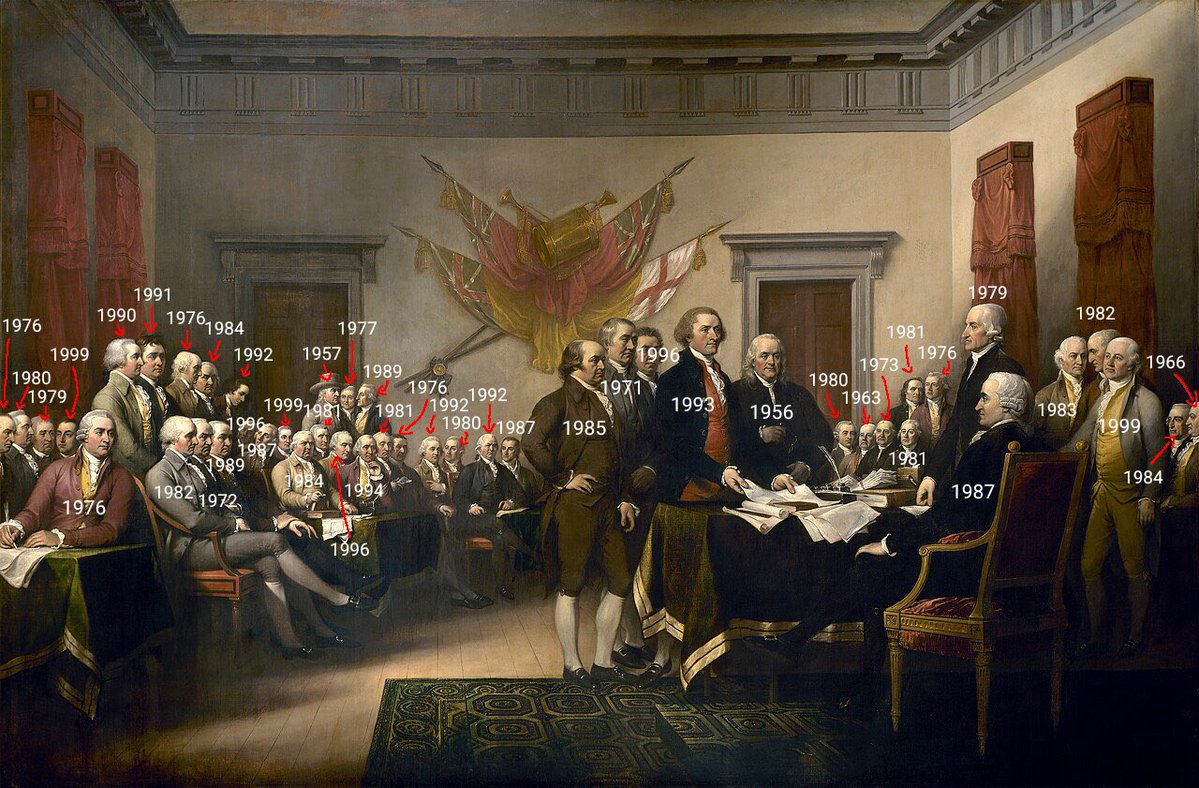
The Committee of Five—John Adams, Benjamin Franklin, Thomas Jefferson, Robert Livingston, and Roger Sherman—was appointed to draft the Declaration of Independence 250 years ago today.
Jefferson's draft of the document is here at the Library, and will be featured in a new exhibition opening July 3.
Adding to this a bit - the Polynesians did erect massive stone structures, but throughout all of Polynesia there is nothing like Easter Island’s Vinapu (which is clearly Inca construction).
Polynesians built up platforms made from volcanic rubble, but never masoned finely joined stonework like we see in South America. The Inca consisted of over 20,000,000 people & was incredibly interconnected. They certainly knew the people of Rapa Nui & that was clear even before we had the DNA.
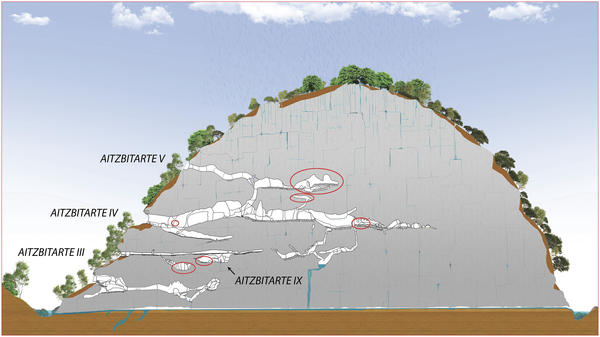
🦴Ice Age humans at Labeko Koba reused animal bones to shape flint blades
🦣Mammoth, woolly rhino & reindeer remains show harsh conditions
🔥Evidence suggests they smashed bones to use as fuel during colder periods
@paleomonrepos@recercauniscat
https://t.co/zJZ3EP5yvE
A cave in the Pyrenees at 7,330 feet above sea level contained 23 ancient fireplaces, traces of a child, and green stones that prehistoric people appear to have been climbing up there to process as copper ore for over 4,000 years https://t.co/mQ0ya9qlk8
Who is interested in the pre-history of the Basque?
40k BP - Domesticating dogs to help w/hunts, creative cave art, camps & flint workshops, evidence of shelters, clothes, and what they ate... Read this🧾
@MichaelButtonX@ill_Scholar
https://t.co/pzUd6tSOEn
Ever google Basajaun?
A 9,000-year-old skeleton discovered in a cave near Cheddar, England, became known as “Cheddar Man.” When scientists analyzed his DNA, they found an astonishing connection: a living descendant was working as a history teacher less than half a mile from where the ancient remains were uncovered, linking nearly 300 generations across nine millennia.
I need to go to Russia and get down inside the Khara-Hora Shaft with a 4K camera.
This possibly pre-historic underground system of shafts needs to be properly documented.