Official figures out this morning report that last month, the UK government borrowed £24.5 billion.
But the fineprint shows that almost £11 billion of that extra borrowing went on debt interest payments.
That's more than £400 per household on debt service costs, in September alone.
So far during this financial year, from April to September, the government's debt interest payments amount to £61 billion.
Now, this number will barely feature in UK newspapers and across our airwaves. It may be mentioned in passing in out-of-the-way business sections, or on the odd business bulletin.
But this huge debt interest bill won't register with the vast majority of our political and media class, or impact the national debate.
Let me explain why that's so wrong and so dangerous ...
£61 billion is a massive amount of money.
It's equivalent to the UK's entire annual defence budget – the money we're paying, increasingly to foreign creditors, simply to service our national debt for six months, not to pay any of it back.
£61 billion is equivalent to the money you'd raise over a year from adding a whopping 7 pence to the basic rate of income tax.
For £61 billion, you could build around 40 large, state-of-the-art hospitals, or employ more than 100 thousand extra nurses for ten years.
£61 billion would pay for free-at-the-point of use social care for everyone who needs it in the UK, for an entire year – three times over.
Again, this is the debt interest bill on Britain's spiralling national debt – now more than 3 trillion pounds – over the last six months alone.
The UK's public finances are close to meltdown – yet so many MPs and journalists continue blithely to view ever more public spending and borrowing as the answer to every problem.
Those who highlight the dangers post by our hugely precarious national accounts are dismissed as cranks, ideologues or worse.
But basic arithmetic has no ideology.
And there is nothing "progressive" or "kind" or "right-on" about driving the UK ever closer to the fiscal cliff edge, provoking a crisis that will make the "austerity" years of the 2010s feel like a picnic, a crisis in which poorer households will suffer the most.
Yes, Britain's national debt is lower than that of France. But because our borrowing has been rising so sharply, and because we're so prone to inflation, our debt service costs are much higher.
The UK is spending a disgraceful 3.6pc of GDP on public debt interest, while France spends less than 2.5pc.
Endless airtime and column inches are devoted to spurious conversations about a billion or two of additional "fiscal headroom" we may or may not have in three years' time.
And, of course, any "extra headroom" is immediately pledged in new spending – which means yet more borrowing.
These conversations are a waste of time – and, in fact, are deeply counterproductive. Three-year fiscal forecasts, even one- and two-year forecasts, routinely turn out to be askew by tens of billions of pounds.
I'm not saying we don't need fiscal rules - we do, but we need more immediate rules, which actually bite, acting as a meaningful constraint on out-of-control borrowing and spending.
Instead, political and media sages present the nation with spuriously precise discussions about fictional fiscal outcomes way into the future – using rules which are deliberately designed to kick arithmetic realities into the long grass ....
An increasingly expensive, over-bearing, out of control state is not the answer to Britain problems.
But unless we change course, it will certainly be our downfall.
Please like/share if you think what I'm saying is important – and if fiscal realities should feature more prominently in our national debate.
And for more sharp, plain-speaking economic analysis subscribe to:
"When The Facts Change - economic and politics in a fast-moving world, with Liam Halligan"
@TorstenBell You’re avoiding the reality, wealth is exiting Britain at an unprecedented pace. Thats being driven by the insanely high tax burden, especially on the higher earners, taxes for which they receive next to zero public services. Government spending must drop, and quickly
@matthewsyed Stellar article today and spot on. Europe needs to change course quickly, it will require some tough discussions with the electorate as opposed to the continued mass delusion that seems to persist.
@Hertz I raised a customer complaint due to a false damage report with you, complaint raised 9th August and zero response from you. How do I actually get this addressed?
@Barclaycard the inapp chat service is down, for people who don’t have the required 15 minutes to wait on the phone, is there another way to order the pin that you keep forgetting to send to my supplemental card?
How much do you actually keep?
To clear £120k after tax, this is what you’d have to earn:
Dubai - £120,000
Hong Kong - £140,000
China - £160,000
U.S. & Germany - £165,000
Canada & France - £172,000
U.K. - £205,000
Where would you choose to live?
For all of this century it’s always been easier for young folks to find work in the UK than in the EU, where youth unemployment rates were consistently higher than UK.
It explains why so many young, educated, ambitious Europeans flocked to the UK to work, much to our mutual benefit.
These days are over.
Britain’s youth unemployment rate has risen above Europe’s for the first time: unemployment among 16 to 24-year-olds jumped to 15.3% in the three months to September, surpassing the EU’s rate of 15pc, according to the OECD.
It marks the first time youth unemployment in Britain has been higher than in the bloc since records began in 2000.
Labour policies — especially pushing up the minimum wage too much — are to blame. Even the Bank of England says minimum wage increases for pricing young people out of work. But raising national insurance contributions has also crippled many industries that employed young folks.
Thanks Starmer-Reeves. Another fine success story.
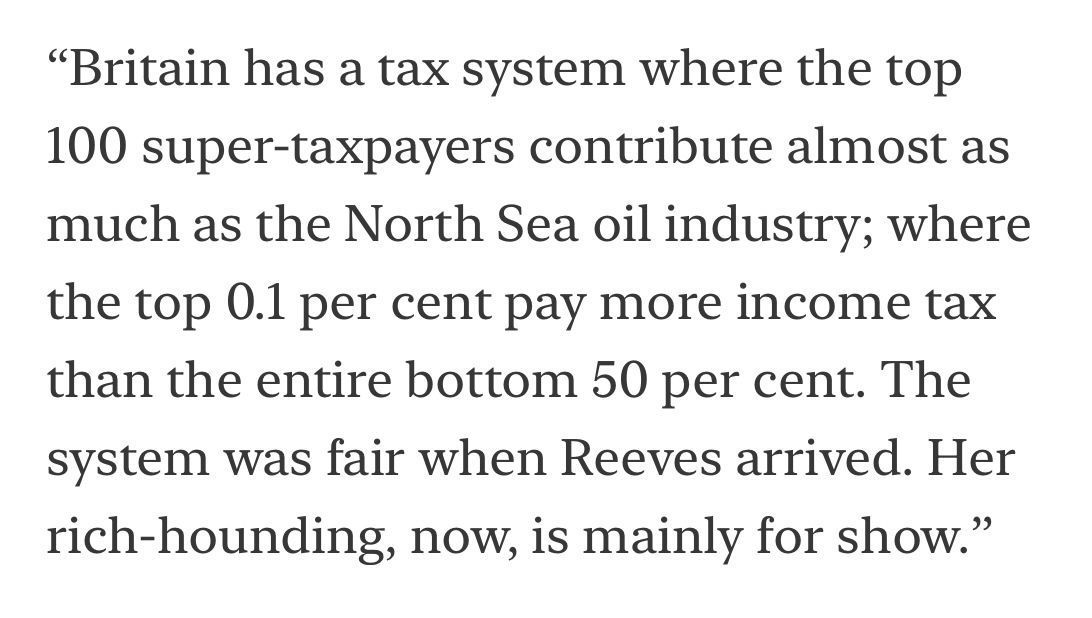
The top 0.1% in the UK pay more income tax than the entire bottom 50% combined.
And that was kind of working - until many of the top 0.1% decided to leave.
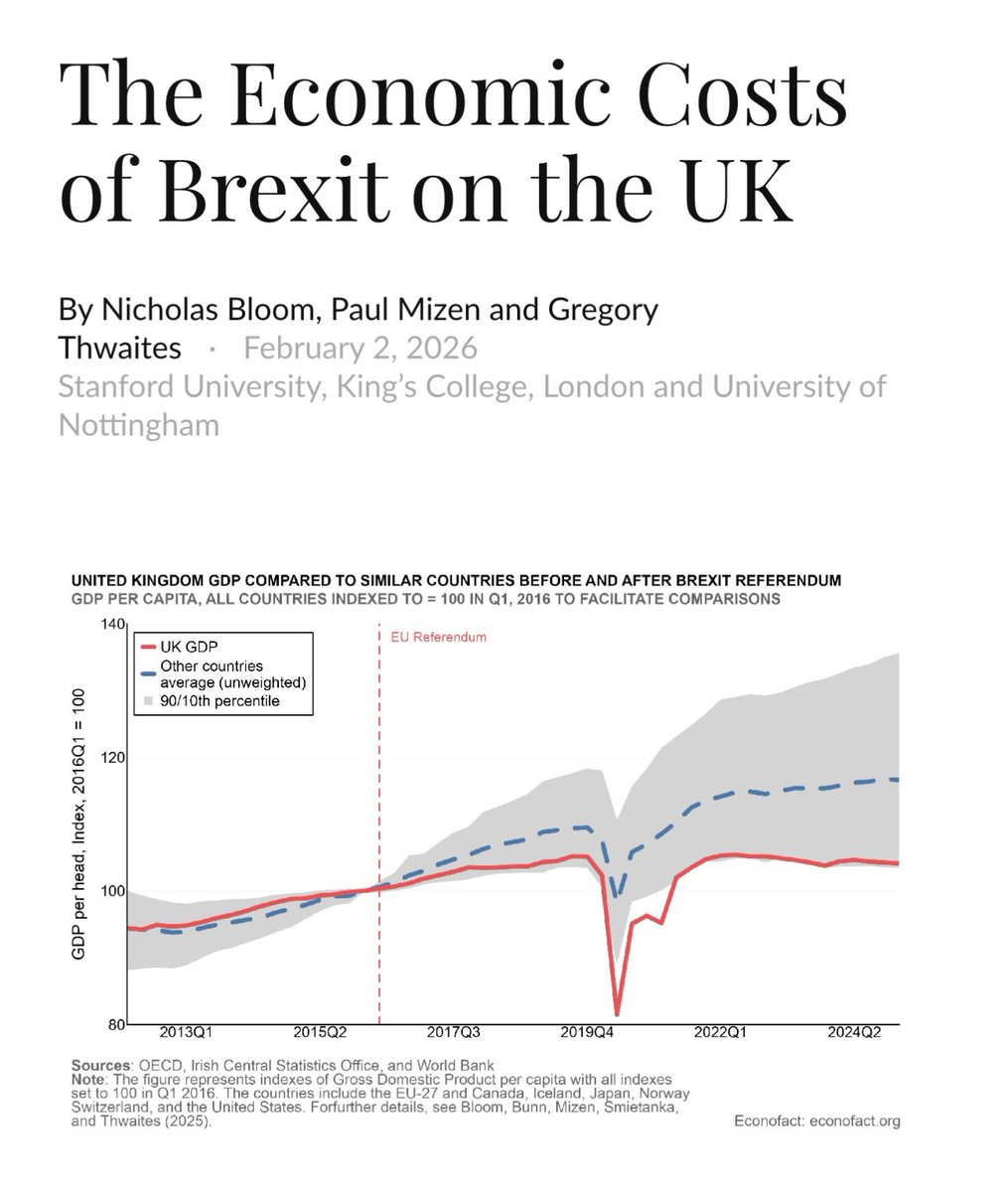
🚨 The clearest, most devastating summary of Brexit’s damage which answers every remaining excuse.
Brexit caused a slow economic bleed:
•GDP is 6–8% smaller than it would have been by 2025: worse than forecast.
•Investment is down 18% compared to similar economies.
•Employment and productivity are 4% lower.
•The damage accumulated year after year, driven by uncertainty, friction and lost integration.
Nearly 1 in 10 CFOs spent 6+ hours a week dealing with Brexit fallout for years. Huge amount of time/money preparing for economic sabotage.
👀The killer finding 👉firms most exposed to the EU:
😩 Were the fastest growing before Brexit
😥 Became the most damaged after Brexit
Brexit punished Britain’s most productive, outward-facing businesses, the exact engines of growth.
Brexit is a rare modern case study of a rich country which proves deliberately raising barriers and the result is:
•Lower growth
•Lower productivity
•Lower wages
•Permanent relative decline
⚠️ A BIG warning for any country flirting with economic nationalism, trade wars, or sovereignty over integration.
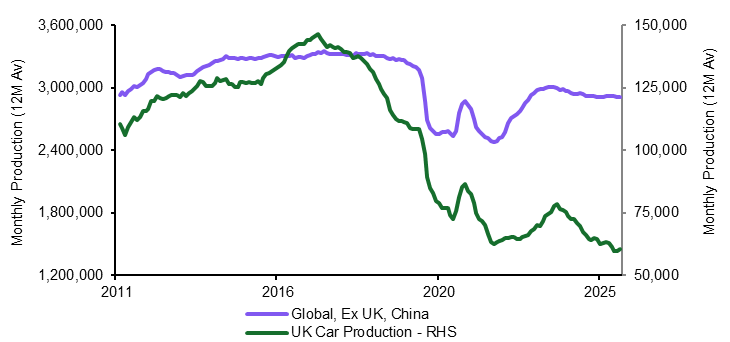
An economic renewal plan for the UK needs to have a pretty clear diagnosis of how this was allowed to happen. Even stripping out huge Chinese expansion of car production, UK car production has lagged the RoW. Brexit and the complete madness of driving up energy costs to highest in the world are the "drivers" (sorry, not sorry).
Esteemed school shuts after 100 years as it isn't 'financially viable' https://t.co/f9cZGVi47t
@UKLabour when you launched the VAT on school fees, you said there was "no evidence schools would close". The evidence was there. The evidence is here. U-turn now and scrap #SchoolFeeVAT before more schools shut and more children face disrupted education. #EducationNotTax @DailyMail
Another respected independent school, with over a century of service, closes after Labour’s VAT raid on fees. Ministers were warned. They ignored it. Families pay the price. This isn’t fairness - it’s bad policy, badly made.
@maya_wautzen in today’s @Telegraph