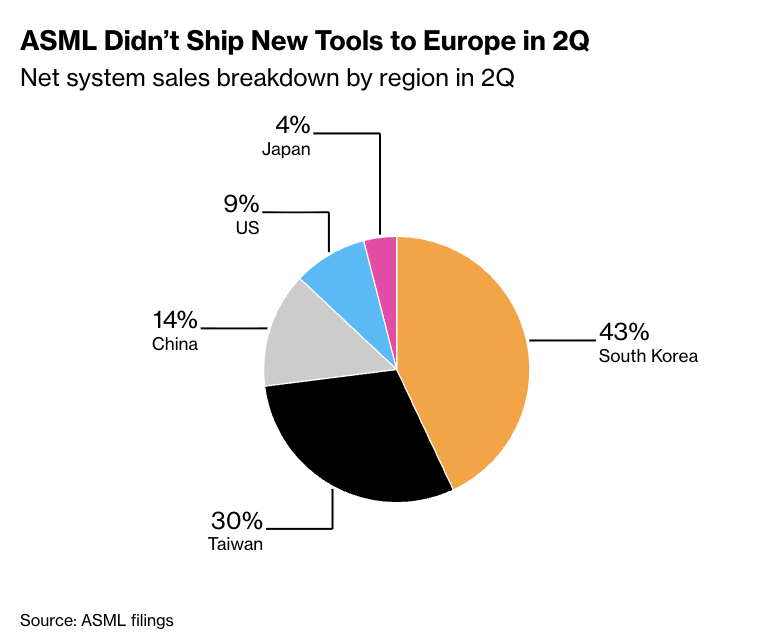
Europe's largest company $ASML which makes the machines to make the most advanced semiconductors, sold $0 worth of product to customers within Europe last quarter
A record 1.2 billion young people will enter developing-world labor markets over the next decade, even as AI raises new questions about the future of work, Harry Jacques writes from Southeast Asia in F&D magazine. https://t.co/bWZH9raKhx
At some point in your career, you meet an engineer who looks lazy until you realize he is just playing a different game. You give him a problem that sounds like a day of work, he asks a few irritatingly obvious questions, searches the codebase for ten minutes, removes most of what everyone was planning to build and ships something tiny before lunch.
Years later, after maintaining enough software yourself, you understand why those engineers were so valuable. They weren’t trying to write impressive code. They were trying to leave behind as little code as the problem allowed.
Ponytail is basically an attempt to install that instinct into an AI coding agent. Instead of immediately generating a solution, the agent is encouraged to search for existing code, built-in platform features, standard-library functions and dependencies that are already present before adding anything new.
That changes the objective from "solve this by writing code" to "solve this, and write code only if you have to."
In its current benchmark, Ponytail reduced generated code by about 54% on average, with some tasks seeing reductions up to 94%.
Most coding agents have infinite energy and zero maintenance trauma.
Ponytail gives them a little maintenance trauma.
Here's the GitHub Repo: https://t.co/WnFp9YNY53
ETH Zurich just open-sourced their entire 2026 robot learning course.
Not a MOOC. The actual course. Slides, lecture recordings, coding assignments, GitHub repo.
The curriculum goes from imitation learning and RL all the way to Vision-Language-Action models and foundation models for robotics.
Guest lectures from the co-founder of Physical Intelligence. The creator of Diffusion Policy. Pieter Abbeel. Dieter Fox.
12 weeks. Free. No signup.
Taught by Oier Mees and the team at ETH Zurich.
If you want to understand where robot intelligence is actually heading… this is the reading list the field is using right now.
📍[https://t.co/eKsIjILi60]
——
Weekly robotics and AI insights.
Subscribe free: https://t.co/9Nm01QUcw3
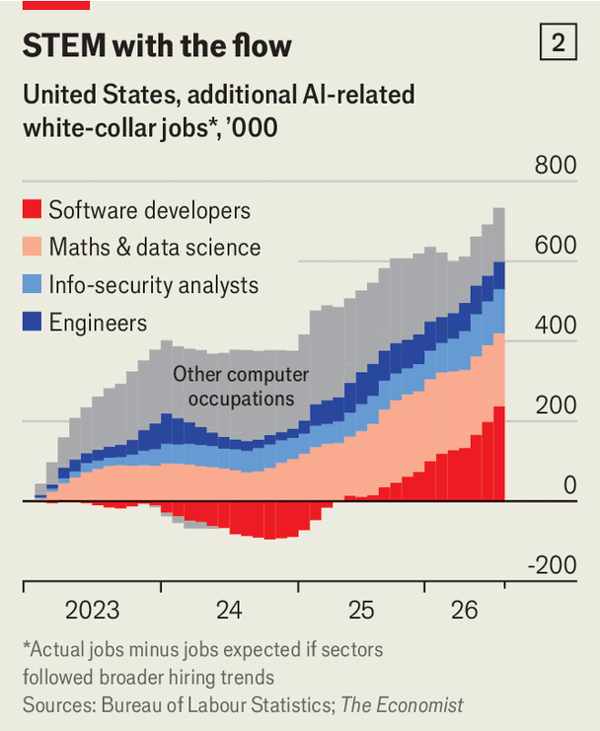
I hereby declare the "learn to code" era officially dead:
Big declines in the number of people studying computer science in the last year or two 📉
Chart from this week’s edition of our newsletter on AI and the labour market https://t.co/y4yKn6GTl1
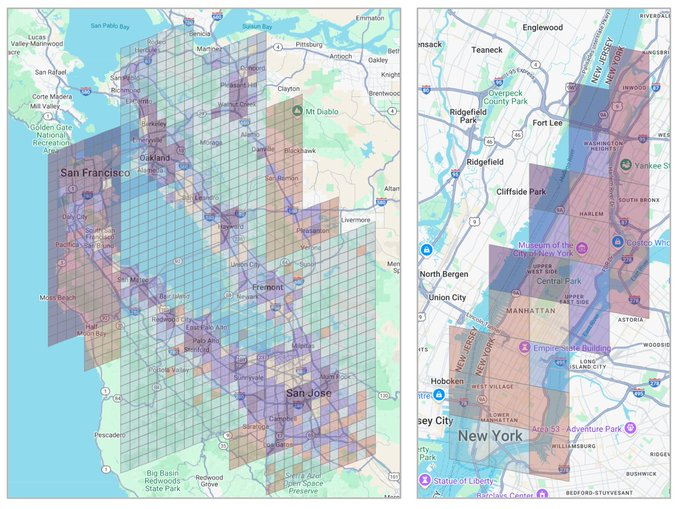
Google trained an AI to predict your neighbourhood's income by counting the coffee shops, bus stops, and high-rises on a map. Nobody told it what income was.
The model is called S2Vec, and it was published by Google Research as part of their Earth AI initiative. It takes the built environment (every building, road, park, and business in an area) and converts it into a layered image. Three coffee shops and one park in a grid cell become pixel values. The AI then reads that image the same way a computer vision model reads a photograph.
The training method is the part that matters. S2Vec uses masked autoencoding: you show the model a patch of a city with chunks missing, and it learns to fill in the gaps. Show it a cluster of high-rise apartments next to a subway station, mask out a section, and it predicts a grocery store belongs there.
Do that millions of times across the globe and the model learns the deep spatial grammar of how cities organise themselves. No human ever labels a region as "financial district" or "suburban residential." The model figures out those groupings on its own from the geometry of what's built where.
The output is an embedding, a string of numbers that acts as a mathematical fingerprint for any location on Earth. Feed those embeddings into a prediction task and S2Vec can estimate population density, median income, and carbon emissions for regions it has never seen before.
On zero-shot geographic extrapolation (predicting for regions entirely absent from training data) S2Vec was typically the best-performing individual model.
It matched or beat satellite imagery baselines like RS-MaMMUT and outperformed GEOCLIP on socioeconomic prediction. The best results came from combining S2Vec with satellite image embeddings. Built environment data alone couldn't capture vegetation, terrain, or transportation patterns well enough for environmental tasks like tree cover and elevation. But fused together, the two modalities outperformed everything else.
The standard approach to geospatial ML has been hand-crafting indicators for every new problem. Predicting air quality meant building a bespoke feature set. Estimating housing prices meant building another one. S2Vec replaces that with a single general-purpose representation that transfers across tasks.
The training data is map features, not satellite pixels.
That distinction is pretty important to understand. It means: map data updates faster, costs less to process, and covers built infrastructure at a resolution satellite imagery can't always match.
A satellite sees rooftops. S2Vec knows there are three cafes, a pharmacy, and a bus stop underneath them.
Google's broader Earth AI pipeline now has three foundation models working in parallel.
1. PDFM for population dynamics.
2. RS-MaMMUT for satellite imagery.
3. S2Vec for the built environment.
Stack them and you get a system that can read a neighbourhood the way a local understands it.
More info on it here: https://t.co/vVJlLlfhc7
Lost my phone at the office and spent 30 minutes turning the place over. Find My was disabled by MDM.
Out of ideas, I asked Claude how I could find it. It suggested tracking the Bluetooth signal strength, then wrote me a meter in about a minute.
I walked around watching the number climb. Found it.
Apparently you can just make the tool you need now.
Code: https://t.co/fmnISzHfZ2
Kimi's CEO🇨🇳: "You used to need a team, a budget, and months. Now you need a weekend and a $15 plan"
Yang Zhilin spent 11 minutes on stage showing how to ship a full app solo with K3
Every excuse for sitting on your idea just got repriced to the cost of a lunch
Lecture slides for my "Introduction to #ComputerVision" and "#DeepLearning in Computer Vision" courses.
🆕 Gaussian Splatting
🆕 Flow Matching
🆕 Sparse Autoencoders
The included videos do not contain voiceovers yet, planned for a future revision.
China just open-sourced AI that makes $200 cameras outperform $2,000 sensors.
Ant Group dropped:
→ 3.2M training samples
→ Full code + models
→ Fixes depth cameras on glass, mirrors, metal
A $200 consumer camera + free AI now beats $800 pro sensors.
China is giving away the entire robotics stack.
This is infrastructure-level disruption. ⬇️
Indian origin households lead as the UK’s most economically productive group in the UK.
Their hard work crowns them top taxpayers, pouring billions into UK coffers via progressive income taxes and without leaning on social welfare benefits; instead, they contribute far more as self-reliant achievers. No handouts, just outsized impact.
We contribute. We coexist. We achieve by our own efforts.
#BritishHindus #BritishIndians #BHI #UK
Introducing Agentic Vision — a new frontier AI capability in Gemini 3 Flash that converts image understanding from a static act into an agentic process.
By combining visual reasoning with code execution, one of the first tools supported by Agentic Vision, the model grounds answers in visual evidence and delivers a consistent 5-10% quality boost across most vision benchmarks. Here’s how the agentic ‘Think, Act, Observe’ loop works:
— Think: The model analyzes an image query then architects a multi-step plan
— Act: The model then generates and executes Python code to actively manipulate or analyze images
— Observe: The transformed image is appended to the model's context window, allowing it to inspect the new data before generating a final response to the initial image query
Learn more about Agentic Vision and how to access it in our blog ⬇️
https://t.co/UdSOuF2YXY






![IlirAliu_'s tweet photo. ETH Zurich just open-sourced their entire 2026 robot learning course.
Not a MOOC. The actual course. Slides, lecture recordings, coding assignments, GitHub repo.
The curriculum goes from imitation learning and RL all the way to Vision-Language-Action models and foundation models for robotics.
Guest lectures from the co-founder of Physical Intelligence. The creator of Diffusion Policy. Pieter Abbeel. Dieter Fox.
12 weeks. Free. No signup.
Taught by Oier Mees and the team at ETH Zurich.
If you want to understand where robot intelligence is actually heading… this is the reading list the field is using right now.
📍[https://t.co/eKsIjILi60]
——
Weekly robotics and AI insights.
Subscribe free: https://t.co/9Nm01QUcw3](https://pbs.twimg.com/media/HReL_DmWIAI7iFg.jpg)