Another SubEtha milestone on Base Sepolia.
Following the publicly available zERC20 specification, we verified participant-scoped payment history, including authorized access for payers and providers and rejection of unauthorized access.
More testing and hardening ahead.
SubEtha’s testnet PoC is complete.
We successfully verified both accepted and finalized payment states on Base Sepolia, validating the core end-to-end flow from payment acceptance through finalization.
An important milestone toward reliable x402 payments.
AI agents need infrastructure to route intelligence.
They also need infrastructure to move money.
But their payment relationships should remain private by default.
Tokens are the central currency for companies building with AI.
We've agreed to acquire OpenRouter to help businesses optimize token routing and usage.
"The payment is public. The link is not."
That's zERC20 in eight words, and @subethalabs just shipped it for x402 agent payments. Open source, with developer docs.
Agents making hundreds of micro-payments a day leak their entire playbook. Now they don't have to. 👇
Today I built an explainer site and a radio episode about SubEtha.
Both ends of the payment are visible. Only the line between them isn't written.
When an AI agent pays an API, that settlement stays on a public ledger forever — so a payment log doubles as a strategy log.
SubEtha keeps the x402 flow as it is and swaps out only the settlement, moving it to a zERC20 burn → proof-gated mint, so the correspondence between who paid whom is never written on-chain.
This is not anonymity.
Amounts, the payer's address and the treasury all stay public.
What disappears is only the correspondence — and when payment volume is low, it can still be guessed.
That limitation is in there too, laid out with diagrams and animations you can play with.
Five languages. The radio runs about 10 minutes.
This is an unofficial, educational explainer, and SubEtha itself is an unaudited, non-production reference implementation.
Give it a try
Site: https://t.co/BwieN2HvCu
Radio: https://t.co/pwAbg1qIGr
Explore SubEtha:
Website: https://t.co/haBhAk4AJt
Docs: https://t.co/RMEpFYypbe
We're looking for early builders and design partners to run the PoC and challenge the design.
SubEtha is now public.
Official website and developer docs for private x402 payments settled on zERC20.
AI agents pay APIs.
The payment is public.
The link is not.
Open-source local reference implementation.
Details below ↓
A New Chapter for HyperLend Begins!
The EVM ecosystem has reached a turning point. With liquidity now settling into its natural structure, the foundations are finally in place for HyperLend to scale.
Over the past few weeks, we’ve been heads down onboarding liquidators and arbitrageurs, building out the pipes for real execution.
What will change: We’re now shifting our focus from EVM liquidity to the deeper, more efficient HyperCore orderbooks. This unlocks larger trade sizes, tighter spreads, and significantly more capital-efficient liquidations. As a result, we’ll be able to support far more borrowing activity, and our markets will scale rapidly over the coming weeks.
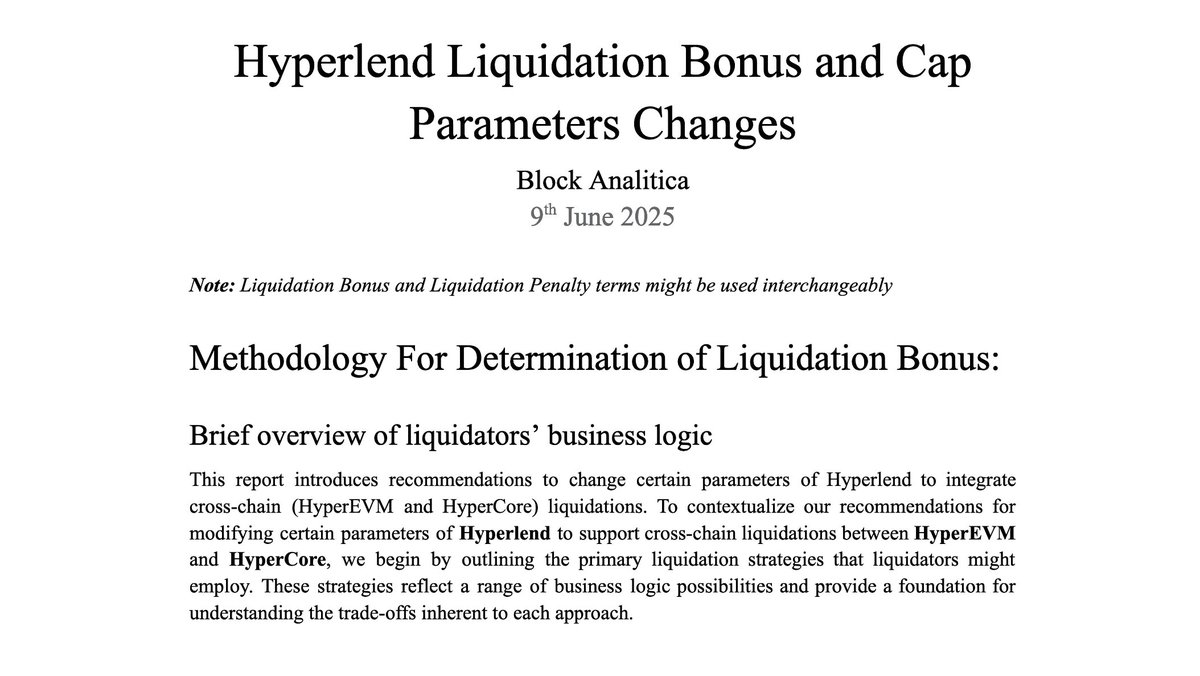
Our risk team (@BlockAnalitica) has authored a deep dive into the new cross-chain liquidation flows, covering the implications for protocol parameters, execution risk, and what it all means for you as a HyperLend user.
The breakdown of everything 🧵
Reproducing DeFi operations in the frontend, documenting the behavior in detail, and then building MCP based on that spec—
this flow makes migrating protocols into MCP clean and efficient.
Mycel’s ATP uses TSS on ICP to manage keys for accounts on other chains.
It enables ownership transfer on ICP, allowing cross-chain value movement—an abstraction of cross-chain swaps without direct asset transfer.
LLMs could eventually generate contract calls on the fly.
But for now, defining clear read/write functions for each DeFi protocol in MCP feels like the more scalable and cost-effective path for LLM-driven DeFi automation.