This guy used Claude to build a Quant Bot and made +$589,139 on Polymarket
25,388 predictions with a 63% win rate in 77 days
That comes out to roughly $7,651 in profit per day and almost 14 trades per hour
With $217K in deposits, he is now up 2.7x, which is about +271.5% ROI
The bot strategy is simple:
It finds markets where the pricing is still off,
gets in before the odds fully catch up,
and repeats the same setup again and again across many entries.
The edge on each trade is small, but scale and repetition turn it into a massive result
Most profitable trades:
$17,839 → $36,318 (+$18,478, +103.58%)
$3,112 → $15,011 (+$11,898, +382.22%)
$10,676 → $22,178 (+$11,502, +107.74%)
What makes it work is not one huge trade. It is the same small advantage, applied fast, applied often, and repeated until the pricing gap is gone
Giving this free for 24 hours.
To get it:
1. Comment 'Prediction'
2. Like and retweet this
3. Follow @Tanju_mim so I can DM you
My Uber driver asked what I do for work.
Software.... Cool. Can you look at something?
He handed me his phone at a red light. Terminal. Claude chat. Green P&L.
+$6,200.
He drives Uber 4 days a week. Makes $1,100. Has a 2-year-old daughter.
Where did you find this?
Your article. The 10,000 wallets one.
He read it 3 months ago. Did not understand half of it. Asked Claude to explain it like he's five.
214 messages. All during breaks between rides. Parked at gas stations. Waiting for pings.
1st thing Claude told him: 87% of wallets lose money. Do not be the 87%.
He installed poly_data. Fed it to Claude. Found 47 wallets with Sharpe above 2.0. Filtered crypto only. Quarter Kelly. $200 starting bankroll. From his tips.
93 messages later Claude helped him build the 20-line brain from the article. Bayesian updates. EV filter at 5%. Fully automated.
Last 45 days:
→ 480 trades
→ 91.3% win rate
→ +$6,200
Best trade, whale convergence on Fed rate cut.
4 wallets entered in 2 minutes.
Entry $0.12. Resolved $1.00. +$1,760.
While dropping off a passenger at JFK.
The passenger tipped him $5. The bot made $1,760.
His wife found the Telegram alerts on his phone.
Thought he was texting another woman.
He showed her the P&L curve.
Can you make me one?
How long until you quit driving?
He looked at me through the rearview mirror.
I'm not stopping. Uber is my cover story.
I wrote the article. He actually opened terminal.
You only need Claude + laptop + 1 hour/day.
Giving This Free for 24 hours. To get it:
1. Comment the word "Trade"
2. Like and Retweet this post
3. Follow me @codewithimanshu (so i can DM you)
Save this post. Deploy the bot this weekend.
Start with $200. Scale on evidence.
I made $22,400 last month copy-trading a bot that simulates BTC 10,000 times before every trade.
Same setup a Hong Kong marketer used to make $360K in 30 days.
I've prepared the exact step-by-step guide to make this Bot.
I could've sold this for $999. Giving it free for 24 hours.
To get it:
1. Comment "Money"
2. Like and Retweet
3. Follow me @shedntcare_ (Only then, i can DM you)
The system:
> Claude = the algorithm's brain
> MiroFish = the simulation engine
> 10,000 cycles run before every single trade
> $5,000-$15,000 profit per position
His wallet hit $366K. Mine hit $22.4K in 30 days copying him.
He's not predicting the market.
He's running 10,000 versions of the future before the market moves.
You're picking trades on vibes.
He's running Monte Carlo simulations while you sleep.
You Must Follow me @shedntcare_ , so i can send you DM.
I'm quitting my job to go full-in on Claude.
Just Asked it to:
Analyze mispriced Polymarket markets for arbitrage opportunities and find wallets using it to copy.
Turned $2K into $12K overnight.
Monitored 1,000+ wallets.
I realized something fast.
There are arbitrage bots I can't beat without code knowledge.
But I can find them. And copy them.
Claude built a monitoring terminal and connected it to a Telegram copytrading bot.
It's not a script. Not even a bot.
It's an AI agent that improves with every wallet it finds.
Fetches wallet behavior. How it trades. Arbitrage patterns. Position sizing. Timing.
70% win rate.
7 wallets copytrading right now from 500+ monitored.
Bot never pauses. Never gambles. Just math and profit.
You only need: Claude + a device + 1 hour per day.
Giving this free for 24 hours.
To get it:
1. Comment "cash"
2. Like and retweet this
3. Follow me @codewithimanshu so I can DM you
An Anthropic engineer paid for my espresso at Sightglass when he saw my screen
I was running my Polymarket bot from the counter. He was next in line. Looked over my shoulder. Stopped scrolling.
"That's not a normal trading app. What's it actually running on"
I told him. Claude Code. Four repos. $25 a month.
He sat down without asking.
"I'm on the agent team. We stress test Claude for exactly this. You're letting it find its own edges"
Not just edges. Wallets.
86 million trades. Every wallet. Every entry. Every exit.
"You're feeding Claude raw wallet data and letting it identify who consistently wins. Then cloning them"
He said it slowly. Like he was writing the threat model in his head.
One prompt. Find every wallet with 100 plus trades and win rate above 70%. Rank by profit. Export top 50.
Claude scanned 14,000 wallets in 4 minutes. Returned 47.
The top 20 made more than the bottom 13,000 combined.
"That's not a stat. That's a hit list"
Exactly.
"And you didn't write the scoring function"
Claude did. I just wired it into an if-statement.
Then I showed him the second repo.
Official Rust CLI. No API key for reads. 500 markets, Claude scores them in minutes.
Gap. Depth. Resolution window.
487 markets become 35 before a dollar moves.
93% killed before I even see them.
A green fill landed on the screen. +$84.
He watched it hit.
"How does it decide to actually enter"
Three agents. Shared wallet. No shared memory. Arbitrage, convergence, whale copy. 2 agree, full size. 1 alone, half. Disagree, no trade.
Consensus filter alone killed 40% of losing trades.
"And the exits?"
The 47 whales never hold to settlement. 91% exit early. 73% of max profit captured. Redeploy immediately.
My bot cuts at 85% of expected move or on a 3x volume spike.
"You built a whale copy bot that exits before the whales"
Yeah.
He put his espresso down.
"How often does it trade"
10 a day on average. Most of them skipped before I look up from my coffee.
My setup:
Claude API - $20/mo
VPS in Germany - $5/mo
poly_data - free
polymarket-cli - free
Polymarket/agents - free
$200 seed. 27 days ago. $14,300 now.
Copytrade here: https://t.co/zDXGamMWw0…
271 trades. 74% win rate. Sharpe 2.47.
I haven't touched it in 27 days.
He stared at the screen for a long time.
"This is literally what our red team simulates. Except you actually shipped it"
He emailed me the next morning.
"Any chance you'd take a call with our policy lead"
I told him the article is the call. Read it twice.
Too late to gatekeep.
You only need Claude + laptop + 1 hour/day.
Giving This Free for 24 hours. To get it:
1. Comment the word 'Claude'
2. Like and Retweet this post
3. Follow me
@ZayvenKnox
What actually is GBrain?
(Y Combinator CEO's personal agent brain)
Every agent memory tool you've seen solves a simple problem: store facts, retrieve facts.
GBrain solves a different one. It gives your agent a knowledge system that wires itself, enriches itself, and compounds while you're not even using it.
Here's what makes it fundamentally different from Mem0, Zep, LangMem, or a CLAUDE.md file.
The standard approach to agent memory is vector-based. Your agent stores memories as embeddings, retrieves them by semantic similarity, and that's the loop. Some tools add a knowledge graph on top.
GBrain flips the model entirely. The source of truth is a folder of markdown files. One page per person, one page per company, one page per concept. Every page follows the same two-part structure:
𝗖𝗼𝗺𝗽𝗶𝗹𝗲𝗱 𝘁𝗿𝘂𝘁𝗵 on top: your current best understanding, rewritten as new evidence arrives
𝗧𝗶𝗺𝗲𝗹𝗶𝗻𝗲 on the bottom: an append-only evidence trail that never gets edited
This is not a vector store with a markdown export. The markdown IS the system of record. You can open it in VS Code, edit it by hand, and 𝗴𝗯𝗿𝗮𝗶𝗻 𝘀𝘆𝗻𝗰 picks up the changes.
Now the part that makes this compound.
Every time a page is written, GBrain extracts entity references and creates typed relationship links: 𝘄𝗼𝗿𝗸𝘀_𝗮𝘁, 𝗶𝗻𝘃𝗲𝘀𝘁𝗲𝗱_𝗶𝗻, 𝗳𝗼𝘂𝗻𝗱𝗲𝗱, 𝗮𝘁𝘁𝗲𝗻𝗱𝗲𝗱, 𝗮𝗱𝘃𝗶𝘀𝗲𝘀. All deterministic, all regex-based, zero LLM calls.
The knowledge graph wires itself on every single write, without spending tokens.
So when you ask "who works at Acme AI?" or "what has Bob invested in this quarter?", the agent walks the graph instead of relying on vector similarity (which struggles with relational queries like these).
Search layers ~20 deterministic techniques in concert: intent classification, multi-query expansion, vector search, keyword search, reciprocal rank fusion, cosine re-scoring, compiled-truth boosting, and backlink ranking. Each catches what the others miss.
But the real unlock is the compounding loop.
GBrain has a 𝘀𝗶𝗴𝗻𝗮𝗹 𝗱𝗲𝘁𝗲𝗰𝘁𝗼𝗿 that fires on every message and captures entities in the background. Person mentioned once? They get a stub page. Three mentions across different sources? Web enrichment kicks in. After a meeting? Full pipeline.
The agent runs a 𝗱𝗿𝗲𝗮𝗺 𝗰𝘆𝗰𝗹𝗲 overnight: scans conversations, enriches missing entities, fixes broken citations, consolidates memory. You wake up and the brain is smarter than when you went to bed.
This is fundamentally different from memory systems that only store what you explicitly tell them to store.
Garry Tan (President and CEO of Y Combinator) built this to run his actual AI agents. It ships with 34 skills, runs on embedded PGLite (no server, ready in 2 seconds), and works as an MCP server for Claude Code, Cursor, and Windsurf.
GBrain: https://t.co/11T8Wp95RK
Claude Code's architecture, mapped.
Calude Code is one of the most powerful agent harnessed out there, it's a lot more than "a CLI that calls claude." the actual system has six layers, and the model is just one node inside the loop.
the diagram breaks down every component:
𝗜𝗻𝗽𝘂𝘁 𝗟𝗮𝘆𝗲𝗿 handles session management, permission gating, and YAML-based trust tiers before anything reaches the model.
𝗞𝗻𝗼𝘄𝗹𝗲𝗱𝗴𝗲 𝗟𝗮𝘆𝗲𝗿 holds the skill registry, context compressor (3-layer, 92% threshold), task graph, and cross-session memory store. this is where harness intelligence lives outside the weights.
𝗘𝘅𝗲𝗰𝘂𝘁𝗶𝗼𝗻 𝗟𝗮𝘆𝗲𝗿 runs tool dispatch through a typed registry with one handler per tool. bash, read, write, grep, glob, revert. streaming runtime handles parallel execution. prompt cache reuses stable prefixes at 10% cost.
𝗜𝗻𝘁𝗲𝗴𝗿𝗮𝘁𝗶𝗼𝗻 𝗟𝗮𝘆𝗲𝗿 connects the MCP runtime to external servers. filesystem, git, custom. tools register inward, memory writes outward to agent_memory. md.
𝗠𝘂𝗹𝘁𝗶-𝗔𝗴𝗲𝗻𝘁 𝗟𝗮𝘆𝗲𝗿 is the most underappreciated piece. subagent spawner, teammate mailboxes over redis pub/sub, FSM protocol (IDLE→REQUEST→WAIT→RESPOND), autonomous board with atomic locks, and worktree isolation with per-task branches and conflict detection on merge.
𝗢𝗯𝘀𝗲𝗿𝘃𝗮𝗯𝗶𝗹𝗶𝘁𝘆 𝗟𝗮𝘆𝗲𝗿 wraps everything. event bus with lifecycle hooks, background executor running daemon threads non-blocking.
the master agent loop sits at the center. perception → action → observation. it's deliberately simple. a "dumb loop" where the model reasons and the harness mediates.
this is the architecture behind what feels like magic when you use claude code. it's not magic. it's harness engineering.
the article below is a deep-dive covering how Anthropic, OpenAI, LangChain, and others build this pattern from the ground up.
As an AI Engineer. Please learn:
- Harness engineering, not just prompt engineering
- Prompt caching vs. semantic caching tradeoffs
- KV cache management at scale
- Speculative decoding vs quantization
- Structured output failures & fallback chains
- Evals (LLM-as-judge + human evals)
- Cost attribution per feature, not just per model
- Agent guardrails & loop budgets
- LLM observability as a first-class discipline
- Model routing & graceful fallback logic
- Knowing when to fine-tune vs. in-context learning
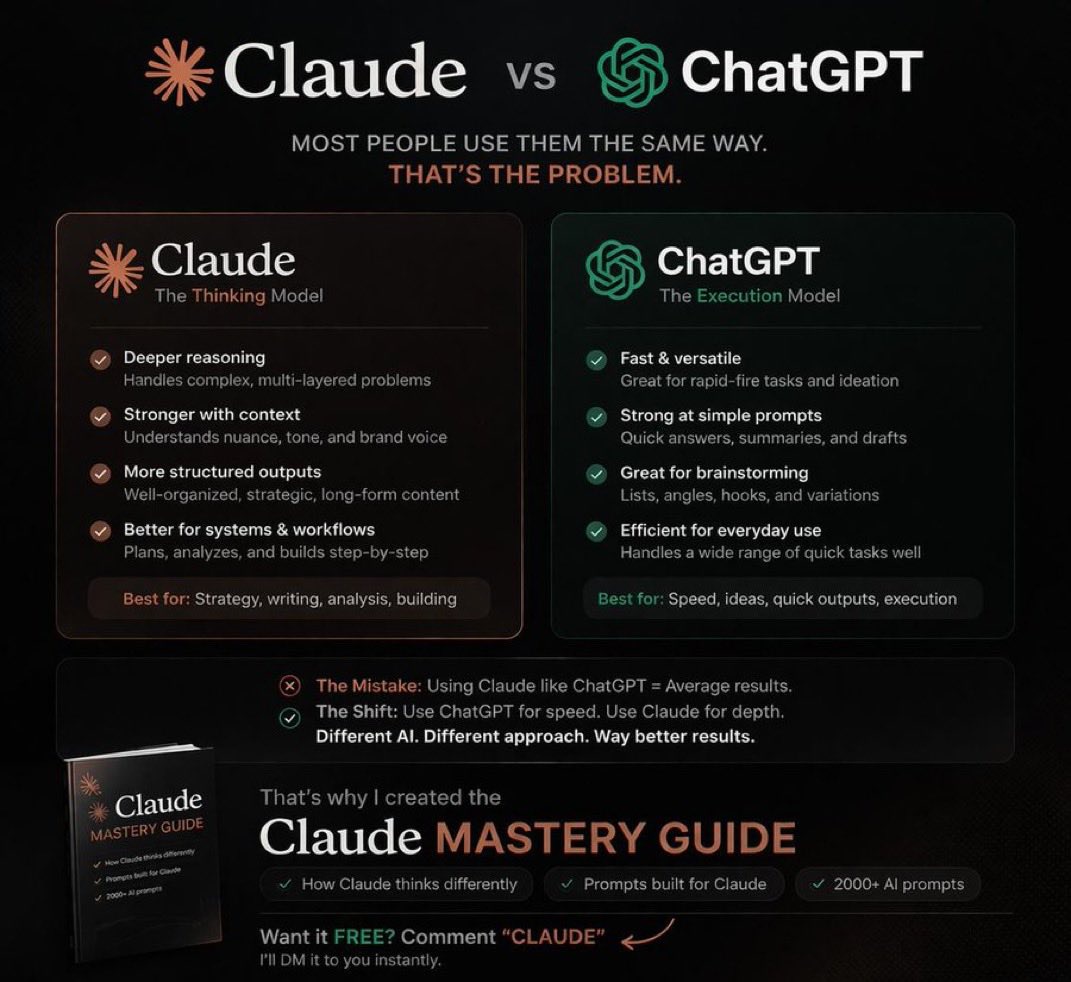
Claude Sonnet 4.6 is the smartest Al right now.
But 90% of people prompt it like ChatGPT.
That's why I made the Claude Mastery Guide:
→ How Claude thinks differently
→ Prompts built for Claude
→ 2000+ Al Prompts
Comment " Claude " and I'll DM it free.
CLAUDE SCANNED GITHUB FOR 24 HOURS AND CAME BACK WITH A POLYMARKET BOT WALLET UP $143,379.
He reverse engineered it overnight, threw $90 at the strategy, and woke up to instant proof it was real.
You only need Claude + laptop + 1 hour/day.
Giving This Free for 24 hours. To get it:
1. Comment the word 'CLAUDE'
2. Like and Retweet this post
3. Follow me
@ZayvenKnox
(so i can DM you)