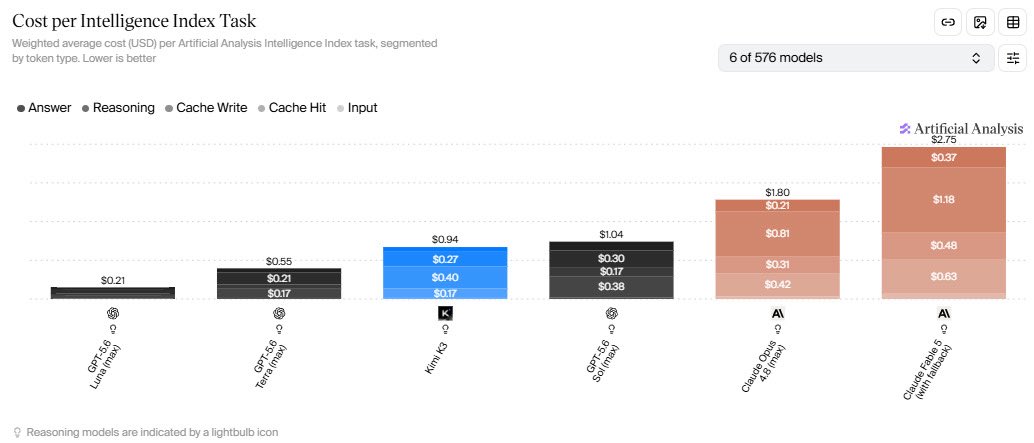
Kimi K3 may be an important inflection point for AI. Potentially negative for Anthropic and OpenAI while being net positive for essentially every other company in the world. I mean that very literally. Although the real “Sputnik moment” would be an open-source frontier model that was also token efficient unlike Kimi K3 which is 50-70% more expensive to run than GPT 5.6 per Artificial Analysis.
Rationale:
A world where there are only 2-3 dominant frontier labs with 90% inference margins is net negative for every other layer while being awesome for those 2-3 labs. Those labs would become monopsonies for power, data centers, semiconductors and hyperscalers and would obviously vertically integrate over time into all those layers while also completely subsuming the application/software layers.
Anything that lowers margins and increases competition at the model layer is good for every other AI layer: power, semiconductors, hyperscalers, neoclouds and yes even software.
This is why Jensen is so supportive of open-source. An open-source model requires the *exact* same amount of compute to run as a closed frontier model of similar size and architecture. Kimi K3 is roughly the same price as GPT 5.6 Terra on a per token basis, which actually suggests that it is less computationally efficient as I am sure that GPT 5.6 is priced to a higher margin than K3. And given that K3 is a token wastrel, i.e. token inefficient, it is significantly more expensive per task than GPT 5.6 and Grok 4.5, which are much more token efficient. Cost per token and token efficiency (i.e. intelligence density per token) are the drivers of intelligence per unit of cost. The winning AI companies will be those that offer the most intelligence per $ over time.
Lower margin % at the model layer = more margin $ at every part of the infrastructure layer and is a godsend for software. This can happen either through open-source models like K3 at the frontier *or* having a vertically integrated model company like Meta, SpaceX or Google at the frontier. Both outcomes result in a lower margin % at the model layer as vertically integrated model companies don’t really care where the margin $ come from. This is why it was so painful for OpenAI and Anthropic when Google was right there with them from a model competitiveness perspective and why Grok 4.5 and Muse 1.1 were just as important as Kimi K3.
The reason Kimi K3 is only *potentially* negative for Anthropic and OpenAI is 1) the @ericvishria point that the Claude and ChatGPT products and harnesses may be more important than their models today and 2) the hypothesis that they have much more advanced model checkpoints internally that are already being used for RSI. In the latter scenario, reaching RSI even a few months ahead of other labs might be enough to cement a permanent lead.
Time will tell on both points. And likely fairly quickly.
Caveat would be that since Kimi K3 is not token efficient and thereby actually more expensive than ChatGPT 5.6, we may need to see a more token efficient open-source model at the frontier or see Grok 5/Composer 4/Muse 2 at multiple points on the Pareto frontier for this potential risk to Anthropic and OpenAI to play out. And I am sure they will both vertically integrate as quickly as possible while continuing the product/harness strength they have shown over the last 8 months.
Using @WisprFlow to vibe code with @claudeai feels like Ved Vyasa dictating the Mahabharata while Lord Ganesha writes it flawlessly in one uninterrupted flow.
Why are we pretending that the pinnacle of AI interaction is typing questions and getting text back?
We are pattern-matching, visual-processing, spatial-reasoning creatures who happened to develop language as a useful hack. We think in relationships and patterns, yet currently we're forced to translate everything into text requests and then back into understanding.
Read more on my latest blog: Re-imagining AI Interfaces
Bill breaks down Medicine 3.0 in 4 main points
- Prevention over Treatment
- Patient as a unique individual
- Acceptance of risk
- Importance of healthspan
An Interesting graph depicting implications of medicine present in the book ‘Outlive’ by @billgifford. Healthspan here is defined as the quality of your life.
Awaited 5 days to get hands on the health supplements in my town, Shahdol. It was worth it at the end, as my mom appreciated the protein smoothie.
Tried jotting the experience here -https://t.co/mvdtotC6qm
Spent morning roaming in my hometown Shahdol for protein & creatine only to come back empty handed! From top general stores to biggest pharmacies, none had it.
What they say:
- "Natural protein khao, ye sab nahi hai yahan"
- "Milta bhi hoga toh nakli milega, online mangwa do"
Low demand keeps MSMEs from stocking these products, which in turn means no marketing. That lack of presence keeps awareness low, hence no demand generation. A chicken and egg scenario, who moves first to break it? How do we crack awareness & distribution here?
Bought a ₹15 water bottle at Raipur Railway Station, Chhattisgarh, only to hear, ‘UPI kya kar rahe ho bhaiya? ₹15 chillar nahi hai aapke paas?’
Completely opposite scenes from Bangalore, where an auto driver upon seeing cash responds with ‘Chillar nahi hai mere paas UPI karo!’
Definetly! Increase in demand would promote supply to catch up. Boosting agricultural efficiency, improving gig worker security, and expanding the Fund of Funds for startups and MSME credit guarantees will help boosting supply. A balanced approach to growth for a slowed economy.
"Medical tourism & ‘Heal in India’ initiative will be promoted in collaboration with private sector, alongside eased visa norms" - FM
India offers treatments at approx 50% to 70% lower cost compared to developed nations, making us a top choice for medical tourism.
#Budget2025
Great news that the FM @nsitharaman has expanded the Fund of Funds by another 10,000 crores! This has been such a force multiplier for the domestic venture capital ecosystem & will continue to be so. Domestic capital needs to be the bedrock for 🇮🇳 startups!
#BudgetSession2025