🚨 Bitcoin might look like it’s bottoming… but the data says otherwise.
RSI is flashing oversold.
sentiment is shifting.
people are calling the bottom.
but liquidity hasn’t confirmed it.
stablecoin flows are slowing.
dominance isn’t at capitulation.
real pain levels? not hit yet.
the same $48K–$50K zone keeps showing up across multiple metrics.
not a prediction. a probability setup.
most people are watching price.
smart money is watching liquidity.
you’re early… or you’re being baited.
then read the full breakdown below 👇
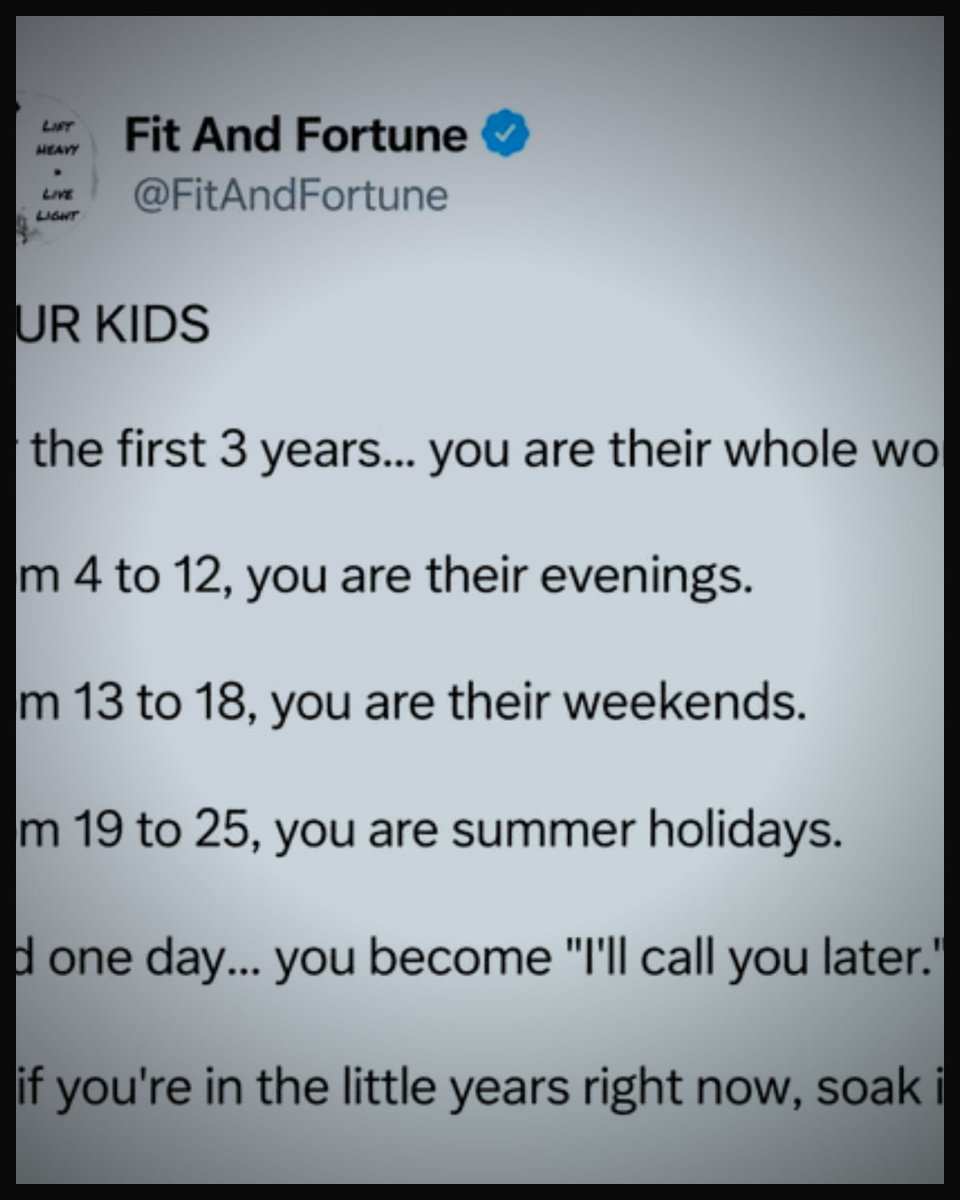
Raising teenagers is one of the strangest experiences in life.
For years, your whole job is to help them become independent.
You teach them how to think, how to choose, how to handle hard things, how to get back up, how to become their own person.
Then one day… they actually do it.
And somehow you’re still surprised.
I’m 48, with three teenage boys and a younger daughter, and lately I’ve been getting a front-row seat to how fast this season moves.
Not long ago, I was driving them everywhere.
Practices. School. Friends’ houses. Last-minute errands. Conversations in the car that felt ordinary at the time but now feel priceless.
They needed answers. They needed rides. They needed help making sense of the world.
And yes, there were plenty of moments when I wanted five minutes of quiet.
Now they drive.
They make plans. They have friends, schedules, opinions, goals, and a world that doesn’t always include me.
Which is exactly what I hoped for.
And also exactly what makes it hard.
As a dad, you want your kids to grow up strong. You want them to be capable, confident, independent, and excited about the life in front of them.
But there’s still a part of you that wants to press pause.
I’ve spent a lot of years building businesses, chasing opportunities, working hard, and trying to create a better life for my family.
I’m proud of that.
But watching your kids grow up has a way of recalibrating what wealth really means.
You can make more money.
You can build another company.
You can find another deal, another goal, another mountain to climb.
But you don’t get another Tuesday night when they’re 8.
You don’t get another ride home when they’re 12.
You don’t get another ordinary day with them at 16.
I know there are incredible chapters ahead. I’m excited to know them as adults.
I’m proud of who they’re becoming.
I’m just not sure I was ready for how quickly they’d get there.
Marriage is basically having a permanent scheduling department that has no idea it exists.
Someone asks you to help them move on Saturday?
“Let me check with Mandy.”
An old friend invites you to a three-hour seminar about a “once-in-a-lifetime opportunity”?
“Yeah, I should probably run that by my wife.”
Your buddy wants you to help pour concrete in 95-degree heat?
“Man, I’d love to, but I need to see what we’ve got going on.”
Meanwhile, Mandy is peacefully living her life, completely unaware she’s been managing my fake weekend commitments for two decades.
And somehow, it always works.
A few days later, you just say, “Unfortunately, we’ve already got plans.”
Nobody asks what plans. Nobody audits the calendar. They simply accept that the wife has issued a ruling, and the matter is closed.
The only flaw in this otherwise perfect system?
If they know Mandy well enough to ask her directly, my entire defense strategy collapses in real time. 😂
Here’s the kind of good-news headline we should talk about more: humans helped bring a species back from the brink.
For decades, the giant panda was one of the most famous symbols of endangered wildlife.
Today, it is officially listed as Vulnerable instead of Endangered.
That was not luck.
China created dozens of panda reserves. Forests were protected. Fragmented habitats were reconnected. Anti-poaching efforts got stronger. Captive breeding became more effective. Scientists, conservationists, and local communities kept showing up year after year.
And slowly, the numbers moved.
There are now about 1,900 giant pandas in the wild, with hundreds more in captivity.
That is not just a panda story. It is a proof-of-concept story.
No, the work is not finished. Pandas are still vulnerable. Their habitat remains fragmented. Their reliance on bamboo makes them especially sensitive to environmental change. Climate change could make everything harder.
But that is why this matters.
We hear so many stories about collapse, extinction, and loss that it can start to feel inevitable.
It is not always inevitable.
With time, funding, science, enforcement, cooperation, and stubborn people who refuse to quit, decline can be slowed. Sometimes it can even be reversed.
Not instantly.
Not cheaply.
Not with slogans.
But with sustained action.
That is worth celebrating.
She finally paid off her house in 2024.
Bought in 1994 for $78,000.
Thirty years of payments: $593 a month.
Now she's 74.
Her Social Security check is $1,910 a month — $22,920 a year.
Then a nearby home sold for $615,000.
The county reassessed hers accordingly.
New property tax bill: $8,100 a year.
That's $675 a month.
She used to pay $593 to buy the house.
Now she pays $675 to keep it.
The mortgage disappeared.
The tax bill didn't.
The deed says owner.
The county treats her like a tenant.
We have officially entered the era where stores are teaching second-grade rounding… incorrectly.
And honestly, that’s the funny part.
Nobody is spiraling over a penny.
What gets me is the journey: someone wrote the sign, someone approved it, someone printed it, laminated it, placed it carefully in a little wooden holder…
And not one person paused to say:
“Wait. That is not how rounding works.”
If the cents end in 1 or 2, you round down to the nearest nickel.
If they end in 3 or 4, you round up.
Same logic on the other side.
This sign basically says: round everything up.
The penny may be leaving circulation.
Apparently arithmetic packed its bags too.
Whoever let a Honda Civic with 12,900 miles go for $5,000 deserves more than a thank-you. They deserve a holiday card for life.
Deals like that feel almost mythical now.
We have people signing up for $60,000 trucks, stretching loans to 84 months, and acting like an $800 or $900 payment is just part of adulthood.
Then this guy shows up with a low-mileage, dependable Honda for the price of a few months of someone else’s payment.
If the car is mechanically sound, he may have 150,000+ miles of inexpensive transportation ahead of him.
The real win is not just the car. It is the absence of the payment.
No giant monthly obligation. No raise immediately swallowed by a newer model. No pretending that financial stress is worth heated seats and a bigger screen.
I like nice cars. Plenty of people do. There is nothing wrong with buying one when it truly fits your plan.
But after years of watching money habits up close, I can tell you this: constantly upgrading vehicles is one of the quietest ways people sabotage wealth.
An $800 payment is $9,600 a year before insurance, fuel, tires, repairs, and registration.
This guy bought the whole car for barely more than half a year of that.
If he drives it for a decade, this could be one of the best financial decisions he ever makes.
Sometimes the biggest flex is a reliable, paid-off car and cash still in your account.
Working a corporate job in your 50s is comedy with a badge swipe.
You’ve built 25+ years of judgment, scars, and results…yet still need approval to disappear on a random Tuesday.
Leadership celebrates your 3% “merit increase” like a windfall while eggs, insurance, and everything else quietly outrun it.
You skip lunch to keep the machine moving, then get added to a mandatory meeting on “wellness.”
You’re doing your role, half of someone else’s, and training the new hire—only to receive a glowing “MEETS EXPECTATIONS.”
You’ve got 250 hours of PTO parked like unused capital, but somehow every date is inconvenient.
At 30, you chased titles.
At 50, wealth is shutting the laptop at 5:00—and ignoring the 4:57 invite.
Working full-time and still having to do mental gymnastics in the grocery aisle is not exactly the dream we were promised.
That’s the part people keep missing.
Most workers aren’t demanding penthouses, luxury cars, designer clothes, or five-star dinners.
They’re trying to cover rent, fill the fridge, pay insurance, absorb an unexpected bill, and still breathe a little before the next paycheck hits.
Of course budgeting matters.
Of course choices matter.
But acting like every struggling worker just needs a better spreadsheet ignores how expensive basic survival has become.
A paycheck should create breathing room.
Not just buy another two weeks of barely hanging on.
Bitcoin getting capped at $84K while Korean tech gets smoked is the tell.
This is not “BTC failed resistance” in isolation.
KOSPI weakness, especially in semiconductors, is a real-time global risk gauge. When the market starts dumping the AI and chip leaders, liquidity is not expanding. It is hiding.
That matters because Bitcoin still trades like the purest liquidity asset on the screen.
If Korean tech keeps unwinding, Asian risk appetite fades, dollar demand can firm, and the bid under crypto becomes thinner. Not because Bitcoin’s thesis broke, but because the marginal buyer suddenly has less balance sheet and more fear.
$84K is the level everyone sees.
The Korea rout is the signal most will ignore.
Others are trying to sell you something or farm your replies. I’m here for unfiltered market alpha. If you still don’t follow, that’s your edge leaking away 🧭
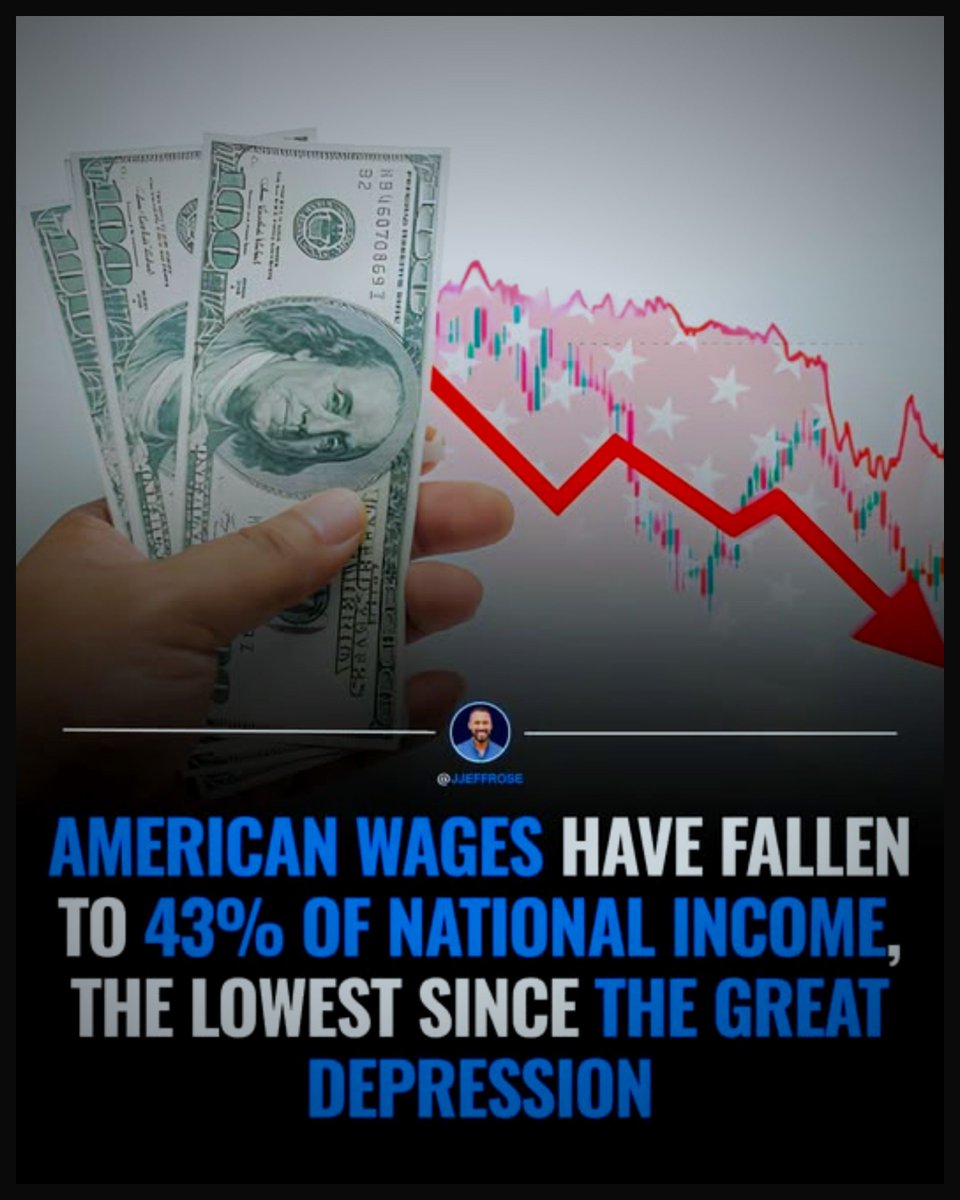
Workers are getting one of the smallest slices of the U.S. economy ever recorded.
Wages and salaries were about 43% of gross domestic income in the first quarter.
That is near the lowest level since the government began tracking the data in 1929.
From the 1940s through the 1960s, that number never fell below 48%.
So where is the money going?
More of the economy’s income is flowing to corporate profits, dividends, interest, and rent instead of paychecks.
Yes, the headline number does not include benefits like health insurance, retirement contributions, and other employer-paid compensation.
Include those, and labor’s share is closer to 54%.
But even that is the lowest level since 1947.
Productivity tells the same story.
Since 1979, American workers have nearly doubled their output per hour.
Pay has not risen anywhere close to that much.
Economists can argue about the exact size of the gap, the best inflation measure, or the right way to count compensation.
But almost nobody argues the gap does not exist.
Even the New York Fed has said this shift looks structural, not something that magically reverses when the economy gets better.
Automation matters.
Global competition matters.
Weak unions matter.
Winner-take-most technology companies matter.
A system where capital scales faster than labor matters.
You can debate policy all day.
But here is the personal finance takeaway:
If more income is flowing to owners, you need to become an owner.
Own index funds so you participate in corporate profits.
Take every dollar of your 401(k) match because it is free ownership.
Consider real estate or a small business if the risk and work fit your life.
Your paycheck is essential.
But a paycheck alone leaves you depending on the part of the economy that has been losing ground for decades.
Keep earning.
Then use part of every paycheck to buy assets.
That is how you move from only working in the economy to owning a piece of it.
My definition of a rich life is simple:
Being 75 years old, sitting on the back patio with my wife.
Grandkids running around everywhere.
Kids who still want to come home, stay awhile, and see us.
Knowing I didn’t spend my best years measuring our life against someone else’s.
Knowing I lived, learned, owned the hard mistakes, and did the best I could.
At what income level does flying first class go from “complete waste of money” to “reasonable financial decision”?
Is there a number where the comfort, time, and reduced stress actually justify the price?
A guy saw a case of soda selling for $8.50 and remembered paying way less not that long ago.
So he checked his Walmart order history.
January 2020: a 30-item grocery run cost $68.90.
Same exact 30 items today: $158.30.
That’s an $89.40 jump.
Nearly 130% more for the same cart.
Sure, one Walmart receipt isn’t the whole economy. But this is what people actually live.
Charts can say one thing. The checkout screen says another.
A 50-inch plasma in 2000 could set you back $18,000.
Now, a sharper, smarter 50-inch 4K TV costs about $250.
For 25 years, consumer tech got faster, better, and dramatically cheaper while rent, medical bills, college, insurance, and food marched the other way.
We mastered affordable gadgets.
Affordable living somehow remains unsolved.
A $170,000 salary sounds like financial freedom until childcare starts swallowing a massive chunk of the take-home pay.
That’s what income headlines miss.
On paper, $170K feels like you’ve made it.
Then come taxes, daycare, health insurance, groceries, rent or the mortgage, cars, gas, and every other normal expense.
Suddenly, that impressive salary doesn’t feel so impressive.
Leaving work is not automatically the answer. Retirement savings, benefits, career momentum, and future earning power all matter.
But when childcare gets expensive enough, families stop asking what the second income earns.
They ask what it actually nets.
I swear something shifted after 2020, and we all feel it even if we can’t name it.
Not just COVID. Not just lockdowns. Something deeper.
Time moves faster. Money disappears quicker. People feel more distant. Every day feels louder, tighter, more exhausting.
The world reopened, but the old ease never returned.
Life before 2020 felt slower, lighter, more human.