the conventional view is that datacenters require reliability
but if your workload tolerated 95% uptime? 90%? you could move workloads between sites if the dc drops and take advantage of underutilized (cheaper) capacity
So long as the frontier labs charge premiums on tokens, they can always outbid startups for compute - for now, NVIDIA's goodwill keeps the ecosystem running
I interviewed @neilmovva for @substratemag on latency-insensitive inference, alternative chips, and why massive datacenters face diseconomies of scale.
"We've always predicted that async inference is going to eat the world. That could easily be 95% or more of inference demand."
Neil's been at the frontier of inference for years, from NVIDIA to co-founding @sailresearchco. I learned a lot from our conversation - you can listen below.
On modular datacenters:
NVIDIA has been piloting modular (5-20mw) datacenters, and SemiAnalysis predicts they'll make up 31% of capacity by 2028.
A big reason why is lead time. 50mw-100mw datacenter lead times are 12-24 months. For <1mw datacenters, 16 weeks
I interviewed @neilmovva for @substratemag on latency-insensitive inference, alternative chips, and why massive datacenters face diseconomies of scale.
"We've always predicted that async inference is going to eat the world. That could easily be 95% or more of inference demand."
Neil's been at the frontier of inference for years, from NVIDIA to co-founding @sailresearchco. I learned a lot from our conversation - you can listen below.
"There's no stranded compute for us anymore."
Most inference providers avoid stranded capacity. Its reputation for unreliability is well-earned. But if you drop latency requirements for background workloads, you'll unlock pools of compute no one else has at prices no one can beat.
Interactivity is expensive. Throughput is cheap.
@cattttang spoke with Sail Research co-founder Neil Movva on latency-insensitive inference, alternative chips, and <1MW datacenters.
Full conversation below.
I interviewed @neilmovva for @substratemag on latency-insensitive inference, alternative chips, and why massive datacenters face diseconomies of scale.
"We've always predicted that async inference is going to eat the world. That could easily be 95% or more of inference demand."
Neil's been at the frontier of inference for years, from NVIDIA to co-founding @sailresearchco. I learned a lot from our conversation - you can listen below.
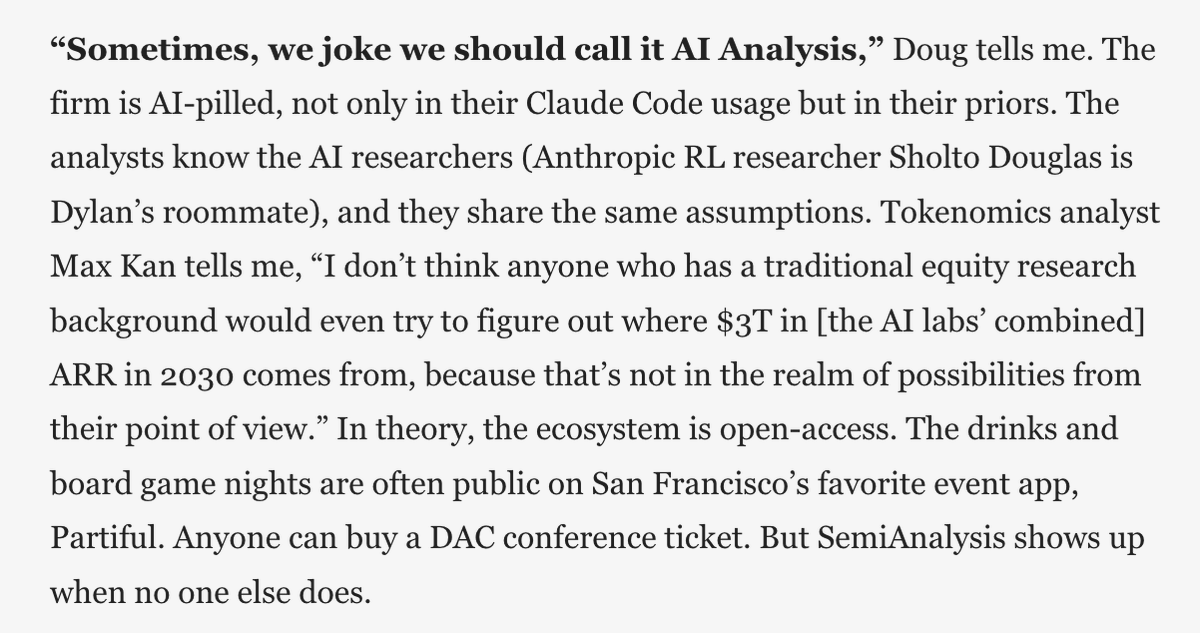
@SemiAnalysis_ has be AI-pilled to have the right priors
A few years ago, no one thought demand would be able to hit today's numbers
In 2023, while modeling datacenter builds, one team member said, "There was a thought of 'Did we mess anything up on the numbers?'....I asked the team, 'How confident are you in these numbers?' They were pretty damn confident, so I just worked on that assumption."
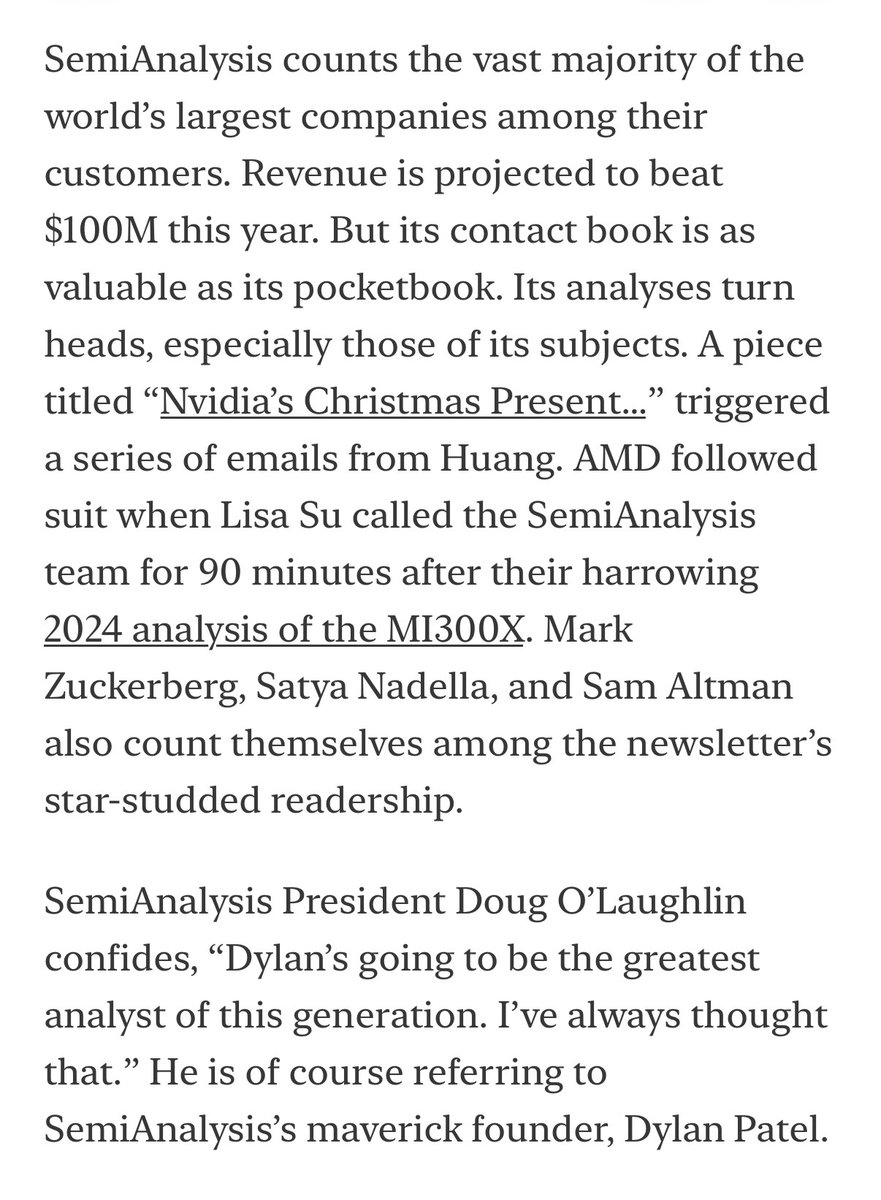
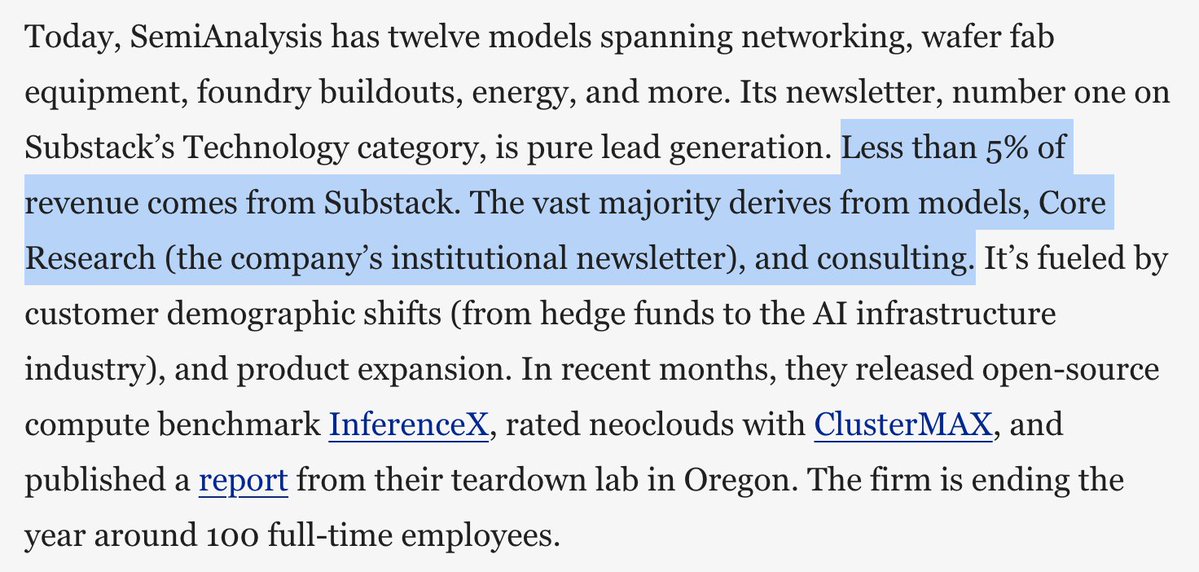
@SemiAnalysis_ rose to fame from its Substack, but the newsletter only makes up <5% of revenue - their product expansion into models, institutional research, benchmarks, etc. has been massive
@SemiAnalysis_'s early bet on predicting NVIDIA's revenue via TSMC CoWoS output and earnings calls from tool companies kickstarted their model program
The accelerator model is one of the most popular today
In just a few years, @SemiAnalysis_ has risen to the forefront of AI infrastructure information, with their work referenced by some of of the biggest players in semiconductors.
The prediction: "@dylan522p's going to be the greatest analyst of this generation."
I sat down with @dylan522p and spoke with over a dozen people about his information machine.
"I don't think anyone who has a traditional equity research background would even try to figure out where $3T in [the AI labs' combined] ARR comes from."
Slack private messaging limits, finding CoWoS volume, and the industry they're looking at next - I wrote about SemiAnalysis here: https://t.co/0FVDIJNaGe
Welcome to Substrate Magazine. Substrate covers frontier technology, from RL algorithms to DRAM supply chain.
@SemiAnalysis_ is the leading information firm in the largest infrastructure buildout in history.
We're excited to profile @dylan522p for our first piece.
I sat down with @dylan522p and spoke with over a dozen people about his information machine.
"I don't think anyone who has a traditional equity research background would even try to figure out where $3T in [the AI labs' combined] ARR comes from."
Slack private messaging limits, finding CoWoS volume, and the industry they're looking at next - I wrote about SemiAnalysis here: https://t.co/0FVDIJNaGe