If you loved #ThePolygamist check out our show #BloodLegacy on @NetflixSA.
Yes, I am shamelessly piggybacking off @SueNyathi's success 😆😆😆😆. Luckily, she knows what I'm like and loves me anyway...
Other shows feel free to join in!!
(Also, read the book, guys!)
[ON AIR] GETTING CANDID WITH 😊
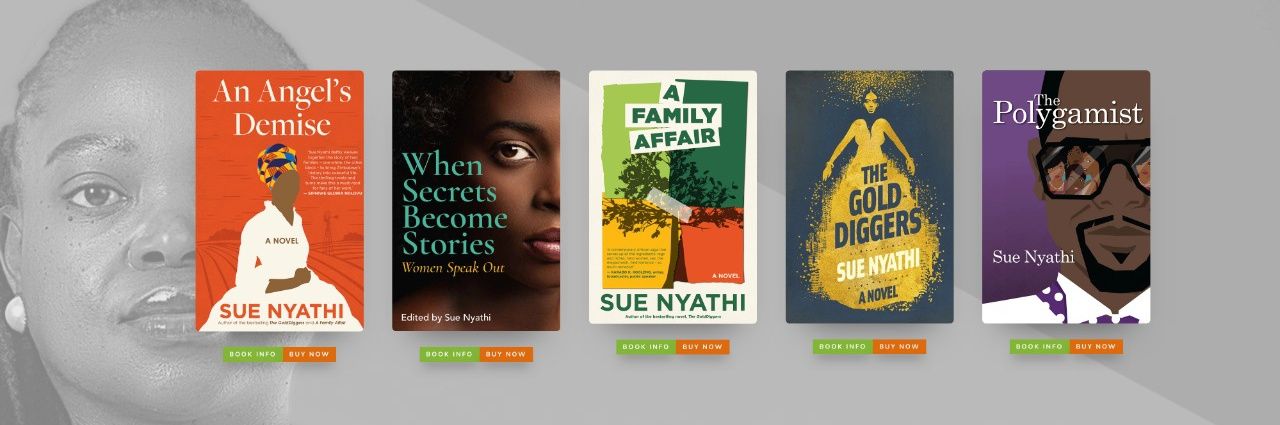
Sue Nyathi and the Global Success of The Polygamist on Netflix
@TshegoMoagi_ is speaking to Sue Nyathi, Novelist, screenwriter and creative.
#POWERWeekendBreakfast
Receiving a shout out from the massive platform, @unwinetashak on her latest episode is an incredible compliment. Thank you Tasha K for the amazing shout out about #ThePolygamist - a South African @netflixsa @stainedglasstv1 supernovela which is adapted from the 2012 novel by @suenyathi. Your mention helps to amplify this story to the world.
Playing “Jonasi” was an honour.
Thank you also to the Winos for watching. We appreciate the love.
#unwinewithtashak #tashak #winos
Zimbabwean-born author Sukoluhle "Sue" Nyathi is living a dream after a South African super-novella, The Polygamist, produced by Gugu Zuma-Ncube
is dominating the screens locally and elsewhere.
The Polygamist is based on the explosive 2012 debut novel by Nyathi who studied finance and investment at National University of Science & Technology in Bulawayo, Zimbabwe's second-largest city.
It was produced by Zuma-Ncube, a South African producer, actress and daughter of former president Jacob Zuma and his ex-wife Nkosazana Dlamini-Zuma, a retired long-serving minister.
Zuma-Ncube is daughter-in-law to Zimbabwean politician Welshman Ncube, a professor of law. She is married to Wesley Bongani Ncube.
The Polygamist was directed by prominent Nigerian-born South African actor and writer best known for his role as Khaya Motene in the SABC 1 soapie Generations.
Originally self-published in 2012 after being rejected by multiple publishers, the book became a massive cultural phenomenon following its June 2026 global adaptation into a 22-episode Netflix supernovela.
The explosive story explores the deep complexities, secrets, and emotional wreckage of undercover polygamy in modern society.
African societies have a long history of polygamy which still exists, although it is now mainly underground.
Polygamy, specifically polygyny, where one man has multiple wives, is practiced by roughly 2% of the global population.
It is highly localised, with the highest concentration occurring in the "polygamy belt" of West and Central Africa, alongside select parts of the Middle East and South Asia.
It is also prevalent in Southern Africa, where Eswatini King Mswati III is the most prominent and leading polygamist with 16 wives, although some of them have died, quit or were divorced.
According to biblical and historical accounts, King Solomon of ancient Israel had 700 wives and 300 concubines.
The second Shah of Qajar Iran (1797–1834) is documented to have had more than 1 000 spouses.
A controversial Islamic cleric from Bida, Nigeria, gained international attention in 2008 for having 86 wives.
By the time of his passing in 2017, he reportedly had around 130 wives and 203 children.
Within days of its release, the hit drama, The Polygamist, soared to the No.3 spot on Netflix worldwide, holding the No. 1 position in South Africa, Nigeria, Kenya, and several other countries across Africa, Europe, and the Caribbean.
Premiered on June 12, 2026, the series explores themes of wealth, deception, and family dynamics, sparking viral debates across the continent and internationally.
The dramatic film follows a wealthy businessman named Jonas Gomora (played by S'dumo Mtshali) and his public image as a family man when he was living as a closet polygamist.
When he dies, Gomora's carefully hidden life of polygamy unravels, revealing a web of secret marriages, mistresses, and infidelity.
The drama — which features other prominent stars like Gugu Gumede— centres on his social media influencer wife uncovering the deception.
It is trending because the show has viewers and critics passionately debating the blurred lines between traditional polygamy and mere infidelity.
It has sparked huge debate on polygamy, infidelity, patriarchy, domestic violence and absent fathers.
Traditional polygamy requires consent and transparency, whereas the show's protagonist normalises deception and infidelity as part of his complicated life.
The film has also caused a spike in reading the original source material - the book - across South Africa and Zimbabwe, among other countries.
The Polygamist has South Africans from all walks of life talking and debating in animated and emotional ways.
In this Newzroom Afrika interview,
Arabile Gumede speaks to Nyathi, and Zuma-Ncube, the women who made it happen.
South African 🇿🇦 drama series The Polygamist has reached number 1 on Netflix in 16 countries since its release on June 12.
It is among Netflix’s most-watched titles worldwide.
It is currently top ranked in South Africa, Nigeria, Kenya, Jamaica, Hong Kong, Hungary, Bahamas, Saint Vincent and the Grenadines, Botswana, Guyana, Zimbabwe, Mauritius, Belize, Trinidad and Tobago, Panama, Italy.
Its success reflects the growing global reach of African storytelling on streaming platforms.




![Powerfm987's tweet photo. [ON AIR] GETTING CANDID WITH 😊
Sue Nyathi and the Global Success of The Polygamist on Netflix
@TshegoMoagi_ is speaking to Sue Nyathi, Novelist, screenwriter and creative.
#POWERWeekendBreakfast https://t.co/4OUHfgY1bq](https://pbs.twimg.com/media/HLPYBm3XMAA7ltl.jpg)


