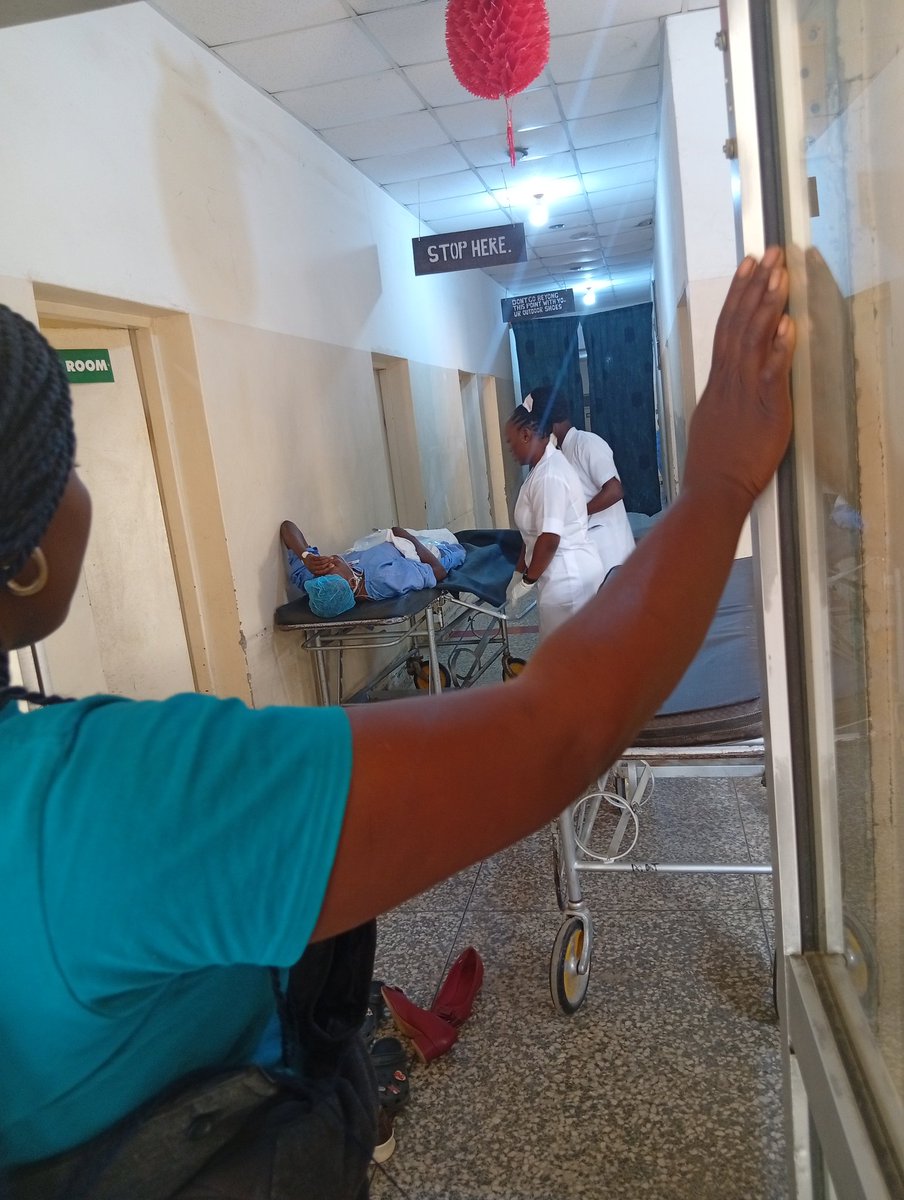
We started joking he must be a robot because nothing ever stressed him. Until last week when he didn’t show up at all.
Turns out his own mother had been admitted at a local hospital the night before. He had spent the whole night sleeping on the hospital floor so he could be there when she woke up.
When he finally came back two days later, the first thing he said was “Sorry for the delay, the food will be on me today.” We all felt like trash.
Yeah, that's my mom lying down there after a successful surgery at the Plateau State Specialist Hospital and that's my sister by the door and I was behind her waiting to receive my Mom from the nurses.
My Mom is diabetic and lost her first leg (amputated) in 2023, and yesterday,
MY FRIEND IS STILL PAYING FOR GMAIL STORAGE.
I told him to do this before.
He went from 14.9/15 GB to 6 GB in a single afternoon.
Hope this helps you ↓
2/
The Inverted Pyramid
What is happening in contemporary Spanish healthcare is a phenomenon worthy of anthropological study: the pyramid of authority has been inverted while the pyramid of responsibility remains intact.
Doctors are required to answer to the judge, to the professional college, to hospital management, to the patient, and to society for every clinical decision. When something goes wrong — and in medicine, things go wrong with a measured and inevitable statistical frequency — the doctor stands alone facing the disciplinary file, alone facing the lawsuit, alone facing the newspaper headline.
Yet, that same professional has been systematically stripped of the corresponding authority. A nurse questions an order in a prosecutorial tone. An orderly decides that a transfer can wait and walks away. A technician refuses to take an X-ray because “the indication is not clear.” And the doctor, who has just weighed fifteen differential diagnoses, must justify themselves to someone who lacks the training to understand the complexity of what is being decided.
The most egregious example comes from the administrative level. The manager who prohibits the use of a certain implant because there is a cheaper one, without understanding that the cheaper one has a failure rate three times higher. The protocol that limits monthly MRIs, as if pathology should adapt to the budget. It happened with shoulder arthroscopy in its early days, banned because “the instruments and implants were very expensive”: the decision on which surgical technique to use was left in the hands of someone who could not distinguish an arthroscope from an otoscope.
The message is devastating: your clinical judgment is subordinate to my economic judgment. Your knowledge is worth less than my Excel spreadsheet.
And there is the degradation of the medical signature. Everything is signed: reports, requests, reports, consents, invoices. This leads to a loss of value in the signature; it banalizes it. But it is a selective banalization: when the signature implies responsibility, it is demanded rigorously; when it should imply authority, it is ignored. The doctor signs a surgical indication and the manager postpones it. Signs a material request and the administrator rejects it. The signature serves to condemn you, not to make them obey you.
The pattern is invariable: the doctor signs, answers, bears the consequences. But does not decide, does not command, does not have the final word in.
Next installment: “The Perverse Framework”
Subscribe to continue reading
(Original source: https://t.co/ZTUKs0aGaA)
I translated this into English for everyone to read. This is written by an orthopedic surgeon colleague in Spain, but I know my American colleagues will appreciate the text an similarities to challenges we face here
1/
The Asymmetry in Medicine in Spain: Responsibility Without Authority (I)
Opinion
Francisco J. Guitián Lema
The Asymmetry in Medicine in Spain: Responsibility Without Authority (I)
“There is irrefutable empirical proof of this asymmetry: the doctor can replace anyone; no one can replace the doctor,” states Francisco J. Guitián Lema, a Vigo-based traumatologist specializing in orthopedic surgery
There is a truth so elementary that it feels uncomfortable to state it: a hospital exists solely and exclusively to cure the sick. It is not there to provide jobs or to justify organizational charts. Nor to feed bureaucracies or to experiment with organizational theories. It exists so that a sick human being leaves it less sick or, at the very least, having received the best possible treatment.
From this premise follows a logical consequence that the Spanish healthcare system seems determined to ignore: in that healing process, there are only two absolutely indispensable figures. The patient, who is the reason for the entire structure’s existence, and the doctor, who possesses the knowledge to guide that process. Everything else — and this is not disdain, but taxonomy — is support structure. Necessary, valuable, often heroic, but auxiliary.
The doctor is the only professional capable of performing the core act that justifies the hospital’s existence: diagnosing the disease and establishing the treatment. Without a diagnosis, there is no possible direction. Without a therapeutic indication, there is no meaningful action. An orderly transports the patient, but it is the doctor who determines where and why. A nurse administers medication, but it is the doctor who decides which, how much, and when. A technician performs a test, but it is the doctor who orders it and interprets its result.
This functional hierarchy is not a social convention or an inherited privilege: it is a direct consequence of training. Six years of medical school plus four or five years of MIR specialization produce a professional capable of integrating knowledge of anatomy, physiology, pathology, pharmacology, and a thousand other disciplines into a diagnostic synthesis that no other healthcare professional is trained to perform.
There is irrefutable empirical proof of this asymmetry: interchangeability. A doctor can, in case of need, perform the functions of any other hospital professional. They can push a stretcher, insert an IV line, draw blood, take vital signs — in Germany, doctors routinely perform these functions. The reverse is not true. An orderly cannot diagnose pneumonia. A nurse cannot order a surgical intervention. The doctor can replace anyone; no one can replace the doctor.
Recognizing this reality does not imply disdain toward anyone. Nursing care is essential. The orderly’s work ensures that hospital flow does not stop. Everyone deserves respect and fair compensation.
But respect for personal dignity cannot be confused with functional equivalence. In an operating room, the surgeon is not worth more as a human being than the assistant; but their function is irreplaceable in a way that the assistant’s is not.
This distinction, obvious in any other field, has become taboo in Spanish healthcare. The prevailing egalitarianism has managed to make an evident functional truth be perceived as a moral offense.
A medical consultation is a meeting of two experts.
The doctor - An expert in the disease condition. Ideally ought to know how the disease starts, progresses and treatment.
The patient - An expert in their own condition. They know what's happening and how they feel. They identify their own health priorities.
In many cases, what's priority to the patient does not necessarily mean it's priority to the Doctor. A patient could come to you with low back pain hindering their day to day and just needs a pain relief but you as the Doctor, you have identified possible multiple myeloma.
So the meeting of Experts is a collaborative approach aimed to tailor care by incorporating both professional guidance and patient autonomy, resulting in a therapeutic alliance and shared decision-making.
I don't know why no one talks about this in Nigeria.
If you've sent money to a scammer, go to a lawyer ASAP.
For amounts under 500k, visit your nearest High Court and apply for an order directing the scammer's bank to reverse the transfer.
#ScamAlert#Fraud
1/2
Nigeria’s founding fathers were a bunch of failures, no exception. When you look at the founders of America, you see a clear vision.
The Vision that is Greatness.
Every conquerer must have a ‘dream.’
You must know what to do with the power (when you finally get it). The founders of Nigeria had no broad-based idea of the type of Nigeria they wanted. They simply wanted to self-govern. It was a competition of “who gets what?” When you look at the Nigeria of today, one is quick to agree that “The-Niger-Area’s” Independence was premature.
One could call it a Failed Project.
1. There is no unity of purpose.
2. The state is completely unsecured.
3. You have economic horrors everywhere.
4. No children are guaranteed a future.
5. They took you past, your present & future.
The labor of your heroes past is in vain.
But there was no labor, zilch!! There was no dream that was Nigeria. Your founders only wanted independence, but didn’t know what to do with it. Theirs’ was a lost cause. The significance of their intentions died with them.
Nigerian Scholar Who Conducted Breakthrough Research on Alzheimer's and Parkinson's About to Be Forced Out by Australian University https://t.co/FsGdEDl7b4