BOND VIGILANTES PLEASE SAVE OUR SOCIETY BEFORE IT’S TOO LATE: Is the bond market trying to tell us in the K-1 class that we’ve gone too far? Perhaps we’ve siphoned too much income and wealth from the already-less-fortunate members of the W-2 class in the form of “booming corporate earnings”?
A country that relies on human beings to supply 85-90% of tax revenues can’t support its $31tn marketable/$9tn foreign-owned debt burden without a thriving middle class and broad tax base that the wealthiest members of society contribute to; they currently do not in any meaningful way.
Thus, printing money is the only reliable way to pay back the IOUs—but only on a nominal basis, not real.
If more players in the bond market catch wind of this thesis, they might sell ’em until the Fed is forced to buy ’em. I actually know quite well a particular gentleman who leans left and runs one of the world’s largest bond funds who would love to see a thriving middle class and broad tax base that the wealthiest members of society meaningfully contribute to. I presented at his summer mentorship program for years, and we modeled ours after his. He may also have been passed over for a very important promotion by the current administration.
If the bond market narrative shifts its focus from expenditures to tax receipts—an admittedly low probability given their relative deviations from trend—it can be a vehicle to catalyze much-needed positive social change. The bond market is the only market that can tell Wall Street there are too many corporate profits—which is by far America’s biggest problem. If you solve this problem, you solve most of what people are complaining about, because most people aren’t educated enough on this subject matter to arrive at such an admittedly complicated conclusion.
Lastly, investors should expect more friendly fire from allies dumping Treasuries to defend their purchasing power against a US dollar that is winning on capital flows because of rate and productivity differentials. Weaponization from adversaries seeking to compound the US affordability crisis may increasingly play a role, too. These dynamics may force the Fed into an increasingly and indefinitely dovish posture as well.
Paradigm D (Ctrl+P) is inevitable, folks. Historic redistributive policies or Paradigm E (total war) is what occurs after that, thanks to inflation.
We’ve done this twice already in US history. Third time’s the charm?
Paradigm A-E primer:
Paradigm A: The 2020–21 lurching into fiscal dominance, which helped catalyze the geopolitically driven supply-demand imbalance in the US Treasury bond market that is likely to persist—and widen—throughout the duration of this Fourth Turning.
Paradigm B: The cut phase of the cut, grow, print menu of acceptable options required to remedy the geopolitically driven supply-demand imbalance in the US Treasury bond market. Cutting requires a reduction in fiscal expenditures and a reduction in trade deficits; both outcomes increase net national savings.
Paradigm C: The grow phase of the cut, grow, print menu of acceptable options required to remedy the geopolitically driven supply-demand imbalance in the US Treasury bond market. Growing requires the adoption of a growth-friendly policy mix featuring tax cuts, deregulation, and credit easing. The goal of the grow phase is to delever the public sector balance sheet by increasing the denominator (e.g., GDP, GDI, domestic liquidity) faster than the numerator (i.e., sovereign debt).
Paradigm D: The print phase of the cut, grow, print menu of acceptable options required to remedy the geopolitically driven supply-demand imbalance in the US Treasury bond market. Printing requires an erosion of central bank independence that results in the monetary authority monetizing debt—either explicitly via quantitative easing (QE) or yield curve control (YCC), or implicitly via reserve management operations (RMP). The goal of the print phase is to lessen the impact of crowding out by the bloated public sector balance sheet upon the private sector.
The liquidity debate is becoming less about a single “debt maturity wall” and more about the number of claims competing for capital.
Over the past five years, US public debt grew 6.8% a year. Global liquidity rose just 2.2% pa, while my US net liquidity proxy contracted by 3.0% pa.
That does not prove a funding shortage. Debt and liquidity do not need to grow at the same rate.
But the direction matters. Governments are refinancing more debt and running persistent deficits, while the AI build-out is also driving heavy corporate borrowing and capital spending.
More high-quality claims are competing for investor demand, dealer balance sheets and funding capacity into a 6-month global liquidity slowdown (Liquidity aggregates up but momentum down).
Markets are absorbing it, but the risk is that this growing financing burden becomes much harder to manage if yields rise further. Bessent blinked last week and helped weaken the dollar (via the JPY) - liquidity positive. The MOVE index seems to be 'managed' well. Credit has started to widen, but hasn't broken out. So signs of stress arent there but the conditions are forming.
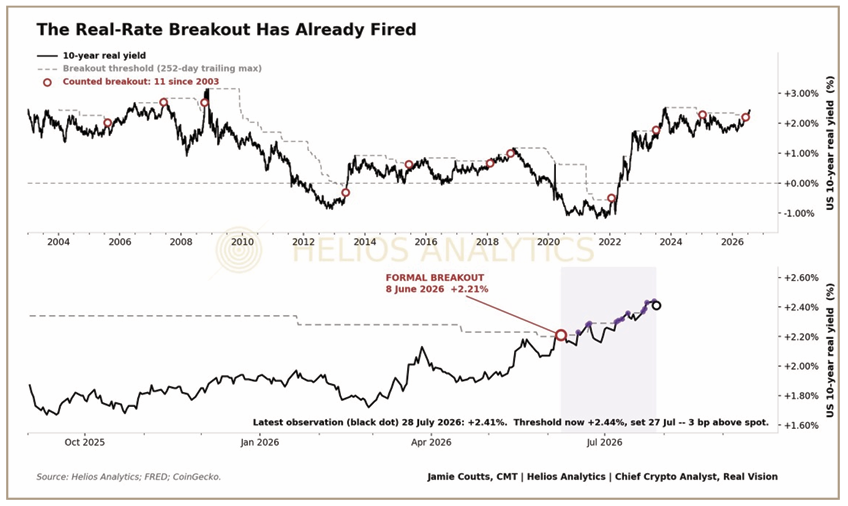
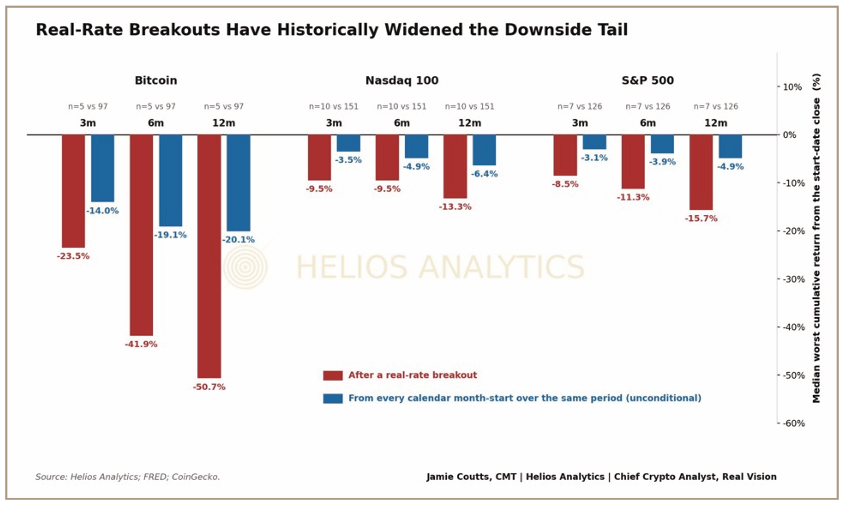
Real Rates could be the tell - and they have broken out. Historically not good for risk assets as they have portended increased volatility & downside moves.
Perfect Storm:
A 3-month 'ceasefire' into mid-terms...
After Bessent intervenes in yen to manipulate dollar, yields & oil lower...
While promising that the "K-shaped economy" ends today & SOH opens tomorrow...
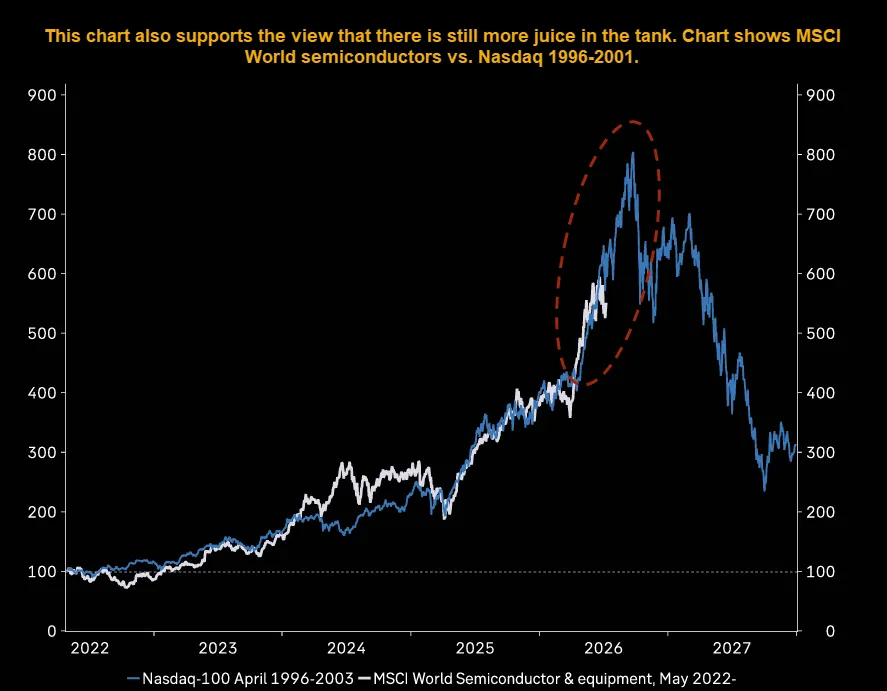
That triggers a 1999-into-2000 fractal...
Good luck everyone!
THIS IS HOW YOU WILL RETIRE IN THE NEXT 5-10 YEARS
I’ll be focused on where capital flows next.
Here’s how I believe the AI buildout evolves:
2026–2027: AI Infrastructure
AI demand accelerates.
Capital pours into the companies building the foundation.
• AI Compute: $NVDA $AMD $AVGO $MRVL
• Memory: $MU $SNDK $WDC
• AI Infrastructure: $VRT $SMCI $NBIS $IREN
2028–2030: Power & Grid
AI becomes an energy problem.
The world races to expand power generation, modernize the grid, and secure critical materials.
• Power Infrastructure: $VRT $ETN $PWR $HUBB
• Battery Materials: $ALB $SQM
• Copper/Grid: $FCX $TECK $SCCO
• Rare Earths: $MP $CRML $USAR
• Nuclear: $CCJ $UUUU $SMR $OKLO
2030+: Physical AI
Intelligence moves into the real world.
Robotics, autonomous systems, defense technology, and space become the next major investment themes.
• Robotics: $TSLA $SYM
• Autonomous Mobility: $ACHR $JOBY
• Defense: $LMT $NOC $KTOS $AVAV
• Space Economy: $RKLB $ASTS $LUNR $PL
2026 is tracking very closely to 1968, 1978, and 2007.
• July - choppy
• August - choppy
• September - grind higher
• October - peak
• November - sell-off
• December - choppy
If we ignore seasonality and just follow the past movements, the markets will remain flat for the next 6 months.
My compliance department has not approved the title so ignore it since it is wrong and has bad market juju.
But I had a great time doing the interview with Angelo @familyoffice for close to two hours. He has embraced AI and used it to build an amazing business for single family offices.
We covered the end of the AI Mid-Cycle Slowdown for momentum, Bitcoin, the Fed, markets, productivity, and the framework I’m using to think about what comes next.
https://t.co/7PaShTbwN2