Attention is—and will always be—humanity’s ultimate asset.
Biologically, human consciousness is single-threaded; we can only truly focus on one thing at a time.
If you’re scrolling an app, you can’t read a book. Attention is zero-sum and mutually exclusive. And any scarce resource with absolute exclusivity naturally becomes high-value hard currency.
Even if longevity tech doubles our lifespan, a day still only has 24 hours.
Subtract sleep and daily maintenance, and you’re left with maybe 8 to 10 hours of high-bandwidth cognitive focus.
As Herbert Simon put it back in 1971: "A wealth of information creates a poverty of attention."
Information has exploded exponentially, but brain capacity hasn't changed. The denominator grew, the numerator stayed flat. The marginal value of attention will only skyrocket.
As hyper-social primates, all human behavior is essentially a transfer of energy and focus:
• Love is just gifting someone your undivided attention. • Power is measured by how much attention you can command. • Commerce requires "joint attention" before a transaction can even exist. (You can't sell to someone who doesn't know you exist.)
Capturing attention is arguably the highest-leverage meta-skill today.
Marketing, personal branding, dating, elevator pitches, cold outreach—they all run on the exact same underlying logic.
The formula is simple: Wealth = Attention × Conversion (Trust & Value)
Yet, most people lose this game and drown in the noise.
Commanding attention isn't luck; it's a trainable psychological framework. It’s about snapping someone out of their cognitive autopilot in seconds and delivering undeniable, high-density value.
In my next post, I’ll break down how anyone can reliably and tactfully capture attention, and turn it into leverage across marketing, business, and daily life.
Drop a follow so you don't miss it.
I think I just unlocked one of the fundamental source codes of how the world really works.
After going down a rabbit hole with AI recently, it hit me:
It all comes down to Attention.
I think I just unlocked one of the fundamental source codes of how the world really works.
After going down a rabbit hole with AI recently, it hit me:
It all comes down to Attention.
Don't build 10 shallow features when you can perfect one core flow.
The best products win by closing the loop on their primary value proposition, not by chasing feature breadth.
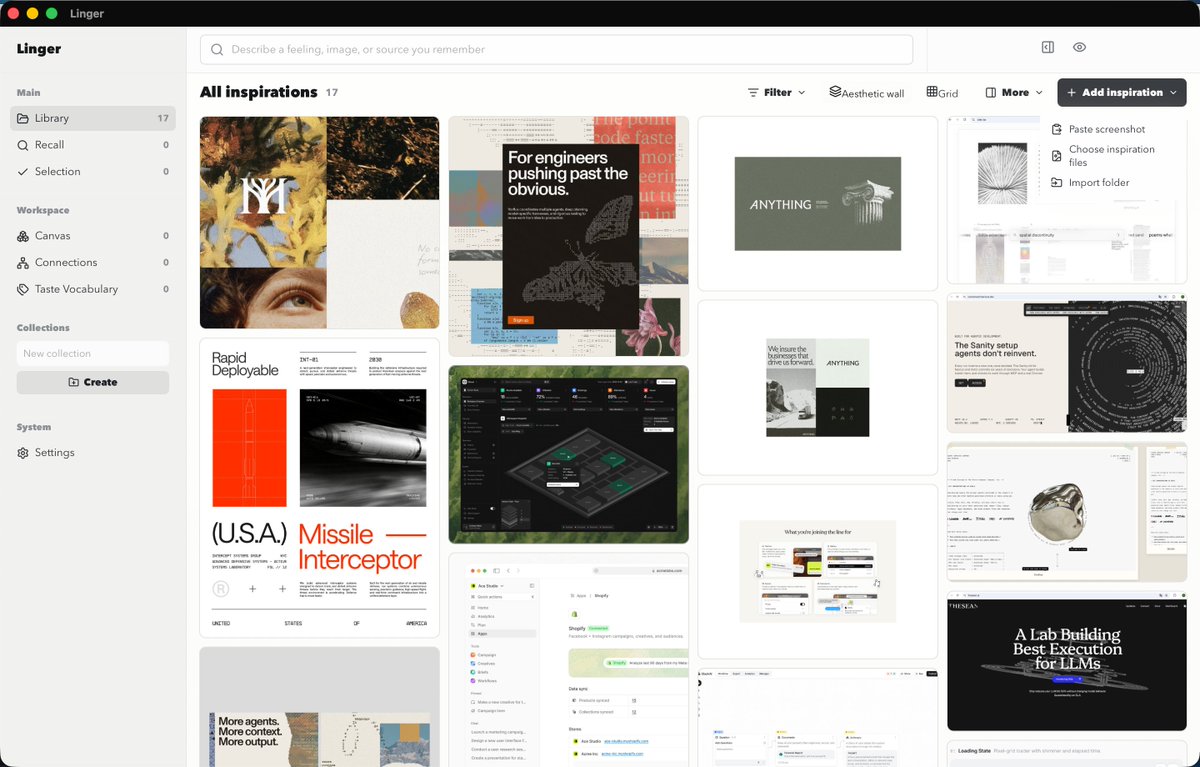
I constantly come across incredible designs and art online, but after liking them, they just get lost in the void.
Then I built a personal gallery space to save and curate all my inspirations in one place. Loving how it turned out.
Cold email is really tough because building trust from scratch is almost impossible. It’s just like getting cold calls from unknown numbers—I’m completely uninterested in 99% of them and honestly just assume they’re scammers, lol.
I think maybe we have two realistic paths: either dig into your existing paying users to understand what made them pull the trigger, or make your cold outreach ultra-personalized. Highlight a specific, concrete problem you found on their site (like a broken link or slow menu load) and use a super lightweight CTA instead of pitching right away. Template-based mass blasts never work on me either.
For local businesses like restaurants, in-person walk-ins with a quick live demo on your phone, local pop-ups, or warm intros from mutual connections will build trust infinitely faster than any cold email ever could.
@VadimStrizheus 100% agree. As devs, we fall into the curse of knowledge and assume everything is self-explanatory.
I literally have to force myself into a total beginner mindset while building just to catch all the confusing UI friction and overhaul our onboarding.
@vultuk@thsottiaux That was actually my initial setup, but the experience isn’t great. Relying on remote desktop tools adds latency and makes UI/UX reviews clunky on the go. Plus, keeping local and remote environments and versions properly in sync still gets messy.
@zdogmode Cuz building is a safe space, talking to real users is a test of courage. You can vibe code in isolation with zero ego damage, but pitching a human risks raw rejection.
My view, people keep saying AI will replace UI/UX, but bro… it’s still the most time-consuming, detail-heavy part of building a product.
Users don’t see your complex backend architecture, they judge your product's polish in 3 seconds flat. Great UI/UX takes taste, iteration, and nuance. You can’t just prompt that into existence overnight.