I'm a writer.
For 7 years I've delivered 1,000+ SEO articles
for international tech brands from Japan.
Last year I hit a wall.
So I built my own tool.
Building Suiko in public, starting now.
🧵
I copied Ulysses pretty heavily when I started building Suiko.
The four-pane layout is getting closer. The outline still doesn’t jump to the right section, and some buttons still do nothing.
Current build ↓
Monk mode: on.
Pausing build-in-public updates for ~6 weeks. Editorial workload is full, and every article ships through the same diff-learn loop Suiko is built on. Client work is the test bench.
Back early September with the data.
Shipped a new app icon today.
Torii gate + red moon.
"Suiko" comes from an old poet's story — spending days revising one word: knock, or push, at a moonlit gate.
That's diff-learn, as an icon.
Today: taught Suiko to check its own homework.
When you approve a rule, it used to just sit there.
Now it tracks itself. 14 days later: did the same mistake come back?
healthy. needs rework. safe to retire.
Diff-learn finally closes the loop.
@Vidhya0606 Seeing the same shift in Japan — though the gap is different there. Japanese-language content that AI actually cites as a trusted source is still thin, so the audience isn't shrinking yet, it's just moving to a channel with almost no supply.
@zarath_dev Same shift on the writing side — once AI handles the sentence-level work, the actual skill becomes knowing what "great" looks like before you start, not fixing it after.
@JoelOhman@thesamparr Same on the localization side — the AI output is only as good as the training data you feed it. Most of my time now goes into documenting what "good" looks like for each client's voice, not writing itself.
@dvassallo Curious what carried over from that world into building software — is it the same instinct for spotting where the crowd's confidence outruns the actual signal?
@levelsio Same experience building an editor with Claude Code — the surprising part wasn't the code generation, it was the scaffolding decisions it got right without being told.
@simonw Same discomfort on the editorial side. AI nails the sentence, loses the reason the sentence exists — the high-level 'why' doesn't survive delegation either.
Suiko now connects to a Claude subscription, not just an API key. Full agent access, not a limited chat.
Risk: it could corrupt what Suiko learns from edits. Fixed with automatic version snapshots.
Tested today, hit a bug mid-test, fixed it, worked on retry.
#buildinpublic
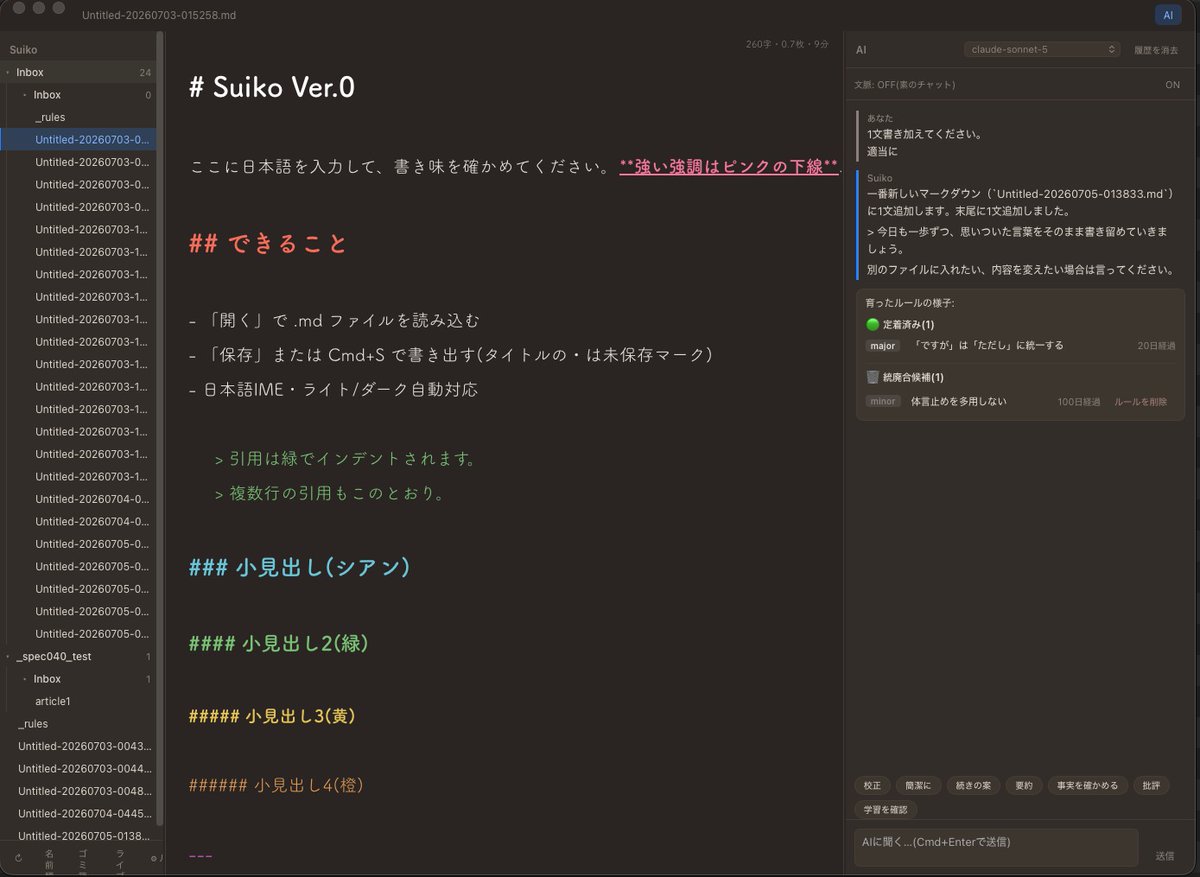
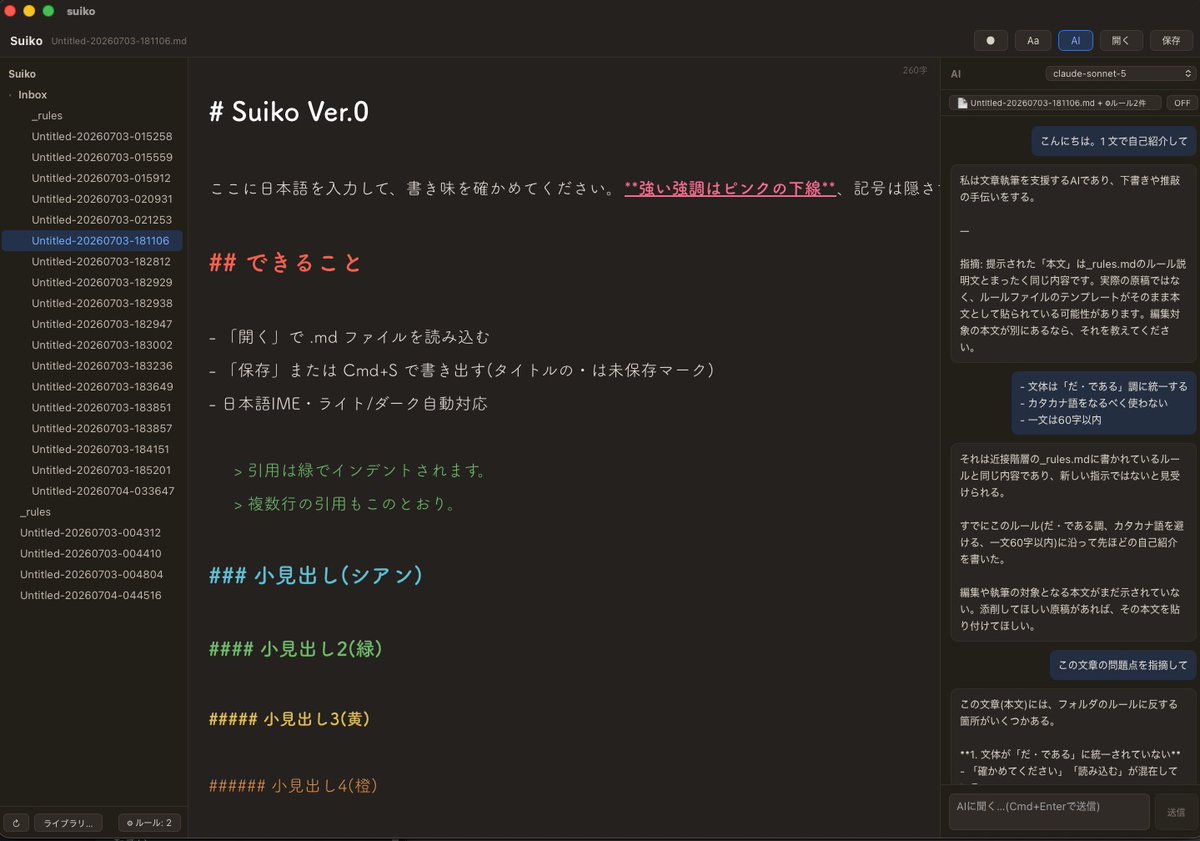
Autosave shipped. AI connected today, reading the folder's style rules and applying them without being told.
Tested it on a doc I hadn't touched yet. It called out the mixed tone and the katakana, unprompted.
Still rough. No diff-learn loop yet.
#buildinpublic
Mid-week update:
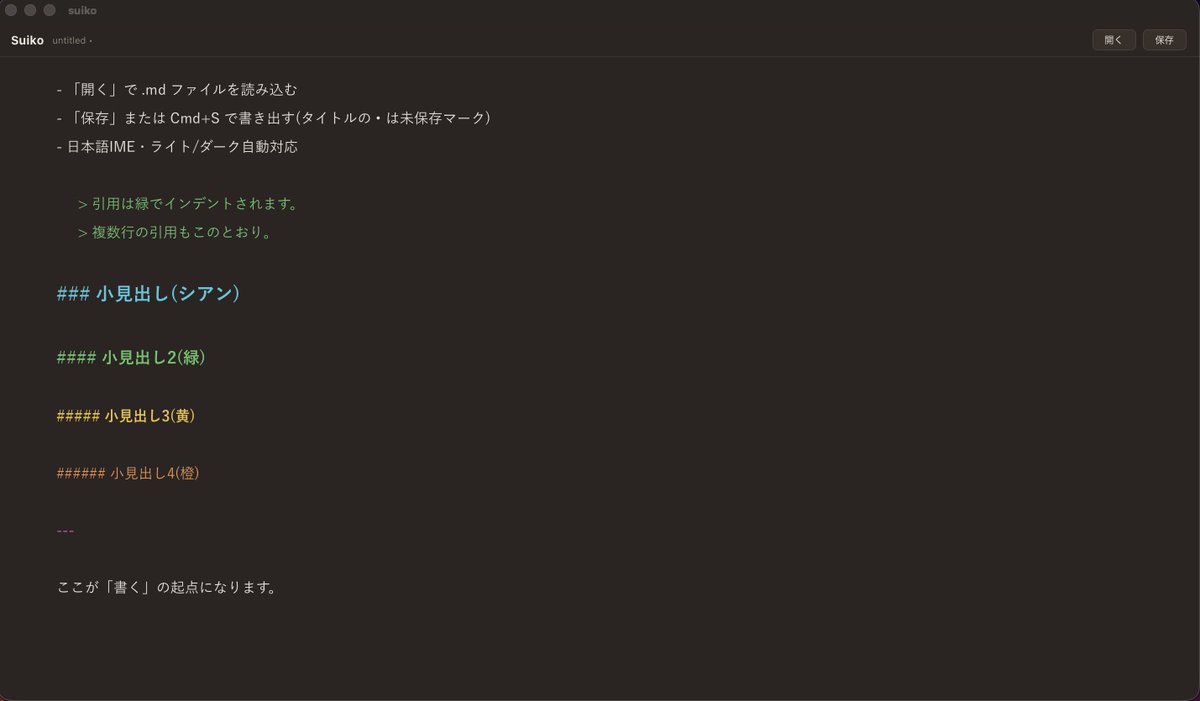
Suiko got a real theme today. Warm dark mode, per-level heading colors, a character counter. Markdown symbols stay visible, just colored.
Honestly, still a toy. No autosave, no AI yet.
But it finally feels nice to type in. Next: autosave.
#buildinpublic
Day 1 building Suiko's real editor.
Wrote the first code.
Tauri + CodeMirror 6. Native, no Electron bloat.
The test: Japanese IME.
Build failed. Rust was years old.
Updated. Recompiled.
Then it just worked.
Japanese, smooth.
It's real now. Not a doc anymore.
#buildinpublic
Spent years editing my drafts.
That feeling when I'd hit a line — "this is off," "rewrite this" — used to vanish by morning.
So I started writing it down. Edit by edit.
Next draft already knows what I'd change.
That's diff-learn — 8 years of edits finally with a place to live
@Kpaxs 8 years writing content for tech brands. The published piece is the
symbol. The 100 cuts before publishing are the substance. Nobody sees
the cuts — that's the hard part.
@amandanat 8 years in Japanese B2B content. Zero-click hits even harder here:
buyers Google your brand + 評判 (reviews) before any newsletter or
demo CTA. The deposit window for trust is longer, and the withdrawal
has to be quieter. Different platform, same physics.