Right now I speak purely as an ICP investor.
In high school, I entered a stock trading competition. Everyone diversified. I picked one company and went all in. I won.
In college, same thing. Another trading competition. Everyone spread themselves thin. I chose one company again. I won again.
They said it was reckless.
They said it was too aggressive.
They said I was crazy.
I call it conviction.
I’m 27 now. And DFINITY / Internet Computer is the company I’ve chosen to back with a significant portion of my life savings.
After deep research, the veil came off. I realized most of the crypto market is vaporware narratives without substance, tokens without infrastructure, hype without engineering.
Then I found ICP.
Real tech.
Real architecture.
Real on-chain compute.
A network actually replacing Big Tech infrastructure.
This isn’t a trade for me.
It’s a long-term asymmetric bet.
History shows I don’t scatter my conviction.
I identify the outlier… and I ride it.
They called it crazy before too.
Conviction always looks insane
right before it looks inevitable.
🕰️ $ICP - Built Different 🤯
2015 → Early vision
Oct 2016 → DFINITY founded
Jan 2017 → Token ledger started
Feb 2017 → Seed funding raised
2018 → Major private funding rounds
Late 2019 → Dev toolchain / SDK released
Dec 2020 → Network decentralization begins
May 2021 → Mainnet launch
May 2021 → Public ICP token live
2022 → Cross-chain crypto upgrades (ECDSA)
2023–24 → Continuous upgrades, governance, ecosystem growth
$ICP wasn’t built overnight
$ICP was built to last ♾️🚀
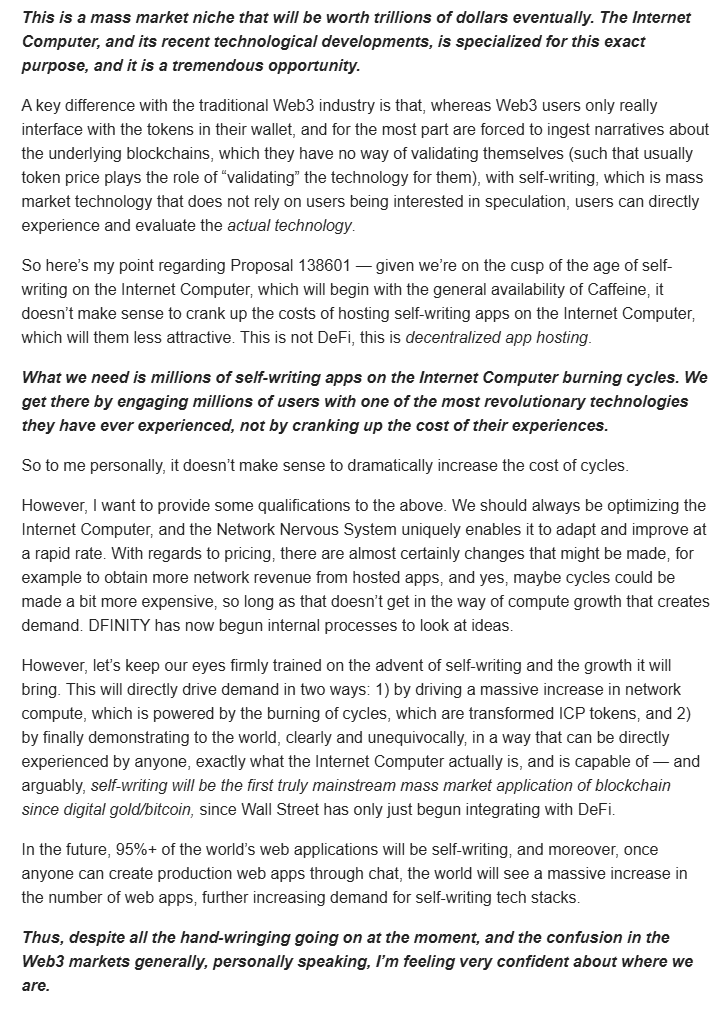
@icterminal Please see ICR post. Caffeine will be a for-profit so can raise growth capital and execute like an aggressive tech venture (it already is) with purpose of driving massive usage of the Internet Computer (targeting millions of apps) Much work behind scenes, details will come later
CAFFEINE LABS AG HAS BEEN OFFICIALLY INCORPORATED IN ZUG, SWITZERLAND, WITH A CAPITAL CONTRIBUTION OF 380K $ICP, PER THE SWISS COMMERCIAL REGISTER.
Source: https://t.co/RxJRJ5J1BY
$ICP It's crazy to realize that not one person who ever bought ICP is in profit. Downtrend since day 1 and still heading lower. Is it the worst performing crypto ever?
Starting with buying 10,000 ICPs for $800,000 in 2021, I've been investing around $5 million for four years. It's okay to mock. I've watched all the ICP ecosystems for the last four years. I've invested and supported every project that's now ruined and gone. I'm losing a lot, but I believe that one day the market will start to accept internet computers. I can call it silly. I'm not a developer, so I just support projects as an act of investment. Don't dismiss investors as greedy people and look at them as part of a project. Hopefully there will be good ways and improvements for the market to accept this.
$ICP
@dfinity@caffeineai@dominic_w
From Ethereum to the Internet Computer: Skepticism Today, Adoption Tomorrow
There was a time when skepticism about Ethereum’s technical capabilities was widespread. After its launch in 2015, Ethereum faced considerable resistance from the established blockchain community, particularly from Bitcoin peer-to-peer maximalists. Many dismissed the idea of smart contracts and the "world computer" vision as unnecessary complexity.
In early 2017, $ETH was trading around $8, a fact I remember clearly, with critics doubting whether decentralized applications would ever have practical use cases. By December 2017 and into January 2018, $ETH had rallied to nearly $1,400, representing an increase of about 17,400 percent. From that point onward, the market began to recognize the transformative potential of programmable blockchain infrastructure, moving beyond the notion that crypto was solely about peer-to-peer Bitcoin transactions.
Patterns in Breakthrough Technologies
History shows a consistent pattern: groundbreaking technology faces initial skepticism before achieving widespread recognition. Established communities, especially today with many Solana-type degenerates running their mouths online, often dismiss new paradigms as impractical until they prove their capabilities at scale. Even now, crypto markets remain largely speculation-driven, but a point will come when hype-driven projects that cannot deliver real capabilities are exposed. When that happens, everything changes.
Parallels with the Internet Computer
The critique and dismissal $ETH faced in 2017 is exactly what the Internet Computer is experiencing now. $ICP launched at $630 on May 10, 2021, but experienced a significant decline due to the FTX debacle, reaching lows of $2.91 in September 2023. When you try to explain the Internet Computer’s basic capabilities and technical strengths, such as near-instant transaction finality and the ability to run applications fully on-chain, people who know nothing about the project start foaming at the mouth, pointing to the chart, and making on-the-spot false claims that $ICP is centralized, without giving it a chance simply because they cannot comprehend it. This architecture introduces never-before-seen concepts like reverse gas models, where developers pay for user transactions, functioning as a layer 2 for $BTC and enabling fully native Bitcoin DeFi, as well as native integration with AI computation. Like Ethereum in 2017, the Internet Computer is a platform for transformative technologies and will require time to mature before markets fully recognize its potential.
In conclusion, a technology’s success depends on whether it addresses fundamental limitations in existing systems. Ethereum faced widespread dismissal from 2015 to 2017, only for the market to later acknowledge its role in enabling decentralized finance and Web2.5 applications, because it is not truly Web3 as often claimed. The Internet Computer presents a similar case, but this time with proven working technology that can genuinely enable Web3. If $ICP continues demonstrating technical capabilities that solve real infrastructure problems, the market will undeniably recognize its value, leading to adoption, media attention, and positive price appreciation. Current negativity on X will not change this outcome, just as online criticism did not prevent Ethereum’s eventual rise.
Dominic Williams is betting on CaffeineAI to change the trajectory of $ICP.
The question is: will this bet pay off?
AI-powered self-writing applications could transform how software is built, but beyond creation lies the business challenge — how many of these applications can achieve real adoption and go mainstream?
While I’m optimistic about CaffeineAI, the foundation must avoid concentrating all its efforts in one direction. A balanced strategy that also strengthens ICP’s DeFi ecosystem is essential.
Currently, ICP is excluded from many of the major conversations shaping the industry. This silence is not in the project’s best interest, and if it persists, the risk of ICP fading into irrelevance becomes real.
Caffeine ☕ early access users, post demo videos of fully onchain apps you've built on the Internet Computer / ICP by chatting with AI, and reply below with a link
We'll distribute 7,500 ICP among the top entries, and give special gifts to runners ups
Deadline: Sept 30 🍀
IPFS = immutable but not verifiable.
ICP = immutable and cryptographically verifiable.
Even as an ICP developer, you often find yourself marveling at how little you actually know about its ingenious design.
Several key milestones of ICP timeline:
1. Mid October: Caffeine AI will be fully launched
2. On December 31st: the number of ICP applications under development exceeded 1 million, and the total number of blockchain developers reached 25 times
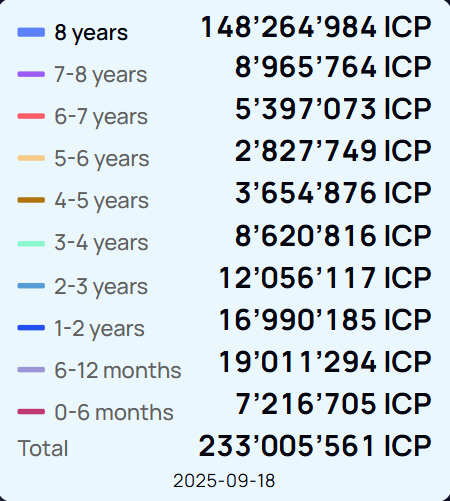
61.8% of all the $ICP staked, is now locked for 8 years🔐This means that 26.8% of the supply is currently locked for 8 years and may not be sold.
In the last year the amount of ICP locked for 8 years increased by 8M ICP, while the total supply increased by 14.5M (Inflation).
This means that 55% of the ICPs that are minted due to the Inflationary mechanics are re-staked✅
This is why the launch (& marketing) of @caffeineai ☕️will be extremely important. If we can reduce the inflation & increase the number of new holders, the amount staked (or re-staked) should dramatically increase while the number of ICPs minted should decrease.
The ICP tokenomics are really good if (and only if) we achieve adoption. This is why I am insisting so much on the marketing of ☕️. If we do this properly, ICP has a great chance of success as it has a very powerful product (☕️ & the capabilities of the Blockchain are fantastic).
Time is ticking⌛️
I often post a lot of thoughts that I've felt in the near five years or so about the recent situation of being turned away from the market.
You probably can't imagine it.
I'm the one who bought 10000 ICPs in the summer of 2021 from a high amount over $80 just after launch and locked them in staking on neurons equivalent to 8 years.
Since then, we've been doing a lot of millions of dollars in ICP over the last four years, and we're still buying.
I talk a lot about Dfinity's negative stories, but most of them are asking for improvement, and I've never concluded that this will fail.
Still, I think Dfinity has the upper hand in this technical area, and I'm saying that the situation where it's turned away from the market and not adopted is the problem with Dfinity company.
#BNB at $1000
#SOL at $250
#ICP at $4
The anger, panic, and disappointment in the #ICP ecosystem right now are terrible, especially among the #BOB community. 😔
I still believe #ICP will succeed. We just need to find a way to bring back both liquidity and excitement into the ecosystem 👌
A kind friend gave me his https://t.co/liNtC5mGdK code, so I have been able to try it.
First impressions: It’s good, and it’s correctly positioned.
There are a bunch of things that can and presumably will be polished, fixed, improved but no show stoppers that I have seen yet.
What @dfinity really gets right is that Caffeine isn’t for devs - it’s for regular people. Caffeine is not an IDE (Integrated Development Environment), it is a website for letting you type in a prompt and seeing the AI spit out a website.
It has tabs for letting you inspect the generated specification and code files, but you don’t have to ever look at them and I expect most users never will. Caffeine is for Vibe Coding, and when that doesn’t suffice, switch to Cursor instead of trying to torture Caffeine into something it isn’t.
If you’re not a dev, or can find one willing to take over, going further once you hit the ceiling in Caffeine will not be a good time. This does not disqualify Caffeine - it is a great tool when you stay inside its capacity, which in turn will grow over time.
My experience is roughly that if you can express what you’re after in a simple prompt and “one-shot” it (Caffeine generates your whole application from your first prompt) then you’ll have a good time. If you need a few follow-up prompts you’ll also be fine. If you’re 50 prompts in and struggling, try something else (another tool like Cursor if the project you’re building is your passion, or try Caffeine on a simpler project if your goal is having fun and maybe building something you can use).
Dom has made a big deal about EOP not losing your data. This is all (very) well and good, but for Caffeine it is less relevant imo, since Caffeine works best when you can one-shot your app. When working in Cursor, on a project with hundreds or thousands of “versions” (commits) spread in different branches - that’s when EOP is so good it might have you tearing up from joy. Most Caffeine users should try to avoid getting themselves into situations where EOP matters.
EOP will help Caffeine users too, a little, because it will usually take a few prompts to get your app right, but here’s the bottom line: If you want to do a big project with lots of users where you keep updating the application with new code and features…you want an IDE and “dev life” is unavoidable, and it has nothing to do with Caffeine not being “good enough” to do that, and everything to do with Caffeine not being, and not trying to be, an IDE.
Once your project sprawls, you will need, most of all, good version control, which means git, and you’ll want it integrated in your IDE. Even if you never look at code, you’ll want to be able to see at a glance which files were modified in your latest version. And you don’t want to regenerate the whole application from scratch for every new prompt, it is too slow and too unpredictable. And you definitely want to be able to go into a file and change some text like “Welcome to my app” into something cooler without having to negotiate this edit with the AI.
The list of things that are better when using an IDE for developing large projects is very long. That’s in the nature of things. IDEs after decades have gotten quite sophisticated and have lists of features that are miles long. For Caffeine, targeting non-devs, the whole point is to peel that away, leaving only the core essentials.
So comparing Caffeine to IDEs like Cursor is to compare apples to oranges, not just unfair but meaningless. However it is worth noting how they complement each other, such that if your Caffeine app is a runaway success and you wonder how you’ll manage maintaining and evolving it given that you seem to have hit a limit where Caffeine maybe breaks more features than it adds with your new prompts, you can engage a dev (or learn Cursor yourself if it is your fancy), move over your code files, and let a real IDE take it from there.
For serious projects, Caffeine thus still complements Cursor in that Caffeine provides a really good way to get started - you’ll probably get up and running and to some minimal version of your app faster than with Cursor!
But for smaller, personal apps Caffeine brings it in a way that Cursor couldn’t - you can indeed create your first app and test it inside 10 minutes of clicking the link that takes you to the Caffeine homepage - no prior experience whatsoever required. I was probably 3 hours in before I saw my first line of code when I started with Cursor, and that’s with several decades of professional dev experience.
And Caffeine generates neat, tidy, well functioning apps.
Bottom line: Whenever you stay inside the scope of what Caffeine can comfortably do, it’s a pleasure to use, very productive, and you’ll be able to generate a lot of cool apps that can be very useful. Whenever your project grows bigger, you’ll either want to move it to Cursor, or (seriously) consider if maybe that project has already landed in a decent and useful shape, doesn’t need to become more, and instead it’s time for a new project. Caffeine is, after all, in my opinion, for moving fast and having fun while creating cool and useful small apps - leave the struggle sessions to Cursor and devs who have already discovered they are masochists.