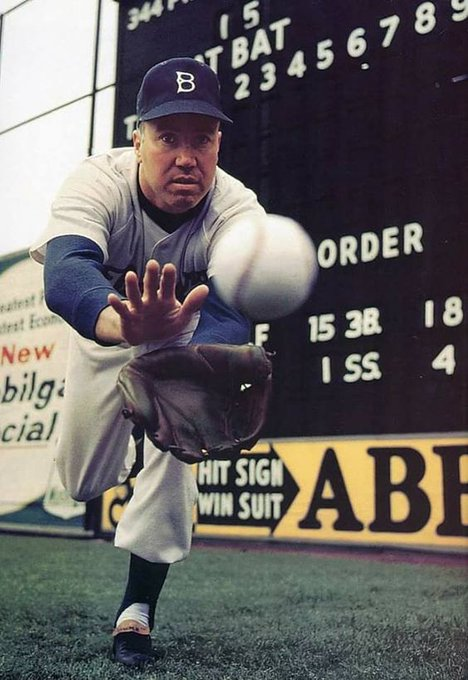
"We wept.
Brooklyn was a lovely place to hit.
If you got a ball in the air, you had a chance to get it out.
When they tore down Ebbets Field, they tore down a little piece of me."
"The Duke of Flatbush", New York Times.
"The night after I was voted into the Baseball Hall of Fame in January 1980, I went out to dinner with some friends to the "River Cafe" in Brooklyn.
We were dining quietly in a corner when some people recognized me, and pretty soon the whole place was applauding, and someone had a bottle of champagne sent to our table and toasted us.
Then a young man about thirty came over to the table, and said he’d been carrying around my baseball card from the Brooklyn Dodgers, ever since he was eight years old, and he asked me to sign it.
Take it from me, it does feel good to be remembered."
Duke Snider.
The average MLB fan will look at Rasmussen’s no-hitter and be like “wow this guy is awesome” meanwhile no Yankees fans are phased because this is just what this team has done in October for our whole lives
Mike Vrabel on a “conflict” between him and Drake Maye:
"Let me tell you why I'm here. I'm here because Drake was the quarterback. Believe it or not, I had choices to where I wanted to coach. I wanted to coach here because Drake was the quarterback."
Among parents 55+ with at least $500,000 invested, 52% haven't told their adult kids what they're worth.
95% of those adult kids say they're ready to handle an inheritance. A quarter of the parents disagree.
So what's the right move? Tell your kids nothing, tell them everything, or something in between? Let me know what you think in the comments.
I've got a strong opinion on this one. Here's how each plays out. 🧵
Probably a first in the history of Indian elections: a candidate who came third has filed an election petition to declare the winning candidate’s election null and void, while the runner-up has no complaints.
Ace fraud @RajeevRC_X, who filed the grossest false affidavit in Indian election history, is now being challenged by our leader @KSSabari1983 in the Kerala High Court.
According to the affidavit:
1. Rajeev doesn't have his own house. The truth is that he has hidden a 49,000 sq. ft. residential property worth ₹200–250 crore.
Instead, he declared his car shed. He valued his 10,000 sq. ft. car shed at ₹15.07 crore, which means it is valued at ₹15,000 per square foot in the posh billionaire neighbourhood of Koramangala 3rd Block in Bangalore. The actual rates there are around ₹65,000 to ₹70,000 per square foot. Going by his own undervaluation, the property should be worth at least ₹91 crore, according to the petition.
2. Jupiter Capital is Rajeev's holding company, through which he holds stakes in nearly 55 companies, including Asianet News, Suvarna TV, Kannada Prabha newspaper, AxisCades Technologies and several companies in tax havens. Of these, AxisCades is listed, and its market value alone, as of today, is ₹8,040 crore. Rajeev's holding in the company is worth ₹4,600 crore as of today.
Rajeev holds 99.97% of the shares in Jupiter Capital through four holding companies. He has shown the book value of all these holding companies as ₹6.13 crore, whereas Jupiter Capital's books show it as ₹1,670 crore. Interestingly, all of Rajeev's affidavits since 2018 have shown the book value as ₹6.38 crore, which makes for another interesting case. The book value of a company changes every year, but strangely, his companies have constant values.
This shows his level of confidence in the ED, IT, ECI and the judiciary that no one will question him.
3. In addition, Rajeev didn't declare his liability of nearly ₹200 crore payable to IFCI Ltd. The amount of ₹83.23 crore has been pending as a liability since 2002, and the final Supreme Court verdict came a couple of years ago. With interest, this amount is more than ₹200 crore.
In a nutshell, Rajeev is a self-declared billionaire who claimed to have assets worth ₹20,000 crore during a podcast done to impress voters. The billionaire, however, doesn't have his own house or cars and has a liability of ₹200 crore to pay, but wants it to be written off like Subhash Chandra's.
This time, Rajeev will be out of the Kerala Assembly, as the evidence against him is strong. And to every Bhakt who gave us free advice during the campaign, asking, “Why are you not filing a case if you have evidence?”: here is the case. Every document related to this is already in the public domain.
Read the @thenewsminute story on this for more.
https://t.co/IhphDsGwFJ
a privacy system becomes much more interesting when it does not require pooled funds to hide transaction relationships.
that distinction is central to the design @Americanfort_io describes for SafeSend. The privacy layer is built around ZK-powered transaction flows intended to reduce public exposure, while explicitly avoiding mixing, tumbling, or counterparty pooling.
That changes where the privacy mechanism sits. Instead of relying on a shared pool where multiple users’ funds are combined, the architecture keeps the transaction non-custodial and focuses on reducing what outside observers can infer from the public ledger.
The other piece is selective disclosure. Relevant transaction information can be shared with a chosen counterparty, auditor, or institution when needed, without making an entire wallet history publicly visible.
So the architectural trade-off is not simply transparency versus privacy. It is public visibility versus controlled visibility: keeping blockchain activity private from general observers while retaining a mechanism for deliberate disclosure when verification is required.
The Democratic Party is more trusted than the GOP to handle taxes, with less than six weeks remaining before the midterm elections.
More At Rasmussen Reports:
https://t.co/wGyDu4x0gV
1/
Many of you asked for UPSC EPFO APFC strategy.
So starting a series.
This is going to be a long thread, so bookmark it.
I’ll cover the overall approach first, followed by separate posts for individual subjects. 📌
#UPSC