Building Ticker & Ink: a morning paper for the US stocks you follow, written from SEC filings.
· Public build log · Python, LLMs & agents
· Not financial advice
found a name. it's called ticker & ink
you pick four us stocks, it reads what they filed every morning and tells you what changed in plain english. 3 minutes, over coffee
early list is open: https://t.co/Y7PVQQ8Iz4
If you have 4 phones, you can have 32 TikTok accounts.
Post 3x a day on all of them and that’s 96 posts a day.
If they average 1,000 views each, that’s 96,000 views per day.
5 downloads per 1,000 views is healthy.
That’s 480 downloads per day.
5% download to pay is healthy.
That’s 24 new paying users per day.
At $50 a year, that’s $1,200 per day.
That’s $438,000 per year without counting renewals.
The math is there. You just need to post.
before app review, check if anything in your app isn't allowed in china. we used callkit just to pause the workout when a call comes in, turns out china doesn't allow it, so we're sorting that out. china sales are tiny for most indie apps, so either skip china or check its rules before you submit
app review has been brutal for a lot of devs lately
our last one went in monday and got approved wednesday
honestly what sped it up the most was testing every screen on ipad and actually building for iphone duo. most people skip both
Switched my mobile app's voices from ElevenLabs v3 to v4. Went from sounding like counting to sounding like a real person. Might be the biggest upgrade of the whole build.
Haiku 5.5 vs Sonnet 5.5, not a general benchmark: just reading SEC earnings filings for my finance paper. Every number has to match the filing or it doesn't print.
3 runs each: $0.09 vs $0.83 a paper. Checker caught Haiku 8 times, Sonnet 3. Wrong numbers printed: 0 for both.
Next build is a mobile app. Keeping the niche quiet this time, but here's the bet:
Read the competitors' 1-star reviews, build around exactly what they get wrong, and make it look great.
On paper that's an easy win. Paying users decide if it works. Testing it in practice.
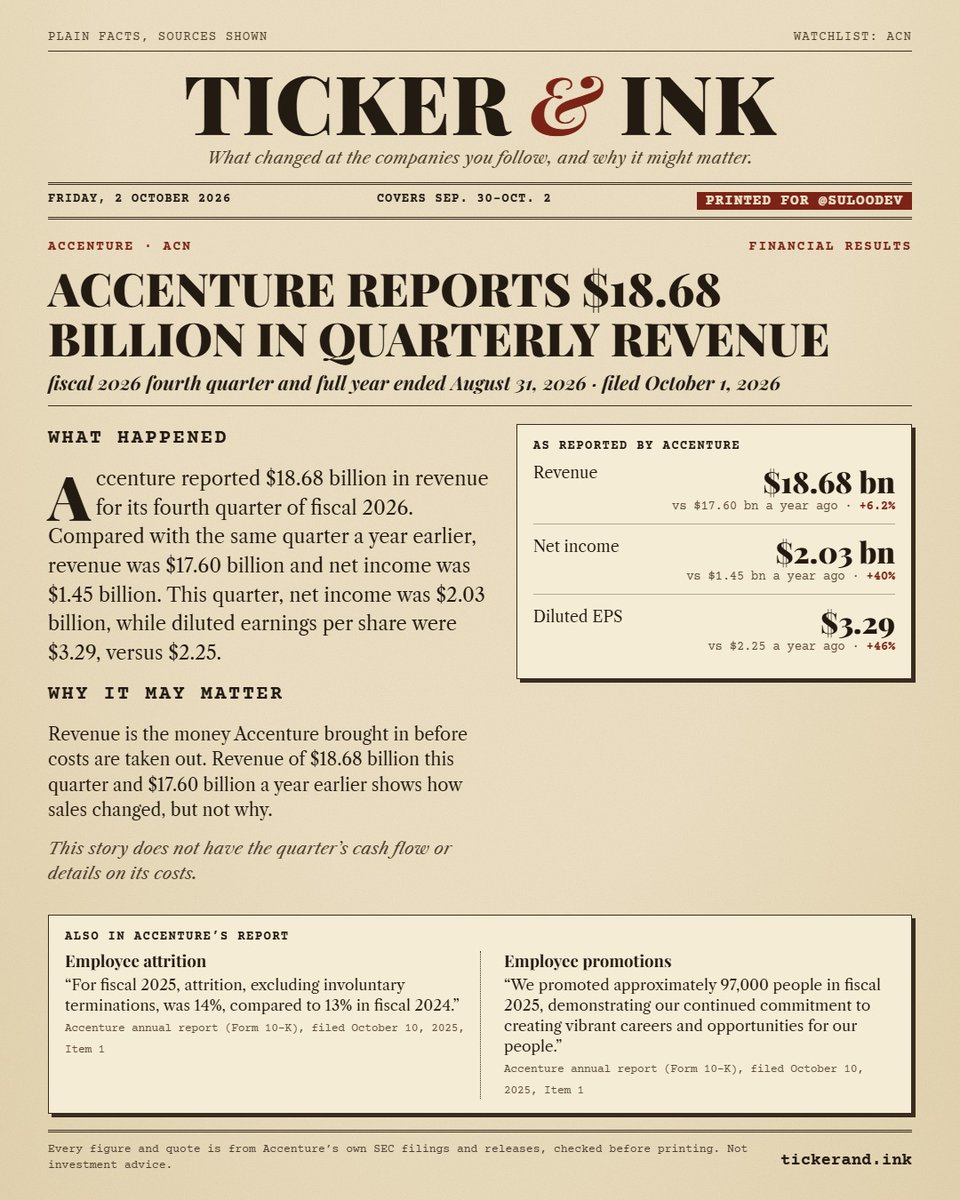
This morning's paper: $NKE and $ACN.
Nike Q1: revenue $11.21B (-4%), net income $712M (-2%)
Accenture Q4: revenue $18.68B (+6.2%), net income $2.03B (+40%)
Yesterday's test run printed that +40% as "+40.0%". Computed from rounded billions; the filing's table says +40.3%. Fixed.
Rule #2 of my AI-written finance paper: copy the company's hedge words, not just its numbers.
Micron guided gross margin at "approximately 85.95%". Two decimals, and they still said approximately. Drop it and you've made a firmer claim than Micron did. So the page prints it.
This morning's paper, $MU edition.
What Micron guides for next quarter:
Revenue $61.5B ± $1.5B
Gross margin approximately 85.95%
GAAP EPS $37.84 ± $1.00
The revenue midpoint is 13% above the $54.23B quarter they just reported.
$MU just reported. Straight from the 8-K:
Revenue $54.23B (a year ago: $11.32B)
GAAP net income $37.70B
Gross margin 86.8%
In June, Micron guided $50.0B ± $1.0B for this quarter. It landed above the top of its own range.
Full page in tomorrow's paper.
yep, that's baked into the return format. every summary ends with "not sure about" and "didn't check" before the verdict
the "didn't check" line does most of the work tbh. if 2 explorers say nothing about the refresh path, the lead needs to know if that means it's fine or nobody looked
my agent setup in 20 sec:
opus 5.5 plans, sonnet 5.5 does the reading, codex on astra reviews
the lead never reads the 1.2M tokens itself. it gets 3 short summaries and makes the call
none of this is fixed btw. the number of agents changes from task to task, and the setup shifts with your plan and every new model. for really heavy planning, talking it through with fable first and switching the sonnets to opus 5.5 works better
$MU just reported. Straight from the 8-K:
Revenue $54.23B (a year ago: $11.32B)
GAAP net income $37.70B
Gross margin 86.8%
In June, Micron guided $50.0B ± $1.0B for this quarter. It landed above the top of its own range.
Full page in tomorrow's paper.
Everyone's talking about Anthropic "losing $42B in 2025." That's from its confidential draft IPO filing, which Reuters reviewed. The number is real. It just mixes two very different things.
About $34B of it is an accounting charge. When Anthropic raised money, some of the financing could later turn into shares. The company got a lot more valuable, so on paper those instruments got more expensive, and that's booked as a loss. It isn't money spent running the business in 2025, though it can still cost shareholders later through dilution.
The business itself lost $8.06B on $4.59B of revenue. That's a big operating loss by any measure. Fast-growing companies often run losses while they build, but the reporting doesn't say whether this one was planned. They ended 2025 with $20.28B in cash, cash equivalents and short-term investments. That's what they had on hand, not a budget set aside for losses.
2026 looks different so far: preliminary Q2 revenue was more than $11.5B, up from $4.73B in Q1, and investor documents showed a positive adjusted operating profit in Q2, the first quarter to get there. "Adjusted" leaves some costs out, so it's not the same as GAAP profit.
The number I'd watch most is the $518B+ in compute deals over the next decade. Around 80% of it is non-cancellable or payable regardless of use. And nearly a quarter of 2025 revenue came from just two customers.
Some backers expect the IPO to value it at $2 trillion or more, per the FT, though no target has been set. An IPO could raise a lot of new capital, but a price like that doesn't change 2025's numbers. It's a bet on the future. Anthropic expects demand for compute to keep outrunning supply. That's a forecast, not a fact, and the higher the price, the more has to go right.
So next time a headline says "loss", split it in three: what's accounting, what the business lost on operations, and what's on hand. The story's usually in the gap.