Every marketing guru would've easily charged $5k for these type of insights what @waitin4agi_ (Varun) gives out for free on YT.
Tho many people know about this but many wouldn't spend their time effort to share the knowledge about the content creation space.
Truly he is torchbearing with luck and channeling it. Good one
💸 Today I invested in a new thing:
Ethereum is essentially a public spreadsheet with every transaction being visible for everyone forever
But that makes it impossible to use for banks because it's not private. Imagine you buy something and everyone in the entire world can see it? That'd be never be accepted
So my friend @oskarth has been working on a new thing called @eth_systems that lets banks use Ethereum but while keeping transactions private
Before this he was working for 10 years on stuff like zk-SNARK (math tricks that let you prove something is true without revealing the details) and advising the Ethereum Foundation, he's the most high IQ person I know, so when he started something that's for-profit (after lots of non-profit work) I asked to invest immediately
YC always taught me to invest in people not companies, the companies (and product) can change (and should) and it can pivot into lots of other things, but if you trust the person you can estimate a higher likelihood of it (and your investment) working out
If you like to see what they will make, follow @eth_systems 😊😊😊
Fun fact: https://t.co/aYImroXzGT
Give you the portfolio sites that you can build and publish online using chatGpt Sites.
I think this would take off unlike the chatGpt workspace which they've shelved.
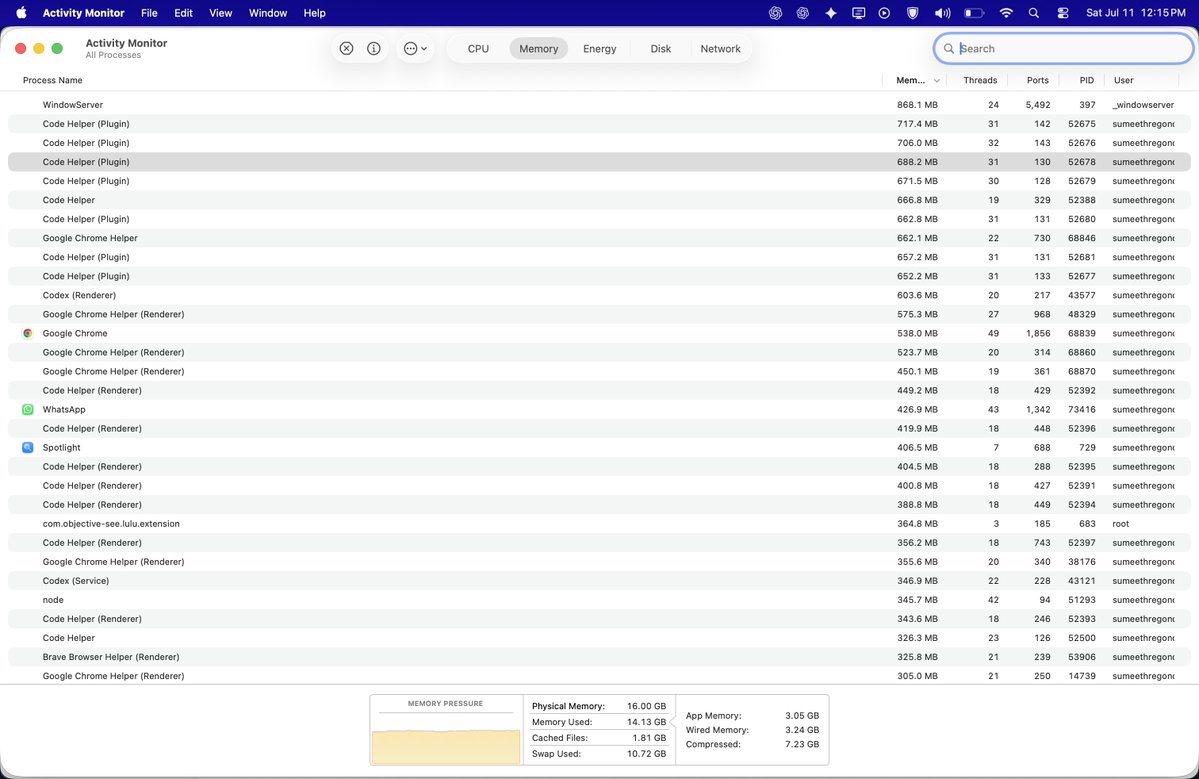
@OpenAI while using the codex for the chatgpt Sites its taking quite a log of memory usages while its running. can you check and optimize this.
The output looks quite good
A lot of programmers are basically fans of programming itself. It’s all about them. They have mastered Rust or Haskell or Zig or whatever, but their objects of veneration are useful mainly as a backdrop to their own cleverness. Anyone who will spend six weeks rewriting a working system in a new language to make the types nicer is more into the rewrite than the product. Extreme technical obsession may serve as a security blanket. If you are the person who knows every flaw in the architecture, every impure abstraction, every place where the old code fails to express its true intent, you already know what to say in every meeting, which is so much safer than asking whether users care.
Your obsession with refactoring is your beard. If you know absolutely all the trivia about borrow checkers, effect systems, async runtimes, and build tools, it saves you from having to know anything about customers, deadlines, support, sales, documentation, or whether the thing actually helps anyone. That’s why it’s excruciatingly boring to talk to such people: they’re always asking you questions they know the answer to, and never shipping anything that answers a question users actually asked.
I didn't expect this tweet to be controversial. But here we are.
Okay so look at the most popular apps you use every day. Now think about what they looked like two years ago vs today.
They're all converging on the same three panels. An explorer on the left. A chat in the middle. A preview on the right.
Look at the new apps being built. Same shape.
That's Slack.
Now think about how your team actually works. Work starts and happens in Slack. You only tab away for two things: context and ui.
Context, because the data you need lives somewhere else. UI, because some things need buttons. Different buttons.
An agent collapses both into one app. Context, it's already good at, it goes and gets whatever you need. UI, it's getting there. Soon it'll build the buttons right where you work.
Whoever nails this shape owns where work happens next. The 2030 Microsoft Office.
the last 24 hours have been absolutely INSANE 🤯
internet went wild over my dumb little fun side-project, blew up to whooping 10M+
- woke up to interview invites from international media
- ended up in 6 national newspapers
- got featured and reshared by some HUGE accounts
- people in tech twitter i've genuinely looked up to saw it, liked it, and reshared
- a bunch of high-signal folks hit follow
- picked up by big digital pages & insta accounts
- and hundreds of dms from people saying it nudged them to go build their own random fun thing 🫶
so if you're sitting on some random idea - build it. ship it before you talk yourself out of it.
you really don't know who's watching or where it goes.
In the last 6 months at @Ahrefs, we analyzed over 1 billion data points across 14 studies. Here's what we learned about AI search optimization:
1) "Best X" blog listicles are the single most prominent content format cited by AI chatbots. They make up 43.8% of all page types cited by ChatGPT specifically.
2) 67% of ChatGPT's top 1,000 citations come from sources marketers can't influence: Wikipedia (29.7%), homepages (23.8%), app stores (6.6%). Only 32.3% are influenceable content like educational pages, reviews, news, and blog posts.
3) 28.3% of ChatGPT's most-cited pages have zero Google organic visibility. These pages get cited repeatedly by ChatGPT despite not ranking in Google at all. A completely separate discovery layer.
4) ChatGPT only cites about 50% of the URLs it retrieves. It fetches dozens of pages per query but uses half as background context without attribution. This means that being retrieved and being cited are very different things.
5) Adding schema markup had zero meaningful impact on AI citations. AI Overviews actually dipped −4.6%, while AI Mode (+2.4%) and ChatGPT (+2.2%) showed changes indistinguishable from zero.
6) YouTube mentions have the highest correlation (0.737) with AI brand visibility out of all the factors we studied (including all the conventional SEO metrics like backlinks, page count, DR, etc). This held true for both Google-owned and OpenAI products.
7) AI Overviews reduce clicks to the #1 result by 58%. That’s up from 34.5% just 10 months earlier. The trend is accelerating.
8) 99.9% of AI Overviews appear on informational intent queries. Transactional, navigational, and local searches are almost entirely AIO-free. Shopping triggers AIOs just 3.2% of the time.
9) For a given search query, Google’s AI Mode and AI Overviews reach the same conclusions 86% of the time — but cite almost entirely different sources (only 13.7% citation overlap).
10) AI Overviews change every 2.15 days on average, with 70% of content differing between consecutive observations. But semantic similarity stays at 0.95. The words, sources, and entities constantly shuffle, but the actual meaning barely moves.