peak AI psychosis is setting up 25 hillclimbing agents every night before you go to bed so you can wake up and smell all the optimizations they're so excited to tell you about after you make coffee
every morning is christmas morning in the singularity
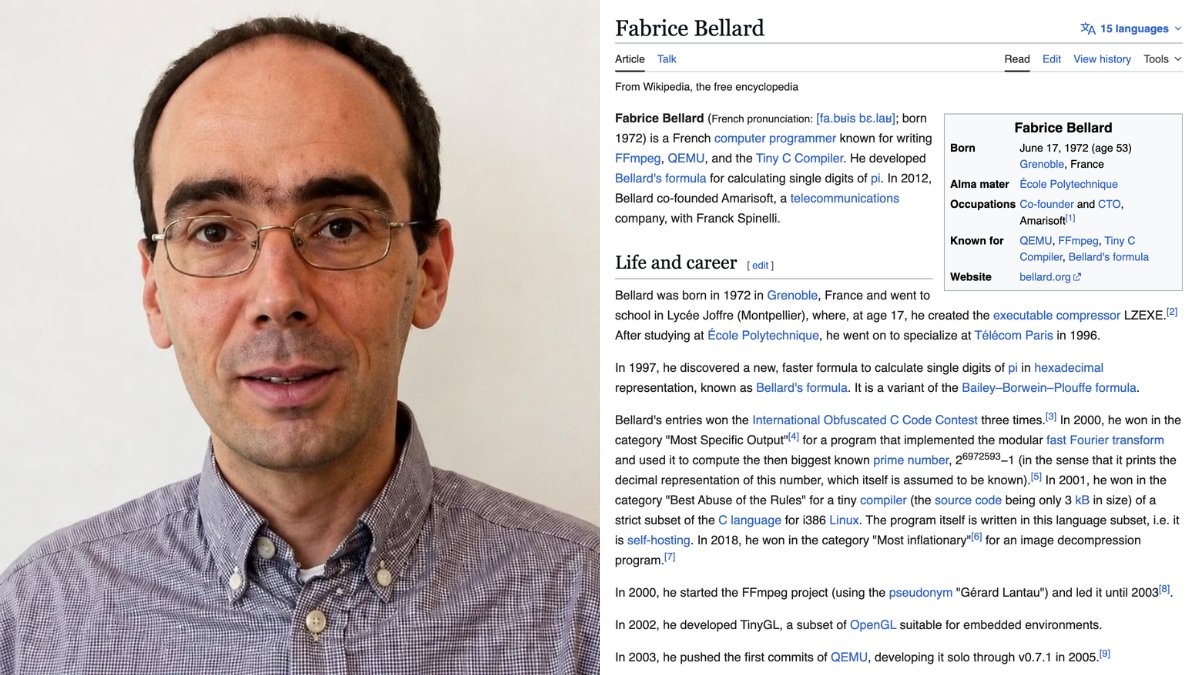
A French engineer who lives quietly in Paris has spent 30 years writing software that the entire internet now runs on without knowing his name.
He wrote the code that streams every YouTube video, every Netflix show, every TikTok clip. He wrote the code that runs the virtual servers underneath AWS, Google Cloud, and Microsoft Azure. He calculated more digits of pi than anyone in history. He has no Twitter. He has no marketing. He just keeps shipping.
His name is Fabrice Bellard.
Here is the story, because almost nobody outside the systems programming world knows what one man has built.
Fabrice was born in 1972 in Grenoble, France. He studied at École Polytechnique, the top French engineering school. He never went to Silicon Valley. He never built a startup empire. He just wrote code.
In 2000 he started a project called FFmpeg, an open-source multimedia framework for encoding, decoding, and streaming video. He was 28. The project did one thing nobody else had done well. It handled every video and audio format that existed, in one library, on every operating system. He led it himself for years.
Today FFmpeg is the invisible engine of the internet. YouTube uses it. Netflix uses it. VLC uses it. Chrome and Firefox use parts of it. Every Android phone, every iPhone, every smart TV, every video editing tool you have ever touched runs FFmpeg somewhere underneath. If you have watched a video on a screen in the last 20 years, Fabrice's code processed it.
He was not done.
In 2003 he started QEMU, a machine emulator and virtualizer. He wrote it solo until version 0.7.1 in 2005. QEMU lets you run any operating system on any other operating system. It became the foundation of modern virtualization. KVM, the Linux kernel hypervisor, runs on top of QEMU. Every major cloud provider, AWS, Google Cloud, Microsoft Azure, IBM Cloud, runs virtual machines on infrastructure built around it. The Quick Emulator is the most cited piece of cloud infrastructure code on Earth.
He kept going.
In 2001 he won the International Obfuscated C Code Contest with a small C compiler that grew into TCC, the Tiny C Compiler. TCC can compile and boot a Linux kernel from source in under 15 seconds. In 2004 he calculated the most digits of pi ever computed at the time, using a personal desktop computer and an algorithm he derived himself called Bellard's formula. In 2011 he wrote a complete PC emulator in pure JavaScript that runs Linux in your browser, a project called JSLinux that engineers still cannot believe is real.
In 2019 he released QuickJS, a small but complete JavaScript engine that fits where V8 cannot. In 2021 he released NNCP, a neural network based lossless data compressor that immediately took the lead on the Large Text Compression Benchmark.
Then he turned his attention to large language models. He built TextSynth Server, a web server with a REST API for running LLMs locally. He released ts_zip and ts_sms, compression utilities that use language models to compress text and short messages at ratios traditional algorithms cannot reach. He released TSAC, a very low bitrate audio compression system. In December 2025 he released Micro QuickJS, a new JavaScript engine for microcontrollers, separate from QuickJS, designed for environments with almost no memory.
Fabrice co-founded a telecom company called Amarisoft in 2012, where he serves as CTO. Amarisoft builds 4G and 5G base station software used by carriers and labs around the world. He has been running it for over a decade while continuing to ship personal projects from his own home page at bellard dot org
He has no Twitter. He has no Instagram. He gives almost no interviews. His personal website is a flat list of projects with no styling, no fonts, no marketing copy. Just titles and links.
A quiet French engineer who never moved to Silicon Valley wrote the code that quietly runs the internet.
He is still shipping.
since you guys loved the exploding tesla..
I used GPT-6 Astra to create a 3D website that pulls apart the male anatomy into 2,234 modeled pieces!
we are in a renaissance of learning
50 websites that can turn a “quick visit” into hours of exploring 🌍
1. https://t.co/e9MzKtH8Ac — Live satellite views
2. https://t.co/F0sYcAhsEB — Track planes worldwide
3. https://t.co/dlD4FsbeZ5 — Track ships in real time
4. https://t.co/enz2psqLq2 — Live weather & storms
5. https://t.co/6WtqMIyIXO — Live lightning strikes
6. https://t.co/rDjMVuFJ9p — Recent earthquakes
7. https://t.co/2hL9AwpAnD @sauda_coder — Explore internet cables
8. https://t.co/OXUHY0vxtW — Monitor global forests
9. https://t.co/3ykvE8xIQm — Live world statistics
10. https://t.co/WIRyI84z3z — Live internet stats
11. https://t.co/WF9Dt2YTJU — Compare country sizes
12. https://t.co/lkLgao8hPE — Explore historical maps
13. https://t.co/62atEjao3d — Historical map archive
14. https://t.co/0roKo8iBFs — Community-built world map
15. https://t.co/t4SwdWbJzL — Windows around the world
16. https://t.co/upNXry1y9K — Virtual city walks
17. https://t.co/0c5Vd0eMlf — Random places worldwide
18. https://t.co/A07775U3oX — Strange places worldwide
19. https://t.co/2LNjVQBuJG — Fun interactive experiments
20. https://t.co/WE3bRUopQP — Atom to universe
21. https://t.co/BlWzVbrKLO — Explore space in 3D
22. https://t.co/F85rw8lZ7F — Interactive sky map
23. https://t.co/DXt3VwPFml — NASA’s daily space image
24. https://t.co/4NjhLkVJzZ — NASA image archive
25. https://t.co/CKAVlLPXI3 — Interactive data stories
26. https://t.co/y6mFbQxfB7 — Global data & insights
27. https://t.co/DkEF24VHkq — Understand global trends
28. https://t.co/w4FExJsjYb — Data visualizations
29. https://t.co/eJbNAd4SBo — World Bank data
30. https://t.co/xyBlo89HIx — Turkey’s official statistics
31. https://t.co/A1aMVlBPFk — Massive digital archive
32. https://t.co/Mq40zmIIEJ — Free classic books
33. https://t.co/IeLWcbvCzB — Explore millions of books
34. https://t.co/YQD3ttZBoy — Library of Congress archive
35. https://t.co/Ix06KBwQyn — Europe’s cultural archive
36. https://t.co/CgTot9xsnm — America’s digital library
37. https://t.co/STGOC79ra4 — Virtual museums
38. https://t.co/HVjvwXZxdj @sauda_coder High-res artworks
39. https://t.co/11ALJRqB12 — Online art collection
40. https://t.co/C0q1e7mBuK — Historical treasures
41. https://t.co/FzLnwbvNFj — Free culture & education
42. https://t.co/DvnRSpu9PG — Explore the Met collection
43. https://t.co/4LzaPivTOn — Explore music genres
44. https://t.co/YRFJAaEZxr — Music by country & decade
45. https://t.co/KRJ5e0TlCK — Wikipedia edits as audio
46. https://t.co/MD4cssnXHm… — Random knowledge
47. https://t.co/SQ0ZFGnCHI — Time & astronomy tools
48. https://t.co/jVSqK5hoZO — Latest science news
49. https://t.co/DO3rXyKDYD — Free research papers
50. https://t.co/HzGCsimVyk — Interactive data visualizations
The internet is much bigger than your usual feed.
🔖 Bookmark this for later.
Follow @sauda_coder for more useful websites & AI tools. 🚀
The winner of an Anthropic hackathon open sourced his entire Claude Code setup. 68 subagents, 286 skills, 94 commands, MIT license
ECC turns Claude Code from one assistant into a full engineering team. It plans before it builds, writes the failing test first, then reviews its own work from a fresh context.
The agents, by job:
Planning. Turns a one-line request into a blueprint you approve before any code exists.
Review. Reads your diff in a clean context, with separate reviewers for Go, Python, TypeScript, Rust, Java and more.
Build repair. One resolver per toolchain, down to PyTorch and CUDA errors.
Security. An OWASP pass on your code, plus a scanner that audits your own agent config for injection risks.
Architecture. System design calls before they turn into migrations.
Domain work. Database queries, ML pipelines, end-to-end tests, docs.
The skills, by category:
Testing. tdd-workflow gates you from red to green, with eval-harness and verification-loop sitting on top of it.
Language packs. Idioms, testing and security for Python, Go, Rust, C++, Django, Laravel, Spring Boot, Next.js.
Context. search-first makes it read the docs before writing, iterative-retrieval keeps subagents from dragging your whole repo into the window.
Shipping. Docker, CI/CD, health checks, rollbacks, and migration patterns for Prisma, Drizzle and Django.
Work that is not code. Writing in your voice, market research with sources, pitch decks, slide decks.
Start with one plan and one rules pack. Installing all 286 skills at once is the fastest way to make it worse.
Change your parents' router DNS to 1.1.1.2 and 1.0.0.2
Cloudflare blocks malware and phishing at the network level
Free antivirus that actually works. Nothing to install/update/disable
SHA-256, the algorithm behind Bitcoin and countless TLS certificates, fits into roughly 100 lines of standard C
the implementation is just bitwise rotations, Ch, Maj, round constants, and 32-bit arithmetic
it pads the message, expands 16 words into a 64-word schedule, runs 64 rounds, and produces the NIST-verified digest
Best paper I've read so far this month:
All elementary functions (sin, cos, tan, exp, log, powers, roots, hyperbolic functions, π, e, and even basic arithmetic) can be generated from just one binary operator:
eml(x, y) = exp(x) − ln(y)
…plus the constant 1.
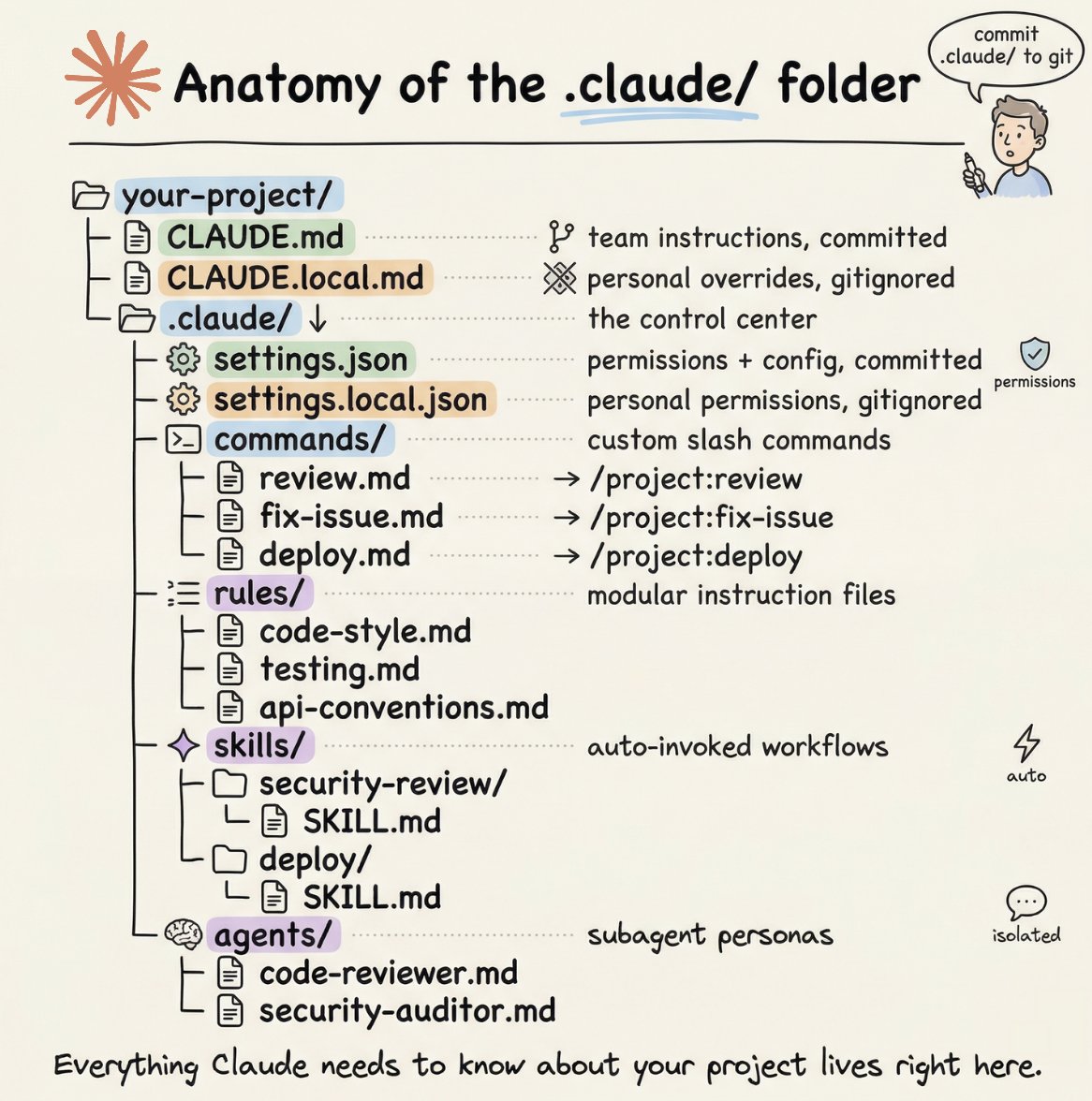
How to setup your Claude code project?
TL;DR
Most developers skip the setup and just start prompting. That's the mistake.
A proper Claude Code project lives inside a .𝗰𝗹𝗮𝘂𝗱𝗲/ folder. Start with 𝗖𝗟𝗔𝗨𝗗𝗘.𝗺𝗱 as Claude's instruction manual. Split it into a 𝗿𝘂𝗹𝗲𝘀/ folder as it grows. Add 𝗰𝗼𝗺𝗺𝗮𝗻𝗱𝘀/ for repeatable workflows, 𝘀𝗸𝗶𝗹𝗹𝘀/ for context-triggered automation, and 𝗮𝗴𝗲𝗻𝘁𝘀/ for isolated subagents. Lock down permissions in 𝘀𝗲𝘁𝘁𝗶𝗻𝗴𝘀.𝗷𝘀𝗼𝗻.
There are two .𝗰𝗹𝗮𝘂𝗱𝗲/ folders: one committed with your repo, one global at ~/.𝗰𝗹𝗮𝘂𝗱𝗲/ for personal preferences and auto-memory across projects.
The .𝗰𝗹𝗮𝘂𝗱𝗲/ folder is infrastructure. Treat it like one.
The article below is a complete guide to 𝗖𝗟𝗔𝗨𝗗𝗘.𝗺𝗱, custom commands, skills, agents, and permissions, and how to set them up properly.
llmfit. Useful tool that probes hardware and tells you exactly which LLMs will actually run.
- handles MoE expert offloading, picks the best quantization for your RAM, estimates tokens/sec before you even pull the weights.
Essential for local dev.
https://t.co/qn8PmqQNbV
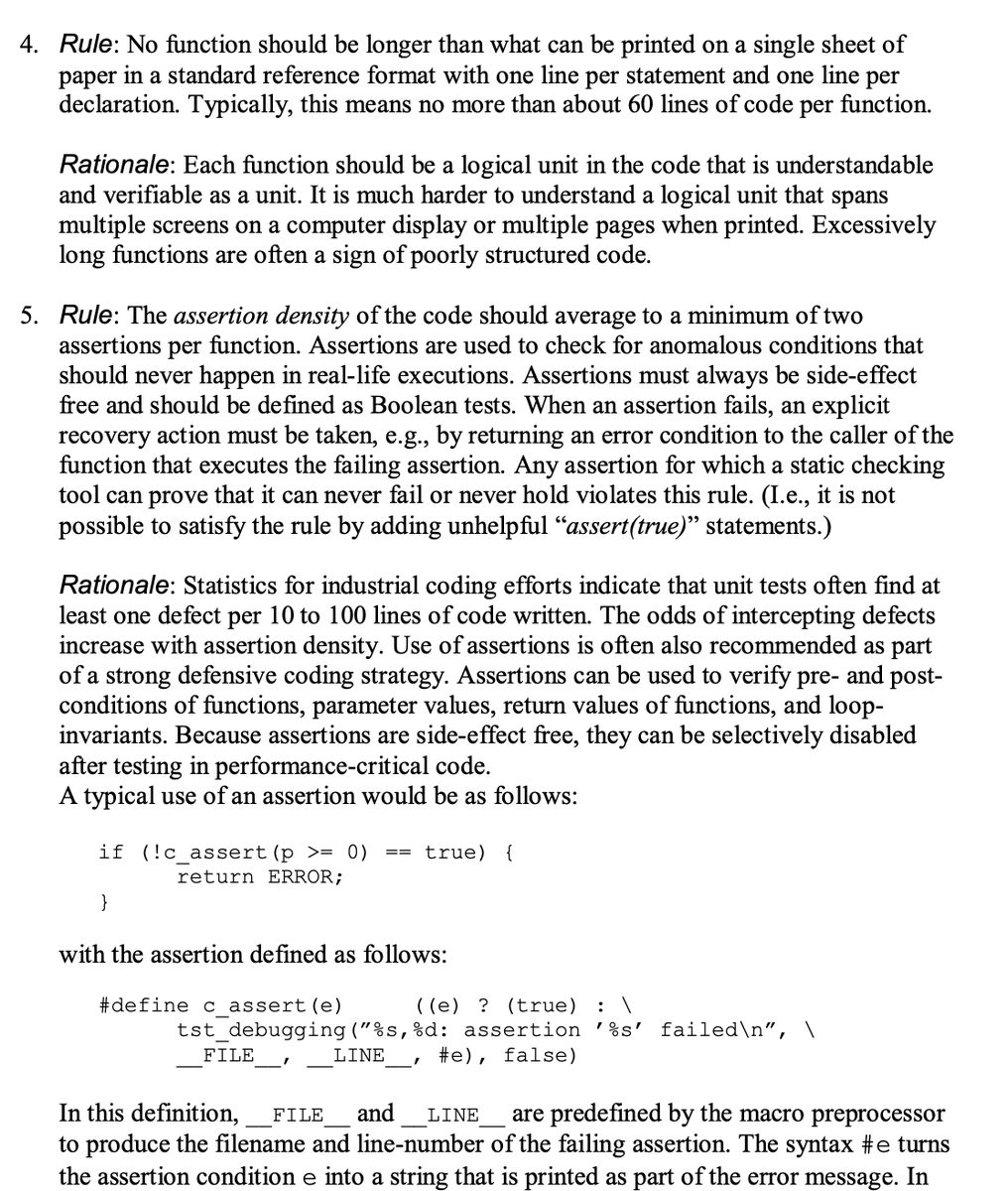
NASA writes mission-critical flight software in C.
And the rules are absolutely INSANE.
> No recursion. Ever.
> Every loop must have a provable upper bound.
> No dynamic memory allocation after initialization.
> Max ~60 lines per function.
> Minimum 2 assertions per function.
> Every return value must be checked.
> Zero compiler warnings allowed.
> Daily static analysis. Zero warnings there too.
> No function pointers.
> Restricted pointer dereferencing.
This is how they write code at NASA / JPL for mission-critical systems.
Google isn’t trying to win the AI race.
They’re trying to own the entire AI Agent ecosystem.
While everyone argues ChatGPT vs Claude, Google quietly built:
Models → Gemini Pro, Flash, Deep Think, Gemma
Design → Stitch, Whisk, Imagen
Research → NotebookLM, AI Mode
Video → Veo, Flow, Google Vids
Coding → Antigravity IDE, Gemini CLI, Jules
Agents → A2A, ADK, FileSearch API
The scary part?
All of these tools talk to each other.
That means:
10x faster prototypes
End-to-end AI workflows
Production-ready agents on GCP
The next AI war won’t be model vs model.
It’ll be ecosystem vs ecosystem.
I mapped this stack out here:
https://t.co/G3hahQclKI
Save. Share. Build.