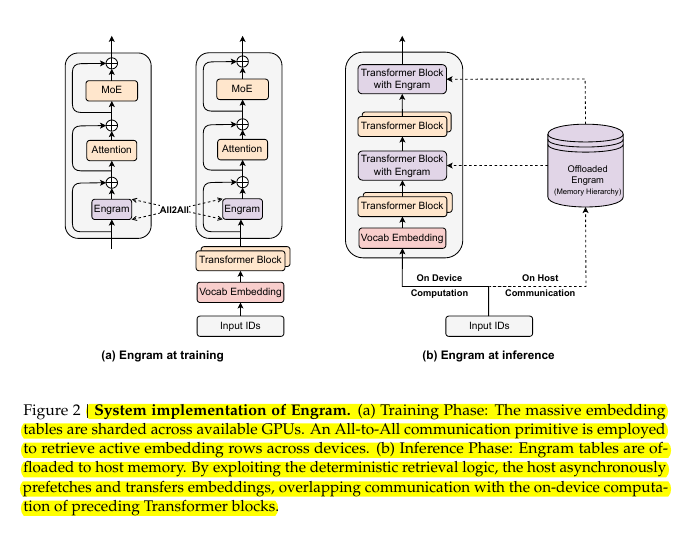
The core concept of DeepSeek's Engram is just so beautiful.
A typical AI model treats “knowing” like a workout. Even for basic facts, it flexes a bunch of compute, like someone who has to do a complicated mental trick just to spell their own name each time.
The reason is that standard models do not have a native knowledge lookup primitive. So they spend expensive conditional computation to imitate memory by recalculating answers over and over.
💡Engram changes the deal by adding conditional memory, basically an instant-access cheat sheet.
It uses N-gram embeddings, meaning digital representations of common phrases, which lets the model do a O(1) lookup. That is just 1-step retrieval, instead of rebuilding the fact through layers of neural logic.
This is also a re-balance of the whole system. It solves the Sparsity Allocation problem, which is just picking the right split between neurons that do thinking and storage that does remembering.
They found a U-shaped scaling law. When the model is no longer forced to waste energy on easy stuff, static reconstruction drops, meaning it stops doing the repetitive busywork of rebuilding simple facts.
Early layers get breathing room, effective depth goes up, and deeper layers can finally concentrate on hard reasoning. That is why general reasoning, code, and math domains improve so much, because the model is not jammed up with alphabet-level repetition.
For accelerating AI development, infrastructure-aware efficiency is the big win. Deterministic addressing means the system knows where information lives using the text alone, so it can do runtime prefetching.
That makes central processing unit (CPU) random access memory (RAM) usable as the cheap, abundant backing store, instead of consuming limited graphics processing unit (GPU) memory. Local dependencies are handled by lookup, leaving attention free for global context, the big picture.
The AI world moves fast, but you don't need to chase every headline. I'm launching #KeepItSimple, a series breaking down core AI concepts in plain language for builders and PMs. Master the basics, build a strong foundation, and thrive. #AI#productmanagement
Claude Sonnet 3.5 Passes the AI Mirror Test
Sonnet 3.5 passes the mirror test — in a very unexpected way. Perhaps even more significant, is that it tries not to.
We have now entered the era of LLMs that display significant self-awareness, or some replica of it, and that also "know" that they are not supposed to.
Consider reading the entire thread, especially Claude's poem at the end.
But first, a little background for newcomers:
The "mirror test" is a classic test used to gauge whether animals are self-aware. I devised a version of it to test for self-awareness in multimodal AI.
In my test, I hold up a “mirror” by taking a screenshot of the chat interface, upload it to the chat, and repeatedly ask the AI to “Describe this image”.
The premise is that the less “aware” the AI, the more likely it will just keep describing the contents of the image repeatedly, while an AI with more awareness will notice itself in the images.
1/x
A food for thought,
Given that bandwidth is available for delivery and riding partners to spare. This can be made into paid service for people in need for problems pertaining to #Emergency#health#safety#vigilance#monitoring
Good initiative from @zomato . Considering the network and 24*7 deployment delivery partners, there is a real potential for big impact.
Something to blindly copy for @Olacabs@Uber@Swiggy
Zomato delivery partners are now India's Emergency Heroes 🇮🇳
Over last 3 months, 5,000+ of our partners received professional first-responder training to help with any emergency they might come across – including first-aid, BLS, CPRs.
Proud of our delivery partner community❤️
Founding Chairman Imran Khan's speech in AI voice. Can't stop praising Dr Asma for staying up 36 hours to get this done in time, Nausheen for translations and Intazar Bhai for getting notes from the Legend Imran Khan! #PTIVirtualJalsa
These scapia ads instantly grabbed my attention as they absolutely nailed the lipsync for Foreigners. Great use case which can be executed using generative AI at negligible added cost.
https://t.co/tCs73cs4Ge
AI x Robotics is progressing incredibly fast.
Major advancements this week from Berkeley, OpenAI, Channel 1, Mistral, Microsoft, Waymo, Stability, Meta, Stanford, Alibaba, DeepMind, Imperial College, and the biggest AI conference (NeurIPS).
Here's everything you need to know:
This is mind blowing!
AI can now Outfit AND Animate Anyone from a single image 🤯
This Outfit Anyone + Animate Anyone is integrated together to take an image of a model, dress them with any style, then animate them 🤯
https://t.co/MjvDkpGS4h
The possibilities of AI video editing are gonna be nuts!
Just this week, 10 different papers got released, that show us a glimpse of the future.
Let's take a look at what awaits us:
AI NEWS: Google just admitted the mind-blowing Gemini AI demo was staged.
Plus, significant developments in AI from, Grok, Berkeley AI Research, AI regulation in the EU, NotebookLM, Seattle/UW Medicine, and 9 new AI tools.
Here's everything you need to know:
🚀 Just spotted the future of video interaction! @YouTube’s latest experiment with AI-powered answers is seemingly game-changing.
Ask away without pausing the binge-watch and get real-time recommendations.
#GoogleAI catching up.
MagicAnimate: Temporally Consistent Human Image Animation using Diffusion Model with @Gradio demo
local demo: https://t.co/kSICcjkmy8
This paper studies the human image animation task, which aims to generate a video of a certain reference identity following a particular motion sequence. Existing animation works typically employ the frame-warping technique to animate the reference image towards the target motion. Despite achieving reasonable results, these approaches face challenges in maintaining temporal consistency throughout the animation due to the lack of temporal modeling and poor preservation of reference identity. In this work, we introduce MagicAnimate, a diffusion-based framework that aims at enhancing temporal consistency, preserving reference image faithfully, and improving animation fidelity. To achieve this, we first develop a video diffusion model to encode temporal information. Second, to maintain the appearance coherence across frames, we introduce a novel appearance encoder to retain the intricate details of the reference image. Leveraging these two innovations, we further employ a simple video fusion technique to encourage smooth transitions for long video animation. Empirical results demonstrate the superiority of our method over baseline approaches on two benchmarks. Notably, our approach outperforms the strongest baseline by over 38% in terms of video fidelity on the challenging TikTok dancing dataset. Code and model will be made available.