Fairground does not use traditional liquidity pools. There is no AMM pool or shared LP vault that traders deposit into.
Liquidity is supplied by market makers and LPs who post No-rush orders on both sides of a market. Those orders sit in the residual of the matching cycle and fill against leftover standard order flow at the current oracle price. They never fill against other No-rush orders, and placing them does not start a matching cycle.
The economic model is built around that:
Standard orders (market and limit) pay an impact fee (0–5 bps) priced from external venue slippage. When they fill against a No-rush order, the No-rush side receives that impact fee.
The open interest created by a No-rush fill is tagged eligible for rebates. Rebates accrue continuously on that eligible size while it remains open and are paid when the position is reduced or closed. The rebate pool comes from trade fees plus impact fees from standard-vs-standard matches.
No-rush orders still pay the trade fee, but can receive a volume-based discount (down to 0.5 bps) based on the wallet’s No-rush volume over the prior 14-day window.
A typical maker approach is to post large long and short No-rush orders, hold the resulting two-sided open interest to collect rebates, and rely on the impact fee when standard flow hits that liquidity. Because there is no price threshold, the maker must be able to hedge the position that results.
In short, @Fairgroundfi 's “pools” are just the resting No-rush size on each side. Traders take liquidity with standard orders and pay for it; makers supply residual liquidity with No-rush orders and get paid via the impact fee plus rebates on the eligible open interest they create.
Docs: https://t.co/3Vdd7XZugX
@Fairgroundfi@ForteProtocol
While a market is closed, orders do not fill. That includes orders you place during the closure and orders that were already resting (limits, stop losses, take profits). They simply sit until the market reopens and become eligible again.
Because fills always happen at the oracle price, a gap between close and reopen is possible. The first matching cycle after the open uses the new oracle reading. Matching itself still only runs when a standard order is placed or a matching transaction is sent.
The rule is simple: if the underlying is closed, @Fairgroundfi does not fill. No weekend surprise fills on FX or commodities. Crypto keeps moving.
Docs: https://t.co/MEuOPOcglM
Testnet just ended. Hours follow the underlying market conventions.
Crypto never sleeps. FX and commodities do.
Fairground follows the underlying market’s hours instead of forcing 24/7 on everything.
Crypto markets are open 24/7 with no daily close and no weekend halt.
FX is open 24 hours a day, 5 days a week:
Opens: Sunday 5:00 PM ET
Closes: Friday 5:00 PM ET
Commodities generally follow CME Globex hours:
Opens: Sunday 6:00 PM ET
Closes: Friday 5:00 PM ET
Gold (XAU) and silver (XAG) have an extra 60-minute break each day starting at 5:00 PM ET. All times are US Eastern. Stocks are not listed yet; when they are, they will follow regular NYSE/NASDAQ hours (9:30 AM - 4:00 PM ET, Monday–Friday) plus holiday exceptions.
@Fairgroundfi@ForteProtocol
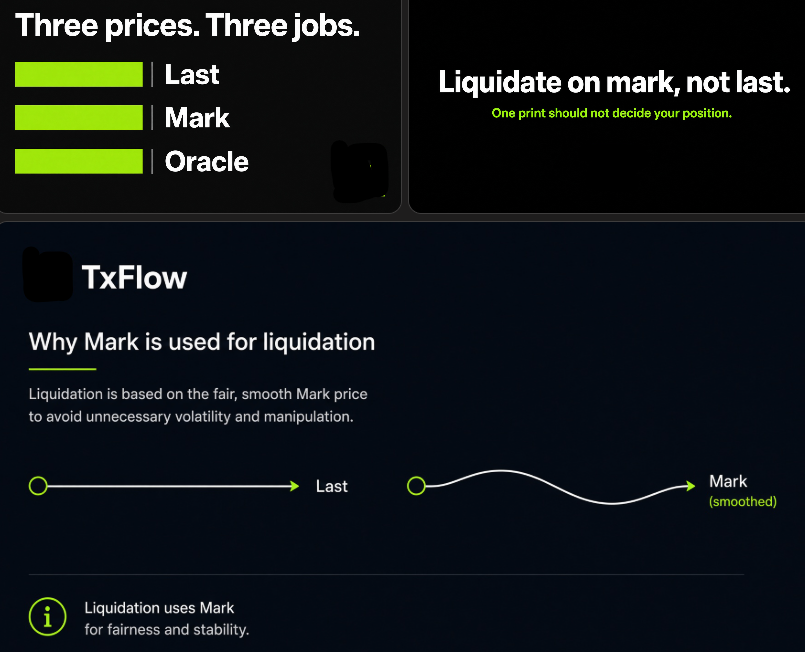
Three prices, three jobs - why TxFlow liquidates on mark, not last
A perpetual on @TxFlow_L1 does not have one price. It has three, and mixing them up is how people get surprised. Last is simply the most recent trade on the book. It drives what you see and what you get filled at.
Mark is a smoothed fair price. It is what values your position, calculates unrealized PnL, and decides whether you get liquidated.
Oracle is an aggregated external reference for the underlying. It is the anchor that funding uses to pull the contract back toward the real market.
Liquidation deliberately ignores the last price. On thin books a single aggressive order can print a wick that would liquidate healthy positions if last were used. Mark is smoothed on purpose so one print does not decide the outcome. Your position is measured against a price that reflects the broader market, not one trade.
Funding does the longer-term job. The oracle publishes the rate based on how far the contract is trading above or below that external reference. When the contract is rich, funding is positive and longs pay shorts. When it is cheap, shorts pay longs.
The actual payment is calculated on your notional at the mark price:
funding payment = (size × mark price) × rate
Default cycle is hourly. Isolated positions adjust the position margin directly; cross positions adjust account equity. Both mark and oracle are published on-chain by validators every block and are identical for every trader, no per-user price.
The practical edge is simple. Watch mark for liquidation risk. Watch the gap between the contract and the oracle for funding direction. The last price is just the tape. Because everything is on-chain and the rules are deterministic, you can verify which price drove any liquidation or funding event by replaying the block.
Still early. The book is public, the prices are public, and the distinction is explicit. If you trade size, knowing which price does what is the difference between getting wicked and staying in the trade.
Appreciate if you could use my referral, it gives you 5% off perp, spot fees, and a $50 bonus trading fee credit.
Referral Link: https://t.co/PM794Lkr0f Referral code: TXSHADOWSP
@TxFlow_L1@kaisrr3a
TxCore consensus of @TxFlow_L1 is "Tx-BFT", a DAG based Byzantine Fault Tolerant protocol that orders transactions for the trading state machine.
1. How Tx-BFT works
Validators do not wait for a single leader to propose the next block. Instead they organize transaction batches as vertices in a directed acyclic graph (DAG) in parallel. Each vertex is one validator’s batch for one round and references a 2f+1 quorum of the previous round. Because there is no leader bottleneck, validators can extend the DAG concurrently.
From that DAG the protocol deterministically extracts a single globally consistent commit sequence. Every honest node derives the same order from the same DAG. A batch reaches finality once a 2f+1 quorum of voting power confirms it. Finality is irreversible, there are no chain reorganizations.
2. Between clients and consensus
A transaction batcher sits in front of consensus and groups incoming transactions into batches to amortize overhead. It exposes three confirmation states to clients:
- Submitted: accepted and handed to consensus
- Included: placed into a proposed block
- Committed: reached the 2f+1 quorum and is final
3. Consensus output
For each committed batch, consensus emits three things:
- a globally sequential block number
- a commit digest
- a consensus timestamp, the finality time agreed by the validators for that batch
That consensus timestamp is the only clock the state machine uses. Funding settlement, GTD order expiry, TWAP slicing, and any other time-dependent logic all key off it. The state machine never reads wall-clock time, so every node produces identical results.
4. Execution after consensus (TxCore)
Once a batch is committed, TxCore executes it as a single-threaded deterministic state machine. Execution follows fixed stages:
1. Signature verification (EIP-712)
2. Deterministic ordering derived from the committed sequence
3. Per-transaction execution (nonce check → route to match / clear / transfer / etc.)
4. Block-tail processing (funding, margin recomputation, liquidation checks, ADL). An oracle update in the same block forces a full margin recalculation.
5. Event emission
Because the rules are fixed and the input sequence is identical, every node that replays the block produces byte-for-byte the same state. Matching, clearing, margin updates, and liquidations all complete atomically inside that single state machine.
5. Practical result
Tx-BFT gives TxCore parallel proposal capacity without a leader, irreversible finality at 2f+1, and a single agreed timestamp that keeps all time-dependent trading logic identical across the network. The trading engine itself stays single-threaded and deterministic so any node can independently verify every fill, balance, and position by replaying the committed sequence.
@TxFlow_L1@kaisrr3a
@TxFlow_L1 Android users finally get to ape into vaults and climb the leaderboard from the couch while iOS folks are still refreshing the web tab like it's 2019. This is the way.
Big thanks to the @Fairgroundfi team for the 200K+ bonus XP drop for Season 4 for the most active traders!🙏
Really appreciate the loyalty XP for those who stayed active throughout the season, plus the feedback XP for everyone who completed the Season 4 survey. Both dropped at the same time. Feels good when a team actually recognizes consistent participation and takes the time to reward people who give genuine feedback.
Been trading on the testnet for a while now and the zero funding fee model is genuinely different once you get used to it. When mainnet fully opens to everyone, a lot of people are gonna wish they paid more attention during these seasons. The trading experience already feels cleaner than most perps platforms.
Don't sleep on this one once it goes live for all.
@Fairgroundfi@ForteProtocol
Typical flow for a terminal or wallet:
1. User connects wallet (the address is the account).
2. User deposits USDC into the Perps sub-account.
3. User approves your builder fee.
4. User (or your agent) authorizes an agent key if you are placing orders programmatically.
5. You submit orders with the builder object attached and stream fills/updates.
Testnet is open. Mainnet builder codes require an application and whitelisting. Most teams are expected to go live soon once the testnet flow is working.
What this means in practice?
- You get the full on-chain CLOB, margin engine, and liquidation system without operating infrastructure.
- Shared liquidity is available across the markets listed on TxFlow.
- Builder fees sit on top of the platform’s own trading fees.
- The same integration path works for outcome (prediction) markets as well, with a higher fee cap (1%).
Live examples already exist (trading terminals and algorithmic platforms routing to TxFlow). The order book itself stays on TxCore under Tx-BFT; the builder layer is just the attribution and fee mechanism for anyone routing flow to it.
@kaisrr3a@TxFlow_L1
TxFlow perps integration is built around a single on-chain order book that external apps, wallets, bots, and terminals can route to without running their own matching engine or holding user funds.
How the perps live on the L1?
Perpetuals run natively inside 'TxCore', the trading state machine of the @TxFlow_L1 . Matching (price-time priority CLOB), margin (cross or isolated), funding, and liquidation all execute inside consensus as deterministic state transitions. Every order, cancel, fill, and liquidation is a public transaction that any node can replay. Tx-BFT provides the ordering. There is no separate off-chain matching engine for the core book.
Users hold a single account with separate sub-accounts. The Perps sub-account holds the margin and positions. Deposits arrive as USDC (currently bridged; native issuance is the longer-term path via TxEVM). Settlement, PnL, and risk checks happen on-chain.
@kaisrr3a@TxFlow_L1
Builder integration (the main external path):
The practical way for third parties to integrate TxFlow perps is the 'Builder Program'. You do not operate the book. You route signed orders to it and attach your own fee.
Key mechanics:
- User signs an `approveBuilderFee` once from their main wallet, setting your builder address and a maximum fee rate.
- You attach a `builder` object to each `order` action: `{ "b": "yourAddress", "f": feeInTenthsOfBp }`. The order signature covers it.
- On perps the maximum builder fee is 0.1% (`f` ≤ 100). If the user has not approved you or the fee exceeds the cap, the builder fee is simply ignored and the order still fills.
- You need at least 100 USDC in your own Perps account to be eligible to accrue fees.
- Claim accrued fees with `claimBuilderRewards` (signed by your agent key). They land in your Perps account.
Integration surface:
- Reads: `POST /info` (balances, positions, open orders, market metadata, book, etc.)
- Writes: `POST /exchange` (signed actions: order, cancel, leverage/margin updates, approveAgent, approveBuilderFee, claimBuilderRewards, etc.)
- Streams: WebSocket for order book, trades, account updates, and fills
- Signing is standard EIP-712. Mainnet chain ID is 869; testnet is 2511. No API keys required.
- Agent keys let a bot or backend place orders on a user’s behalf after the user has authorized the agent.
@kaisrr3a@TxFlow_L1
Fairground Closed Alpha is still open! But the window is narrowing.
They are reviewing applications for mainnet now. Limited spots, judged on real perps history. An application does not mean admission.
Quick updates from the @Fairgroundfi team:
• Apply with a wallet that actually shows your trading activity. If you are still on your Fairground testnet wallet, disconnect and switch to one with history on other venues. Already submitted? You can send a new application with a stronger wallet.
• Mostly on CEXs? The form now lets you add recent volume and VIP status. Already applied? You can resubmit with that info.
• Know other serious perps traders? Share the link. Every spot is reviewed.
Apply here: https://t.co/QMCcCEoM0M
If you have been trading perps, this is the cleanest way in before they close the list. Use the wallet that proves it.
Prediction markets on @TxFlow_L1 price probability the same way the order book prices risk!
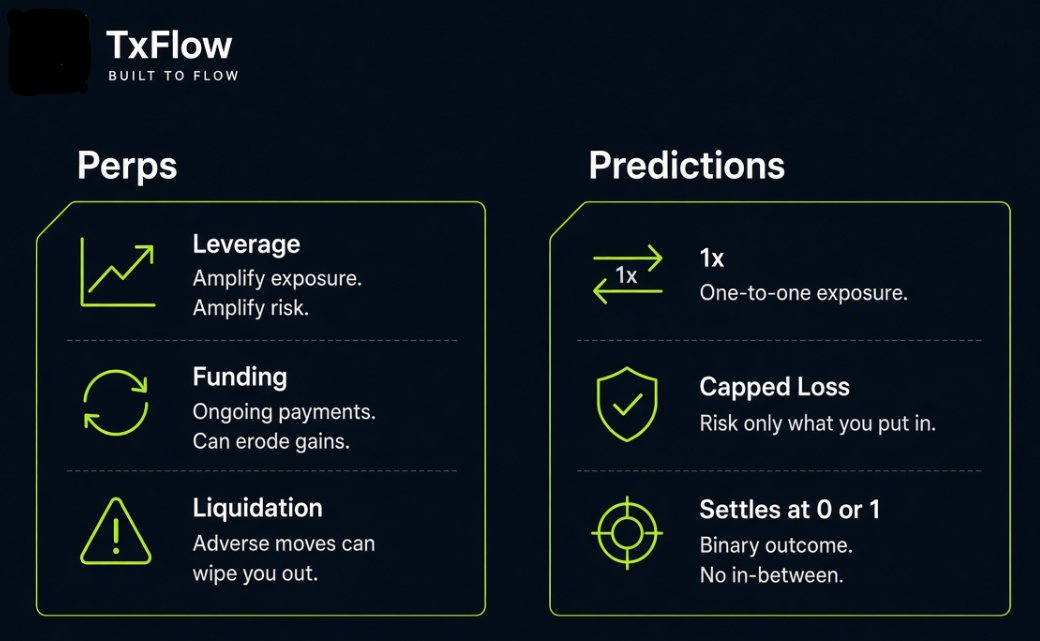
You trade the outcome of a future event instead of the price of an asset. Each market asks one question. You buy YES or NO (or one of several listed outcomes). The price of the share is the market’s implied probability: a YES trading at $0.63 is pricing roughly a 63% chance. In a binary market the two sides stay close to summing to $1. Small gaps come from the spread and available size.
Payout is binary. A winning share settles at $1. A losing share settles at $0. Buy 100 YES at $0.60 and it costs you $60. If you’re right you get $100. If you’re wrong you get nothing. Max loss is capped at what you paid. No leverage, no funding, no liquidation. You can also exit early by selling into the book if liquidity is there. The position is just another instrument on the same matching engine.
Binary markets are the straightforward YES/NO case. Category markets list multiple outcomes with only one winner; the YES prices across them roughly sum to $1. Crypto up/down markets are binary but keyed to a specific reference price and observation time spelled out in that market’s resolution rules. Everything is powered by Probly as the events provider. TxFlow supplies the on-chain matching, margin, and settlement. Outcome markets reuse the same position machinery as perps under the hood, with a fixed-price split/merge layer so you can create a complete YES+NO set from margin collateral or merge matched legs back.
Resolution follows published rules for each market: source, observation window, what counts as YES, and how delays or missing data are handled. Settlement is automatic once the result is confirmed. Proceeds credit in USDC. Cancelled or invalid markets follow the rules published for that specific market. Trading can close before the event resolves.
The interesting part is that it sits on the same L1 as the perps and spot books. Same consensus, same public fills, same ability to read the live book. Probability is just another instrument that clears inside the state machine instead of living in a separate system. Volume on the perp side is already large. The prediction side is still early and thin in places, which is exactly when the edge is highest if you actually read the resolution rules and trade the book instead of the headline.
If you want to trade probability on the same chain that already runs the order book, join here -
Referral Link: https://t.co/PM794Lkr0f Referral code: TXSHADOWSP
@TxFlow_L1@kaisrr3a
@TxFlow_L1 One suggestion for @TxFlow_L1 team - As a goodwill gesture to community and traders, please allocate some additional points when one gets liquidated.
Price and margin:
Closes and reductions happen at the oracle price, or at the computed close-out price in the extreme case. Leftover margin on the closed at-risk positions stays with the protocol. Opposite-side positions simply shrink; their remaining margin stays attached to the reduced size.
Relation to the insurance fund:
The fund is the normal backstop for underwater liquidations. Each market can only draw a fixed percentage of the total fund per close-out. @Fairgroundfi ADL exists so that a single market cannot drain more than its budget. Once the budget is at or past its limit (or a small further move would push it over), ADL replaces further normal liquidations on that side.
In ordinary conditions the fund covers the shortfall and ADL stays off. It only appears when the budget for that market is already threatened.
Explaining ADL mechanics in @Fairgroundfi
ADL on Fairground is the last-resort solvency mechanism. It only runs when liquidation losses would consume too much of a market’s insurance fund budget.
Trigger logic:
The protocol periodically scans positions that are already severely at risk (margin ratio well below the normal liquidation level). It calculates two deficits against that market’s insurance fund budget (a fixed percentage of the total fund):
> Current deficit - dollars needed to settle the at-risk positions at the current oracle price.
> Shock deficit - dollars needed if price moved a further small percentage against them.
Then:
> Shock deficit still inside the budget → no ADL. Normal liquidation continues.
> Current deficit inside the budget but shock deficit over it → ADL triggers preemptively at the current oracle price.
> Current deficit already over the budget → ADL triggers at a computed close-out price chosen so the settlement exactly fits inside the budget. In this case the market may also be halted.
Who is affected?
ADL acts on one side of the market at a time.
> At-risk (losing) side: every position whose margin ratio is below the ADL threshold is fully closed, even if some margin remains. That remaining margin is not returned.
> Opposite side: every position is reduced by the same percentage. The percentage equals the closed size as a share of total open size on that side. Example: if the closed size is 5% of the opposite side’s open size, every position on that side is cut by about 5%. Reductions are rounded to valid order sizes, so individual cuts can be slightly more or less. Profitability of the individual position does not matter.