@LiveLawIndia I appeared pro bono for the petitioner to assist him in this fight for justice. Happy to note that this important case is being reported.
#BREAKING | In a landmark ruling, the #SupremeCourt has issued binding guidelines to end delays in High Courts - setting hard deadlines on reserved judgments, bail orders, and pronouncement of reasons:
Key directives to High Courts:
• Reserved judgments to be pronounced within 3 months
• Bail orders ideally next day; communicated to jail same day
• Undertrials to be released same day or next day at latest
• Operative part announced in court; reasons uploaded within 7 days
• Judgment reserved date to reflect on HC website
• Non-compliance: case reallocated to another bench
• Reasons not uploaded within 30 days: case can be withdrawn to fresh bench
Registrar Generals of all High Courts directed to place guidelines before respective Chief Justices.
The Chief Justice's "cockroaches" remark, and the clarification that followed, revive a question Indian law has tried to settle twice. When a judge speaks from the bench and the speech wounds, what standard governs?
@vvenkatesan’s piece in The Hindu today traces how the standard has held, and where the “clarification” falls short.
The Bombay High Court judge got miffed with the plaintiff and adjourned the matter to 2046. The judge was of the view that the defamation suit could be resolved by tendering an unconditional apology. However, the plaintiff, who is close to 90 years old, still insists on pursuing the defamation suit.
ALL NINE COPS TO BE HANGED!!!
In a landmark judgement, the honourable First Additional District and Sessions Judge of Madurai, G Muthukumaran pronounced death penalty for all nine policemen in the Jeyaraj and Beniks custodial torture and death case.
Inspector S Sridhar, sub-inspectors P Ragu Ganesh & K Balakrishnan, head constables S Murugan and A Samidurai and constables M Muthuraja, S Veil Muthu, S Chelladurai & X Thomas Francis have all been found guilty of the double murder.
On 19th June 2020, Jeyaraj went to his son’s mobile shop in at Sathankulam in Thoothukudi. Police arrested him for violating Covid rules.
Following the father’s arrest, Beniks went to the police station and requested for his father’s release. Beniks apparently had an argument with the cops. They arrested him also and tortured him and his father through the night and later sent to judicial remand.
Beniks died at Kovilapatti Government Hospital on 22nd June, 2020, and Jeyaraj passed away the next day.
The investigation later revealed that the mobile shop wasn’t open beyond the permissible hours. Basically a false case was slapped.
Later, a female constable, Revathi came forward to tell the truth of their torture. Not only were the son & the father beaten brutally throughout the night but were also made to clean up their blood off the police station floor and walls with their clothes.
Beniks sustained 13 external injuries and Jeyaraj had 17 wounds that ultimately led to their deaths. They were bleeding from their rectums when they were sent to jail!!!
Following a huge social media uproar and protests, there was pressure on the then Tamil Nadu government to conduct a fair investigation into their deaths.
If you go through the whole case, you will realise that 59 year old Jeyraj and 31 year old Beniks were killed purely because the ego of the policemen was hurt.
They were angry that Beniks questioned why his father was arrested and being beaten up.
Family of the victims hope this will be a lesson to all policemen who think they can get away with any crime.
But unfortunately in our country most police don’t play by the rules. It is either their ego or orders from above or corruption that drives them. Hoping for better policing and a system that stands for victims, especially the voiceless ones.
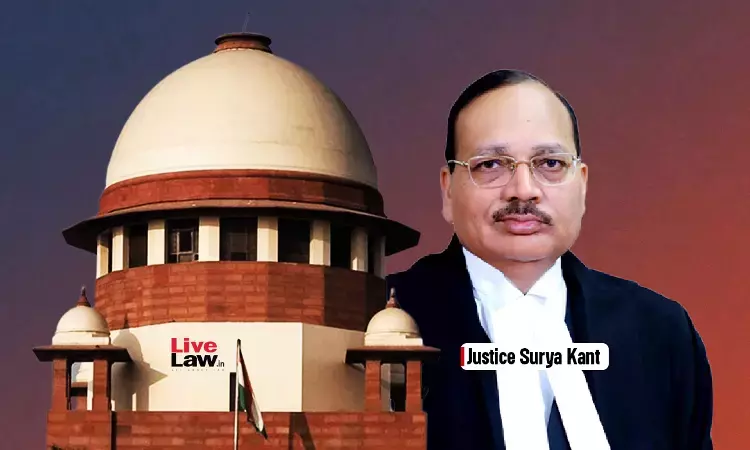
CJI Surya Kant slams a person for making a phone call to his brother over an order passed by him
"Why should there not be contempt proceeding against your client? He dares to call my brother on phone and tells how CJI has passed this order? He will dictate me? You verify, and then as a counsel, first you should withdraw! Even if he hides out of India, I know how to deal with these kind of people. Never ever dare to do it. I have dealt with these kind of elements for last 23 years" CJI said to the person' counsel
Two days ago an uninformed @IndianExpress reporter did a hit job on a fine judge of the Allahabad High Court. The newspaper proprietor amplified the story with a gotcha tweet. This response by a member of the Allahabad bar, tells you the reality of the situation. The newspaper needs to apologise to its readers first and then reconsider its position. In an era where courts are hesitant to grant bail, such hit jobs only compound human misery and promote unnecessary incarcerations
https://t.co/vr1iGafaaB
I was reflecting on the contrasts with China that the sorry, shabby Loomer episode illustrates.
The contrast I refer to is not about openness versus control. It is about attitudes toward hierarchy and self-respect in public life.
What Kissinger noticed in 1971 about India was was a tendency toward obsequiousness when confronted with Western power or proximity to it. That instinct has deep historical roots. The word “khushamd” in Persian and Urdu literally means flattery offered to please someone in authority. In everyday usage it shades into something darker: ingratiation, calculated praise, the art of pleasing those above you in the hierarchy. British administrators in colonial India became fascinated by the term because they believed it captured a social habit they encountered repeatedly in courtrooms, durbars, and bureaucratic dealings.
For two centuries the subcontinent lived under imperial structures in which advancement often depended on pleasing those above you in the hierarchy. The habits of speech that develop in such systems do not disappear overnight.
In a rigid hierarchy where power flows sharply from the top, people learn quickly that bluntness is risky. Survival and advancement depend on reading the moods of authority. Language becomes lubricated with praise because praise reduces friction. Over time this produces a political culture where deference becomes a technique.
China travelled through a very different historical arc.For most of its long imperial history China regarded itself as the civilisational centre. Foreign envoys were received within a carefully staged hierarchy in which the emperor’s court defined the terms of interaction. Visitors were expected to show deference to China, not the other way around. Even when China weakened in the nineteenth century, that cultural memory did not vanish. It remained embedded in the political reflexes of the state.
This difference becomes visible when modern outsiders arrive carrying the aura of Western political celebrity. In India the reception often slips, almost unconsciously, into a familiar pattern: excessive politeness, warm praise, eager listening, and visible admiration. Panels become stages of affirmation rather than interrogation. The visitor is not merely hosted; they are subtly elevated.
China almost never allows this dynamic to emerge.
Chinese officials may be courteous but the tone is controlled and emotionally neutral. Praise is sparse. Questions are disciplined. The visitor’s importance is carefully calibrated so that it never exceeds the authority of the host institution or the state itself. Even globally powerful figures encounter this restraint.
One can see it in how Chinese leaders treat Western visitors. They rarely flatter. They do not perform admiration. They project calm authority and expect the guest to adjust to that frame.
In other words, status flows inward toward the state, not outward toward the visitor.
In India the flow often reverses. The visitor’s celebrity radiates outward, shaping the atmosphere of the encounter. A social media provocateur can suddenly appear larger than the forum that invited them.
This is what gives the Loomer episode its uncomfortable undertone. The issue is not free speech or the right to host controversial figures. Democracies must live with those realities.
The issue is the tone of reception.
When a platform meant for national conversation begins to resemble a stage on which outsiders are indulged and admired, the imbalance becomes visible. It is the same imbalance that Kissinger detected decades ago when he described Indians as masters of flattery.
China’s instinct would have been the opposite. A confident civilisation listens, questions, and reminds the guest that they soeak on someone else’s stage.
#IndiaTodayConclave
#Khushamdi
#PoliticalCulture
#IndiaUSRelations
#CivilisationalConfidence
#SoftPower
#IndiaChina
During his tenure as ACS of the Revenue and Land Reforms Department, Govt of Bihar, Vivek Sir fast tracked digitisation with such intensity that the department for the first time felt truly functional.
I once asked an officer in the dept what it was like working under him. The reply was telling:
"Sir... Hamari abhi shaadi nahi hui hai... Hone wali hai par humko lagta hai ki ACS Sir shaadi ke liye chutti bhi nahin denge! Aur agar shaadi ho bhi gayi, toh meri biwi mujhe divorce de degi. Itna jyada kaam ka pressure rehta hai."
Despite the relentless pace and his reputation as a hard taskmaster, Vivek sir, now RERA Chairman, remains one of the most respected figures among his colleagues and staff. He is a deeply grounded man who possesses a rare understanding of both land complexities and the government’s own failings.
His push for digital records was born from a firm conviction: corruption cannot be eradicated until the land system is fully transparent and digital.
He even convinced the Chief Minister to slash the cost of land registries within family to just ₹100. The CM, who always prioritised law and order, backed this historic move because he was persuaded by the logic - that the vast majority of crime and litigation in Bihar stems from a single source: land disputes.
Making certified land maps easily available to common people, instead of travelling to Gulzarbagh govt press from remore districts and waiting for months, was another decision that I greatly admire.
Ever wondered why land disputes in India never seem to end?
In this brilliant piece for The Pioneer, Vivek Sir explores how a "structural confusion" between the courts and the executive is stalling progress. It is a vital read for anyone interested in why digital, state certified land titling is the only way forward to ensure transparency and stop the endless cycle of litigation.
Link: https://t.co/weS3aRJeWy
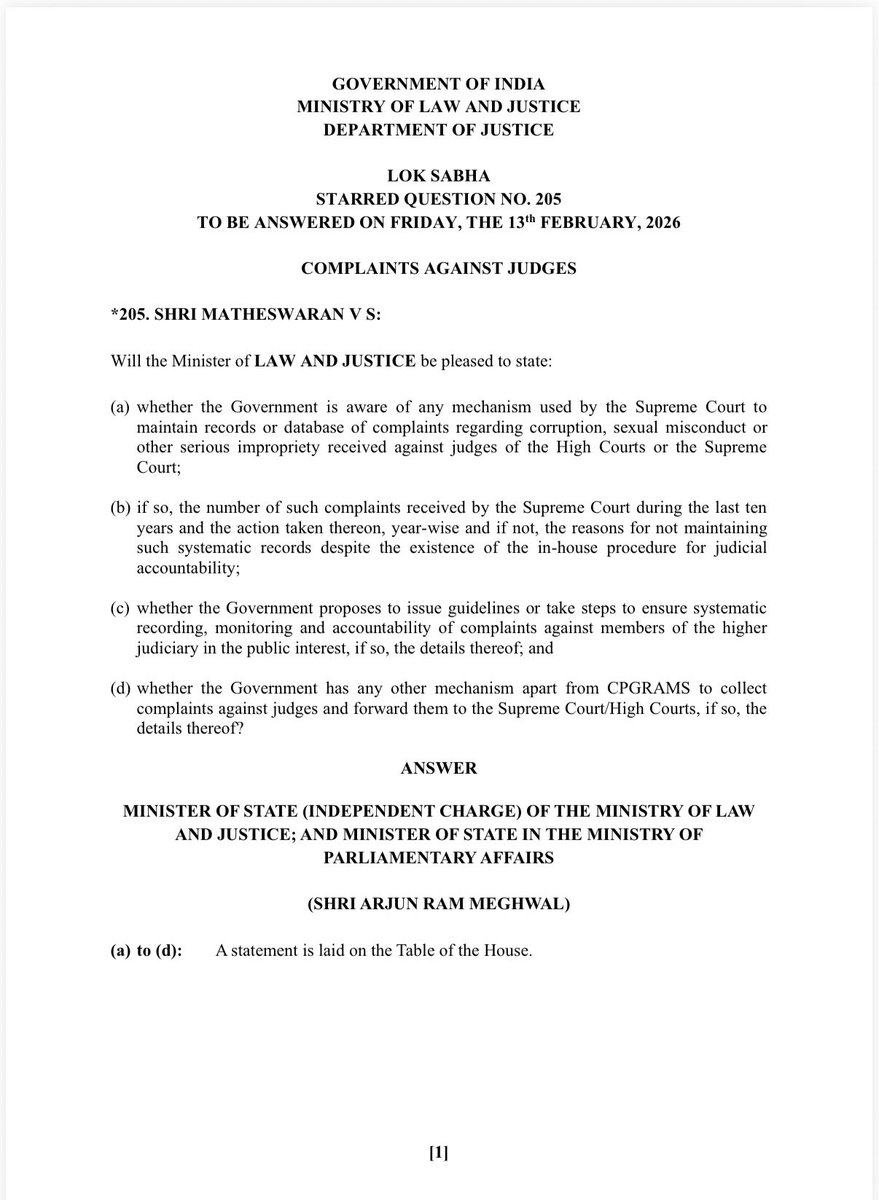
#BREAKING: Over 8,600 complaints were received against sitting judges by the Office of the Chief Justice of India in last ten years alone!
The Supreme Court of India presented this data to the Union Law Ministry in response to a Parliamentary question by Mr. Matheswaran V.S.
It is not known what transpired in each of these complaints, and how, and IF AT ALL they were processed by the CJI’s office. Judicial corruption is a burning issue today and the system stands exposed.
Although the MP asked what action was taken in each of these complaints, the Parliamentary answer is mute on that point. The government is also mute on bringing guidelines or mechanism to record, maintain, and deal with such complaints.
However, the MORE WORRYING and SHOCKING point is this:
Before the Delhi High Court in my case on corruption and misconduct complaints against former Madras High Court Acting Chief Justice T. Raja, the Supreme Court Registry has sworn on the affidavit that it does not maintain data in the format sought for. But HOW did it give year-wise data to the Parliament then?
So is the Supreme Court Registry lying on oath before the Delhi High Court? If so, this is UNPRECEDENTED and the strongest of actions ought to be taken against those shielding a certain judge by denying data! Who is shielding? Why are they shielding? And what fear do they have to simply answer a yes or no to my RTI question? Even going to the extent of misleading the Hon’ble High Court. The system stands exposed today! Accountability must follow.
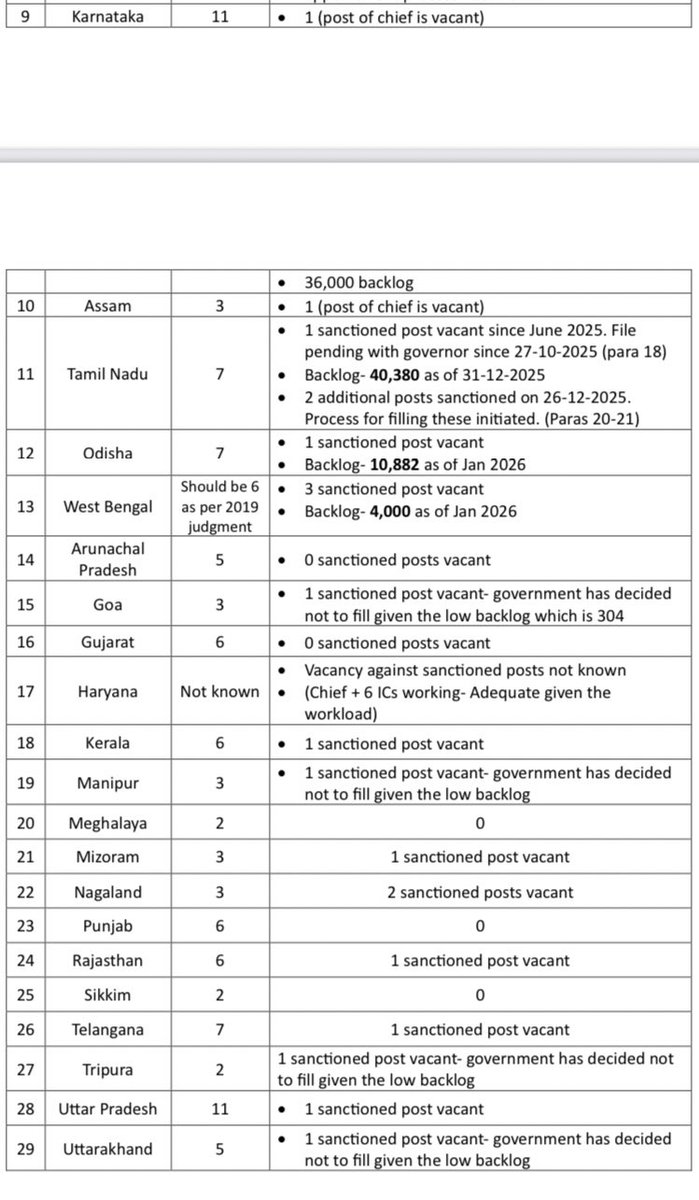
Today our case regarding non-appointment of information commissioners was heard by SC. Finally, after several orders of the court all vacant posts in the CIC have been filled though the deliberations & minutes of the selection committee, dissent note of LoP, short-listing criteria have not been placed in the public domain despite the directions in the 2019 judgment. SICs of Jharkhand & HP remain defunct. See table on state-wise status of information commissions & read thread on the hearing below-
In exercise of the power conferred by the Constitution of India, the President of India, after consultation with Chief Justice of India, is pleased to appoint Shri Ansul @ Anshul Raj, Advocate as a Judge of the Patna High Court. I convey my best wishes to him.
#AshutoshGowariker played an NRI - Mohan in episode America Return (Vapasi) of #ZeeTV anthology #YuleLoveStories (1993-94). He comes to meet his Kaveri Amma (late Kishori Ballal herself)
Do you think this inspired him to make #Swades (2004)?
#ShahRuhKhan
Here's an edited clip 👇