Relocating a large animal across international borders is, at best, a risky undertaking. Historical attempts to do so have often induced extreme stress in animals and disrupted their established bonds and social structures. The fate of the Modi government’s first batch of African cheetahs, which came from Namibia, has been grimmer than usual: five of the eight are dead.
@akhileshhpandey reports: https://t.co/oF4QLQBubS
The software deciding who gets on India's electoral roll is a black box. ERONET was built by C-DAC, quietly handed to TCS, and the Election Commission hasn't said a word about audits, versions or updates. Even judges, ex-ministers and veterans are getting SIR notices.
We're digging in with explainers, RTIs and questions to every body involved.
An independent Supreme Court worth its salt would take immediate suo motu cognizance of Indian Express report. There's nothing more central to Indian Constitution & democracy than fair & free elections. But Court has enabled fraud on electoral democracy. Indian democracy is dead
@appadappajappa 2015 also saw release of a few other interesting ones - Aligarh, Angry Indian Goddesses, Margarita with a Straw, Nil Battery Sannata, Parched, and Umrika, apart from Manjhi the Mountain Man!
@appadappajappa Originally, this was called The Prince of Wales Zoological Garden, and did you know? The initial animal collection came from the private menagerie of one Carl Louis Schwendler, a German electrician working on Indian Railways, along with generous donations from local citizens!
@appadappajappa been there; tried that. post cards are discarded, more often than not. put one inside an envelope, and stick on a 5 rupee stamp. much higher chance of it getting there.
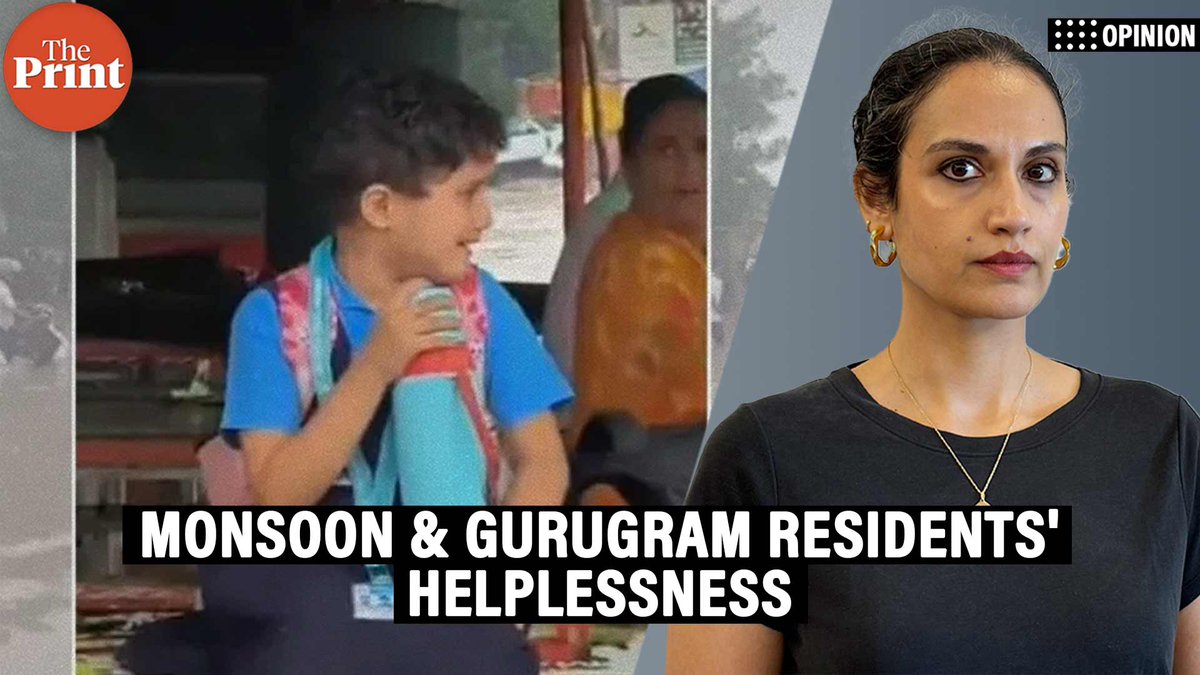
Gurugram is a city of private enclaves connected by public failure- Watch this week's column by ThePrint columnist Karanjeet Kaur @Kaju_Katri
https://t.co/tTQ6PZmzL5
Gloria Steinem’s India years—Miranda House, Gandhian activism, govt book & even a sari ad
Krishan Murari @krishan018 reports
#ThePrintFeature
https://t.co/ydcjgjmN8m
Statement: Delhi Police's facial recognition sweep at Jantar Mantar is unreliable and unlawful: the list of 2,873 must be withdrawn
New Delhi, 4 September 2026
The Internet Freedom Foundation (IFF) is gravely concerned by The Indian Express's investigation, published today, into the Delhi Police's claim that its Facial Recognition System (FRS) identified 2,873 persons with "criminal antecedents" at the Jantar Mantar protests of 20 to 26 July 2026. Of the 205 persons accused of murder, rape and attempt to murder whom it checked, the Express found that at least 25 were lodged in Tihar, Mandoli or Rohini jails when the software placed them at the protest. Some had been in custody for years. This is not a marginal error as it displays a 12 per cent rate of demonstrable impossibility in the only sample independently verified, with no reason to believe the remaining 2,668 names are any better. Yet on 1 September 2026, at the Union's request, the Supreme Court, while quashing all FIRs against student protesters under Article 142, permitted the Delhi Police to register "fresh and specific" FIRs against these 2,873 persons. The Court was entitled to assume that the sworn affidavit of 17 August 2026 rested on verified facts, however these appear to be subject to further verification.
A system the police know to be unreliable
In a 2022 RTI reply to IFF, the Delhi Police disclosed that it treats a match as "positive" at a similarity score of just 80 per cent, and retains lower-scoring "false positives" for "empirical investigation". The system was procured in 2018 under the Delhi High Court's orders in Sadhan Haldar v. NCT of Delhi to trace missing children; the Court was later told its accuracy was around 2 per cent. A tool bought to find lost children is now building dossiers on protesters, which is a function creep.
In K.S. Puttaswamy v. Union of India (2017) 10 SCC 1, nine judges held that any intrusion into privacy must satisfy legality, necessity and proportionality. Legality requires a law, and there is none. The Criminal Procedure (Identification) Act, 2022 permits "measurements", including photographs, to be taken only from persons convicted, arrested or detained (Sections 3 to 5), not the scanning of every face at a lawful assembly against a police database. Neither the Delhi Police Act, 1978 nor the Bharatiya Nagarik Suraksha Sanhita, 2023 confers such a power. The "Crime Kundli" database against which 2,402 of these matches were run has no disclosed statutory basis or retention limit, and the affidavit does not say whether the 2,873 are convicts, accused, or merely named in a case.
A disproportionate assault on the right to protest
In Mazdoor Kisan Shakti Sangathan v. Union of India (2018) 17 SCC 324, the Supreme Court held that peaceful protest at Jantar Mantar is protected by Articles 19(1)(a) and 19(1)(b), and Anuradha Bhasin v. Union of India (2020) 3 SCC 637 requires the State to choose the least restrictive measure. Sifting thousands of faces to single out people for their status rather than their conduct fails every limb of that test. It also inverts the presumption of innocence: "field verification" means police at the doors of 2,873 households whose only established act is, at most, attending a protest, or, as the Express shows, not even that. The Court of Appeal of England and Wales held live facial recognition unlawful in R (Bridges) v. Chief Constable of South Wales Police [2020] EWCA Civ 1058 for leaving "too much discretion" to individual officers. Further, the UN High Commissioner for Human Rights (A/HRC/48/31, 2021) has called for a moratorium on remote biometric identification in public spaces, and the EU's AI Act (Regulation (EU) 2024/1689, Article 5(1)(h)) prohibits it for law enforcement save in narrow, judicially authorised cases.
Our demands
In July 2026, IFF wrote to the Commissioner of Police, Delhi, seeking an end to live facial recognition at protest sites, deletion of protesters' facial templates and match results, and publication of the governing SOPs. Those demands stand. Today we further call upon:
1. The Delhi Police to withdraw the list of 2,873 persons, place the Express's findings before the Supreme Court, and suspend all "field verification" pending an independent technical audit of the FRS;
2. The Union Government to impose a moratorium on facial recognition at public assemblies;
3. Parliament to enact a statutory framework for biometric surveillance with prior judicial authorisation, retention limits and independent oversight;
4. The Supreme Court to be informed that the affidavit it relied upon has been shown to be wrong and subject to further verification.
It takes a spine to show courage and go against the wind.
Thank you, HarperCollins, for standing up against the system.
You have found your bestseller.