2000 ke baad paida hue bachche log, if you are wondering why there is so much noise about #SunnyDeol being the OG SUPERSTAR then ek baar unki 80s and 90s (and beyond) ki yeh filmein dekh lo - You would know!
#Tridev#Arjun#Ghayal#Ghatak#Damini#Border#Ziddi#Jeet#Indian
As for his underrated ones which disappeared unannounced, check out:
#Khel
#RightYaaWrong
#Naksha
#Fox
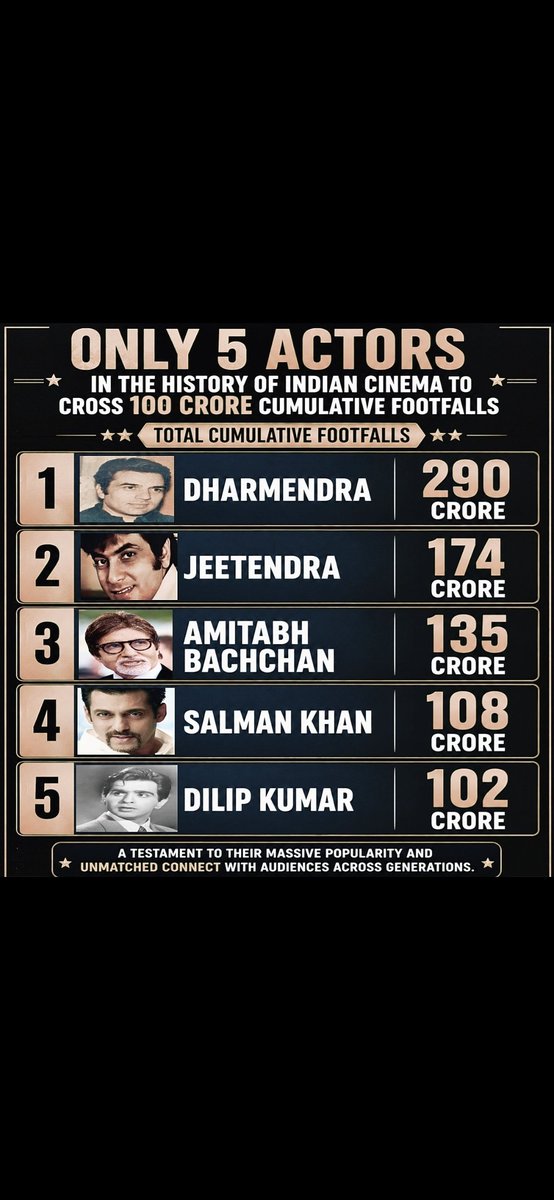
Dharmendra's exclusion from the Dadasaheb remains one of the most glaring omissions in the country's cultural history.
Having debuted in 1960 (Dil Bhi Tera Hum Bhi Tere) and spanning over six decades across 300+ films, his body of work satisfies every benchmark the government selection committee evaluates.
1. Unrivaled Career Longevity and Consistency
Dharmendra is one of the few actors in film history who maintained box-office dominance across five distinct decades. From his debut in 1960 through the 1970s, 80s, 90s, and into the 2020s (most recently in Ikkis ), he transitioned seamlessly from a young romantic lead to an action icon and, eventually, a revered patriarch. Very few artists in world cinema have sustained commercial viability and audience connection for over 60 years.
2. Rare Cross-Genre Range
While popular memory often tags Dharmendra as the original "He-Man" of Hindi cinema, typecasting him does a disservice to his artistic range.
•Realist / Parallel Cinema: His performance in Bimal Roy’s Bandini (1963) and Hrishikesh Mukherjee’s Satyakam(1969)—the latter widely regarded as one of Indian cinema’s finest dramatic performances—showcased intense, quiet vulnerability.
•Mastery of Comedy: He delivered flawless comedic timing in classics like Chupke Chupke (1975) and Pratigya(1975), proving he could command screen presence without relying on action tropes.
•Action & Masala Icon: Films like Phool Aur Patthar (1966), Mera Gaon Mera Desh (1971), Yaadon Ki Baaraat(1973), Sholay (1975), and Dharam Veer (1977) established the template for the quintessential Indian action star.
3. Historical Precedent and Peer Recognition
The Dadasaheb Phalke Award was instituted to recognize "outstanding contribution to the growth and development of Indian cinema". Multiple stars who debuted after Dharmendra—including Amitabh Bachchan, Vinod Khanna, Rajinikanth, Asha Parekh, and Mithun Chakraborty—have rightly been honored with the award. Choosing contemporaries while continually bypassing the actor who anchored the industry’s biggest blockbusters during its formative commercial years highlights an unnecessary delay.
4. Cultural Impact and Mass Appeal
The Phalke Award is not merely a technical or critical accolade; it measures cultural imprint. Dharmendra's screen persona redefined the Indian male archetype—blending physical ruggedness with softness and emotional accessibility. Beyond acting, his production house (Vijayta Films) introduced major talent to the industry, including Sunny Deol and Bobby Deol, contributing directly to the Hindi film ecosystem.
@MIB_India@MinOfCultureGoI@iamsunnydeol@dreamgirlhema@Esha_Deol@AshwiniVaishnaw
BATWARA 1947 -- SUNNY DEOL IS TURNING THEATRES INTO STADIUMS 🔥
Huge crowd for the afternoon show! #SunnyDeol is once again turning theatres into stadiums as this storm of audiences chants #HindustanZindabad 🇮🇳
Thanks to the strong word of mouth, #Batwara1947 is reportedly selling 18–20K tickets per hour on BookMyShow. This is the kind of public craze you can’t fake! 🔥
The Most HANDSOME , SUCCESSFUL, MOST HUMBLE, MOST HELPFUL, BIGGEST MASS ACTION COMEDIAN ACTOR AND LONGEST SERVING ACTOR in the UNIVERSE , NEVER AGAIN will come such kind of PERSONALITY