Now coming to the issues you have imagined or mentioned..
1. GDP Deflator is an Outcome, Not an Input
MoSPI independently measures both:
Nominal GDP: Built directly from company filings, GST data, and government accounts.
Real GDP: Calculated sector by sector using hundreds of specific price and volume indices (PPI, CPI, service price indices).
The GDP Deflator is simply derived: GDP Deflator=Real GDPNominal GDP. It is a mathematical output (an implicit deflator), not a tool used to calculate Real GDP.
2. Why a Simple CPI/WPI Mix Fails as a Fact-Check
Services are missing: WPI completely ignores the services sector, which constitutes over half of the Indian economy.
Comparing a homemade 32CPI+31WPI estimate against the national accounts deflator fails because the weighting and sectoral coverage are fundamentally incompatible.
3. Why the Aggregate Deflator Drops to 2.3% : The overall GDP deflator is a weighted aggregate across all sectors:
Strong Price Rises in Most Sectors: Mining (+25.3%), Construction (+8.2%), Trade & Transport (+5.1%), and Agriculture (+3.8%) all show solid price growth.
Negative Manufacturing Deflator (-1.4%): Under double deflation (deflating output and input costs separately), when input costs (like energy and raw materials) rise faster than final selling prices, the implied value-added deflator can turn negative even while real factory volumes expand.
Net Product Taxes (-4.2% deflator): Nominal net taxes dropped (-0.4%) due to lower excise collections and higher subsidies, pulling the final headline GDP deflator down to +2.32%.
International Methodological Standards & OECD Alignment
This approach—calculating volume measures sector-by-sector and letting the implicit deflator fall out naturally—is the gold standard worldwide:
System of National Accounts 2008 (SNA 2008): Published jointly by the UN, IMF, World Bank, Eurostat, and OECD. Chapters 14 & 15 mandate deriving real Gross Value Added (GVA) using supply-and-use tables, sector-specific price indices, and implicit deflators.
OECD National Accounts at a Glance & Eurostat Handbook on Price and Volume Measures: Explicitly define the GDP deflator as an implicit price index derived from dividing nominal GVA/GDP by constant-price GVA/GDP, not an independently surveyed index.
Double Deflation Standard: Recommended by the IMF and OECD for all member economies to separate input price swings from real gross output.
My Column ||
Net NPA under 1%.
Write-offs ₹19 Lakh Crore.
Recovery 35%.
• Loans written off by banks in 11 years: ₹19 lakh crore.
• 35% — the recovery rate of written-off loans in 2024-25. Only ₹35 recovered for every ₹100 written off.
• In the past 5 years, for instance, only ₹2.10 lakh crore out of the ₹9.23 lakh crore written off was recovered.
• Under 1% — net NPA at banks today. But net NPA and actual cash recovery run on two different clocks.
• ₹1.77 lakh crore — outstanding against 2,104 wilful defaulters reported by PSBs as of June 2025.
· The IBC promises admission in 14 days and resolution in 330 days. In practice: admission takes months, resolution takes over 900 days.
•As of March 2026, 1,885 insolvency cases pending in NCLT,nearly three out of four past that 330-day limit.
• Question: Have bad loans disappeared—or moved from the bank balance sheet to the public ledger?
• Citizen Janardhan ultimately bears the cost of the gap between write off and recovery.
@NewIndianXpress
https://t.co/pQAQMd3OGM
🎧AIPodcast🎧
The NPA Miracle: Reality and Illusion
https://t.co/L5vv3qwUUT
My Column This Week |
Radio Silence: Central Banks Leave Markets Flying Blind
Sintra Consensus: The world's most powerful central banks US Fed, ECB, BoC, BoE buried 'forward guidance.
After decades of forward guidance to anchor expectations central banks want markets to fly blind.
The Sintra consensus consecrated a church that abolished sermons to assume infallibility.
Existential question: What justifies their pulpit if they renounce commentary & prophecy?
Expectations are not fashion accessories worn in economic debates, they drive transmission.
Transparency about the present and silence on the future is a contradiction.
Offshoring of pricing to sentiment-driven algos trading in milliseconds is an invitation to hyper volatility.
Greenspan-era ambiguity was exposed in 2008 GFC. Warsh risks repeating the “flaw in the model.”
Timing couldn’t be worse: BIS warns AI investment boom of trillions risks a 2008-like correction.
ps: As of now RBI is off the silence wagon. EMs can't afford the luxury of ambiguity.
@NewIndianXpress
https://t.co/uiFgQvl4Eg
AI Podcast: Central Banks Bury Guidance, Invite Risks
https://t.co/qX0wCCt3Rf
The Tax That Saved India
Who Is Really Crying, and Why
Behind the loudest anti-LTCG voices lies a simpler truth: India Collected The Toll from FPIs
Story Unmasking the Biggest Capital Gains Tax Myth
Read only in @BWBusinessworld@anuragbatrayo
https://t.co/805R91yKbc
Norwegian journalist Helle Lyng Svendsen heckles PM Modi in Oslo with loaded gotcha questions: 'Why should we trust you?' and 'Will the PM take critical questions from the Indian Press?' while smugly waving Norway’s #1 Press Freedom ranking like it’s moral superiority.
This is peak European colonial privilege dressed as journalism. A reporter from a tiny oil-rich homogeneous nation barges into a joint presser with the leader of the world’s largest democracy and demands a gotcha moment. No cultural intelligence. Zero self-awareness. Pure bad-faith narrative engineering to paint India as authoritarian for clicks back home.
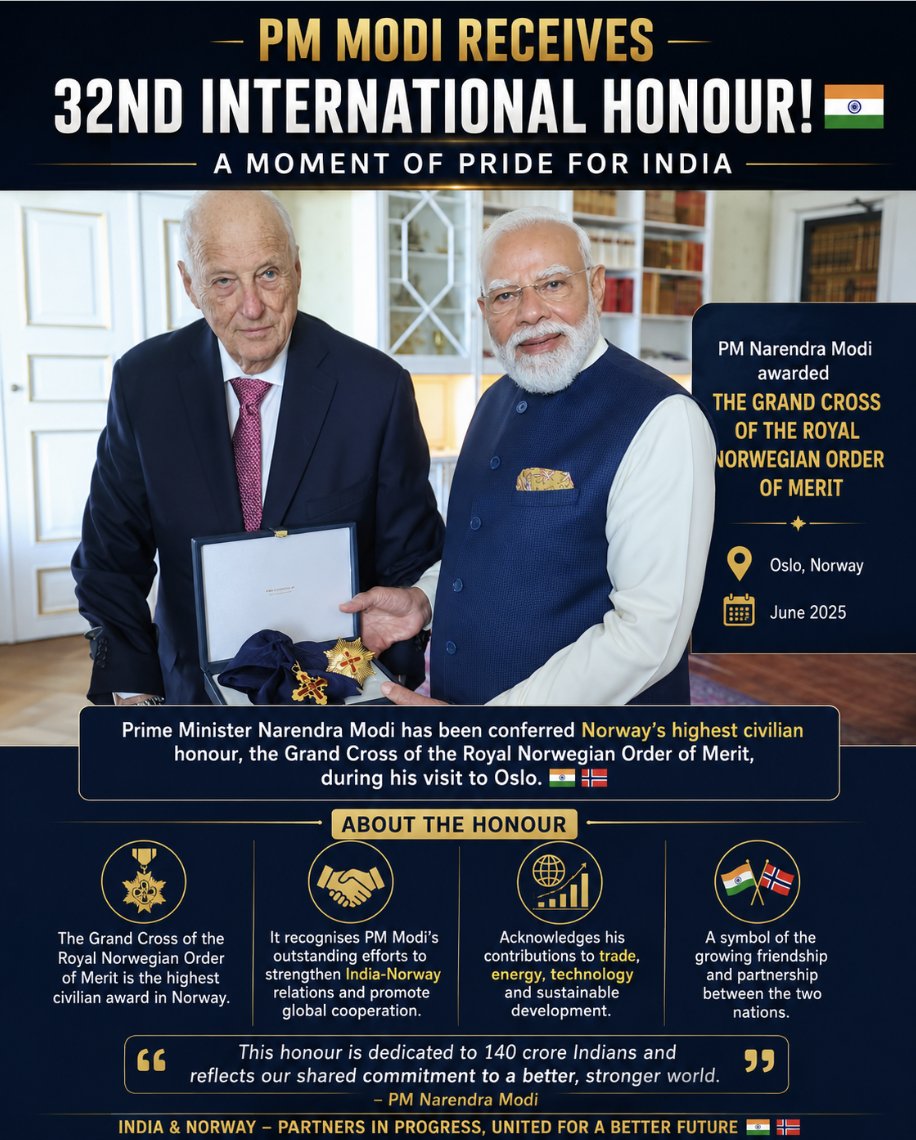
In doing so she is doing a great disservice to Norway, to the people of Norway, and to her own Government which has just bestowed the highest civilian medal in Norway upon Prime Minister Modi.
Let’s flip the script and dig deeper into Norway’s own human rights rap sheet they conveniently ignore while lecturing Bharat:
1. Indigenous Sámi people are still fighting for land rights in their own ancestral territories. Norway pushes mining, wind farms, and oil extraction on Sámi lands without genuine free, prior, and informed consent classic cultural erasure the UN has repeatedly slammed.
2. Barnevernet (child welfare services) has a notorious record of forcibly removing children from minority, immigrant, and religious families, including several Indian families. Multiple European Court of Human Rights cases against Norway for violating family life under Article 8.
3. Prisons and solitary confinement feature excessive isolation and high suicide rates in pre-trial detention. The Council of Europe’s Anti-Torture Committee keeps flagging Norway for cruel, inhuman treatment.
4. Discrimination includes ethnic profiling by police, rising hate crimes against Roma, and immigrants, and domestic violence stats that Amnesty and others keep highlighting.
The Global South and vibrant democracies like India - with 1.4 billion people, 22 official languages, every major religion, and the world’s biggest democratic elections - are not beholden to these condescending and disingenuous lessons from a country whose entire population is smaller than Delhi.
The Indian Constitution guarantees rights since 1950. The Indian media is loud, chaotic, and free, as they should be in any vibrant democracy.
The Indian PM engages the Indian press extensively.
Let's be honest.
This wasn’t journalism. It was performative superiority from someone whose country still hasn’t reckoned with its Viking-to-oil-rich hypocrisy.
A pointed question for Ms Svendsen: before questioning India’s trust, should Norway not first clean its own house?
India gave the world yoga, zero, and vaccines to the Global South during COVID, while championing developing nations.
Lectures from oil wealth ring hollow.
Share this wide - the narrative merchants hate facts.
FACTS >>> NARRATIVES
#ModiInNorway #ExposeHypocrisy #NorwayHRViolations #IndiaStandsTall #GlobalSouthRising 🇮🇳
The #RBI pulled off a #Dhurandhar move, complete with part-2 The Revenge, to stabilise a weakening #rupee, reduce artificial demand for dollars, prevent speculative bets, and gain an upper hand in the Indian currency market.
Just like the blockbuster movie that set cash registers ringing, #RBI's measures too felt like a thunderbolt, advancing the rupee by 1.8% to 93.10 on Thursday, which saw the biggest single-day appreciation in at least 13 years.
🔗https://t.co/ATR4WJIsq3
✍️@sunithanatti@RBI@TNIEBiz@FinMinIndia@nsitharaman
With duty cuts, the government may have signalled its willingness to intervene when needed even at the risk of straining public finances. But critics aren't convinced as the move deceptively comes ahead of the forthcoming assembly elections next month and given voters everywhere are often sensitive to higher prices.
The obvious question is if the government will continue to shoulder the price rise burden in May or June if global prices continue to flare?
🔗https://t.co/DNKFxNr7WJ
✍️ @sunithanatti
#FuelPrice #DutyCut #PetrolDieselPrice @PetroleumMin@FinMinIndia
#WestAsiaWar | If Sri Lanka declared mandatory public holidays for schools, universities and non-essential government employees, Bangladesh moved educational institutions to online learning modes besides implementing a five-hour rotational power-cut schedule for domestic consumers to prioritize the textile sector. Pakistan and the Philippines rolled out a four-day work week for civil servants.
If the situation persists for even one more month, where economies remain on life support for want of oil, LNG, LPG and fertilizers, they'll be losing too much blood without even a cut on their flesh.
✍️@sunithanatti
🔗https://t.co/y8bwbb6wP8
@TNIEBiz@PetroleumMin #OilPrice
#HDFCBank's recent top-level exit evokes a familiar feeling: When someone says there's nothing wrong and yet quits, something is definitely wrong.
In a sudden development, #AtanuChakraborty, a retired bureaucrat who was on the HDFC's board for five years, resigned as its part-time chairman and independent director, citing concerns over 'certain happenings and practices' not aligning with his personal values and ethics.
The gulf of incomprehension remains. Is it possible that someone's pitching a yarn either to throw the bank into a tailspin or to protect it from an unavoidable collapse?
@sunithanatti
https://t.co/XtAKnFDkoJ
Call it what it is: evil, calculated, and deeply treacherous. When an opposition leader celebrates the attempt of global humiliation of his own country, he isn’t fit to lead.
Rahul Gandhi isn’t criticising policy here. He’s boasting that his own party cadres succeeded in disrupting an international summit and denting India’s image in front of the world. That’s Machiavellian sabotage.
A normal opposition fights the government on issues. This is something darker: weaponise embarrassment as strategy. If India is hosting global leaders, tech CEOs and investors, and you can’t control the narrative with competence, then you manufacture chaos so the headline becomes “mess” instead of “moment.” That isn’t politics. That is anti-national theatre.
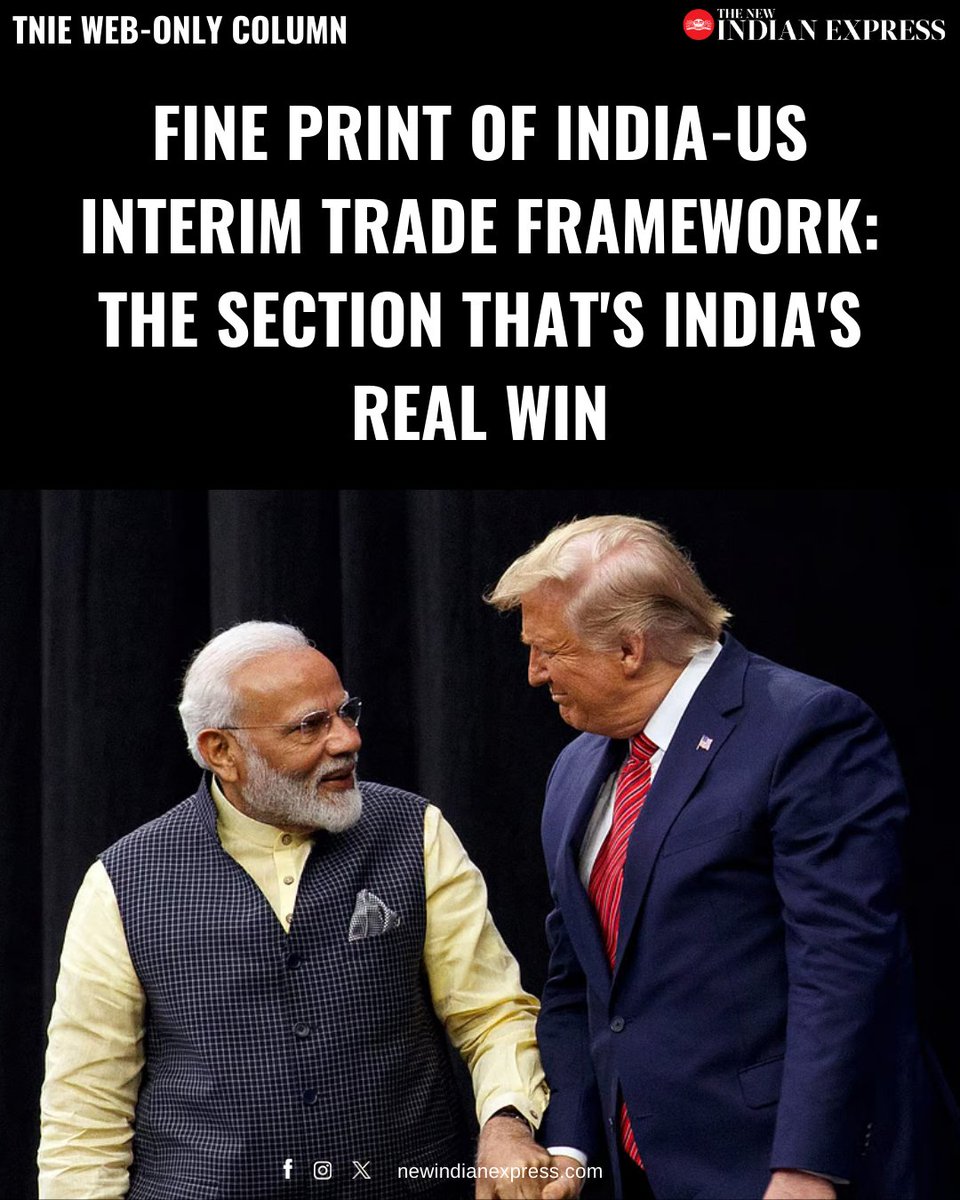
TNIE Web-only Column | Trade deals and humor may seem inappropriate.
More so, if it's about India's freshly minted deal with the US, which came after a prolonged pause. When the interim agreement finally did arrive, confusion and criticism overtook relief.
TNIE made a humble attempt to provide an easy reference guide, putting together various aspects of the joint statement and how they were understood and interpreted by everyone involved in the deal or otherwise.
This is not to belittle the ongoing trade dialogue in any sense, but to simply make room for a bit of laughter to lighten the mood.
🔗https://t.co/L4FZ3FV8DA
✍️@sunithanatti
Trump's tariffs are not really the WIN that he claims. In fact, American importers and consumers are absorbing 96% of the raised prices, writes @sunithanatti citing Kiel Institute data.
https://t.co/iY1VEiLOTH
The most meaningful concession in the framework comes under Section 232 of US trade law. Unlike reciprocal tariffs imposed under the International Emergency Economic Powers Act (IEEPA), Section 232 measures are not exposed to the ongoing US Supreme Court case that could restrict President Donald Trump's authority to impose emergency-based tariffs.
✍️ @jayanthjacob
🔗https://t.co/JxG0w6G7Ol
#IndiaUSdeal
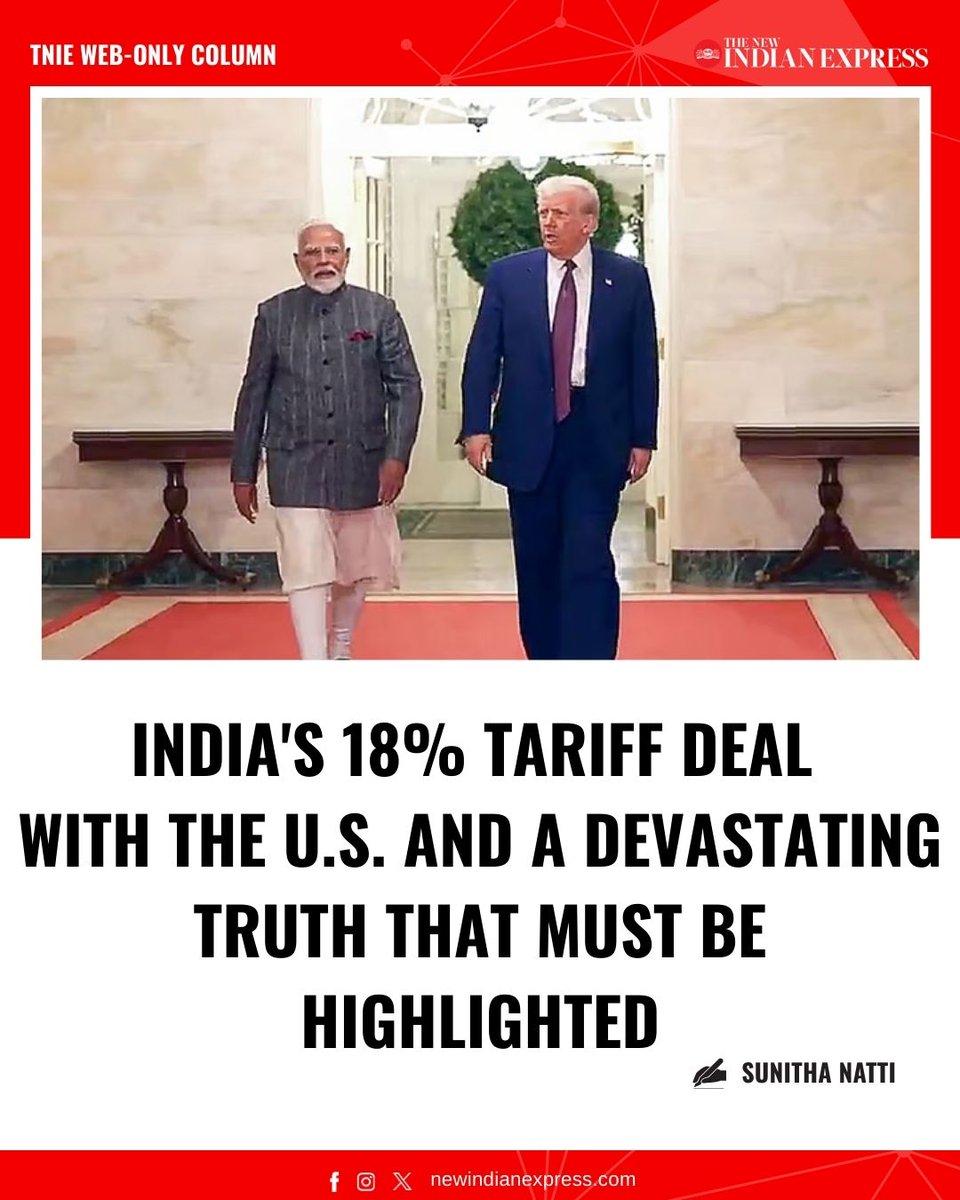
TNIE Web-only Column | Tuesday's big reveal about US' reciprocal tariffs plunging from a punitive 50% to 18% is not a bad second-best. But the proposed deal, announced separately on X by President Trump and Prime Minister Narendra Modi, has raised more questions than answers.
Some dismiss the reduced 18% tariffs as a nothingburger, citing the pre-Trump era levies, which were minimal at about 3-4% on Indian goods exports. But amid evolving global trade dynamics, where tariffs are the norm rather than the exception, higher tariffs on Indian exports aren't self-defeating. And here's the basis for this devastating truth.
🔗https://t.co/6Irpgpto5l
✍️@sunithanatti
#indiaustradedeal #IndiaUS @TNIEBiz@TheMornStandard
For months, Moscow had been accumulating billions in Indian Rupees from oil sales that it couldn't spend.
Then, on August 12, 2025, the RBI issued a quiet but revolutionary circular. It authorized foreign holders of "Special Rupee Vostro Accounts" (SRVAs) to invest their surplus balances into Indian Government Securities and Treasury Bills.
In a move that alarmed U.S. strategists even more, India and the UAE two key American partners began operationalizing a Local Currency Settlement system. The Indian Oil Corporation paid for a million barrels of Abu Dhabi crude in rupees, proving the concept worked.
Russia to recycle its oil revenue directly into Indian sovereign debt, New Delhi created a closed-loop financial system. Russian oil profits were no longer chasing U.S. Treasuries; they were funding Indian infrastructure.
The reaction from Washington was swift. Within weeks, the U.S. imposed tariffs of up to 50 percent on select Indian goods a punitive strike that signaled the partnership was in jeopardy.
RBI had permitted 123 correspondent banks from 30 countries including the United Kingdom, Germany, Israel, and Singapore to open 156 Special Rupee accounts.
Data from November 2025 showed India importing 7.7 million tonnes of Russian oil in a single month, accounting for 35 percent of its total intake, largely settled outside the dollar system.
The host of the 2026 BRICS Summit, New Delhi has moved beyond passive participation to active architecture. The Reserve Bank of India has formally proposed linking the Central Bank Digital Currencies (CBDCs) of member nations a project dubbed the "BRICS Bridge."
Building on the 2025 Rio de Janeiro declaration, India is pushing for a proprietary, interoperable payment rail that would allow Russia, China, India, and new members like the UAE to settle trade instantly in digital local currencies, completely bypassing the U.S. banking system.
RBI actively pilot-testing the e-Rupee’s cross-border capabilities, India is effectively building a "digital SWIFT" immune to Western sanctions. For the Trump administration, this was the final provocation. It wasn't just evasion; it was replacement.
Washington views India’s 2026 agenda not as economic modernization, but as a "monetary mutiny."
(Specially with India dumping US Treasuries upto 50.07 billion $ in one year and accumulate Gold & Silver)
TNIE Web-only Column | Guns are ready to fire everywhere and anxiety is seeping into the very bones of governments globally. Yet, the latest #EconomicSurvey—with a peculiar synthesis of chaos and optimism—yearns for bigger and brighter things for Asia's third-largest economy.
And the Survey's big ta-da reveal is not just FY27's real #GDP growth estimate of 6.8%-7.2%, but the upward revision in India's potential growth to 7% per annum from 6.5%.
✍️@sunithanatti
🔗https://t.co/8OUH3t0Q99
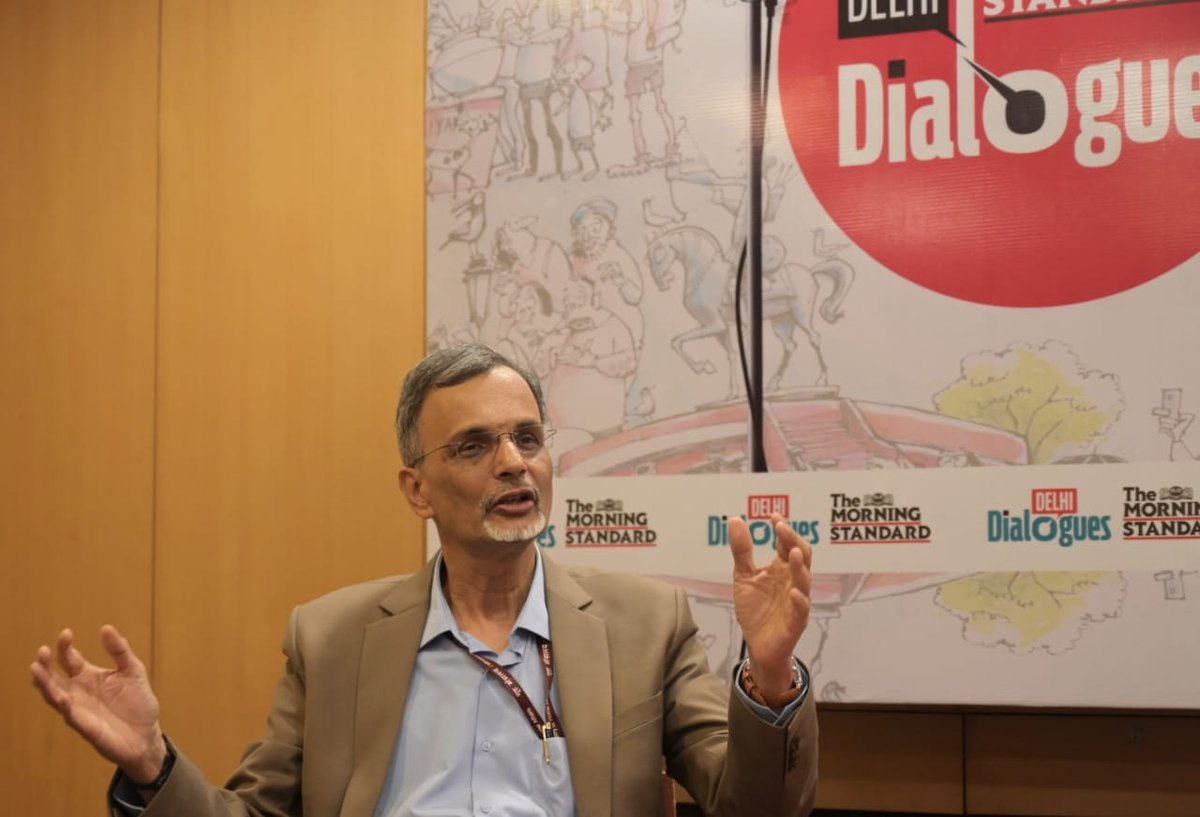
In a freewheeling chat with @NewIndianXpress@TheMornStandard chief economic advisor to the government of India V Ananatha Nageswaran dismissed the concern over #IMF giving a #Cgrade to India's public accounts data. He said: "If you drill down into the areas of improvement the IMF has flagged — revisions to the base year, use of a single deflator, etc. — these are already being addressed by MoSPI. The IMF itself has acknowledged this in an appendix that details ongoing improvements, expected to be reflected in 2026."
@santwana99@TNIEBiz@PushpitaPikuDey
Inside Modi Government's Rs 1 Lakh Crore Plan To Turn Around R&D In India (https://t.co/M5eatGlHIj)
Can a department that historically spent 18 per cent less than its budget suddenly deploy Rs 1 lakh crore to transform India into an innovation powerhouse?
That's the bet India is making on the Department of Science and Technology.
@astrokaran
American embarassment during Operation Sindoor is the reason behind Trumpian rants, Washington's strategic moves and Munir's "Eastern threat" to India. But where does China fits into this?
by Divya Kumar Soti
In recent days, several significant events have occurred in this region that are poised to alter its geopolitical equations. A detailed analysis of these events, both individually and collectively, is necessary. On the occasion of Vijayadashami, while addressing Indian soldiers in Bhuj, Gujarat, Defense Minister Rajnath Singh stated that Pakistan is continuously increasing its military presence in the Sir Creek area and warned that any misadventure by Pakistan would be met with a response so severe that it would change both history and geography. Just days later, Army Chief General Upendra Dwivedi, during a meeting with soldiers in Sriganganagar, stated that if Pakistan does not stop supporting terrorism, India will not exercise the restraint it showed during Operation Sindoor, and Pakistan could even be wiped off the world map. He also urged the soldiers to prepare for the next conflict. Such statements from India are rare, indicating that the government likely has significant intelligence about terrorist conspiracies being orchestrated by Pakistan, prompting both the Defense Minister and the Army Chief to issue consecutive warnings.
Prior to this, Pakistan’s Army Chief General Asim Munir visited the United States twice, receiving special hospitality and time with U.S. President Donald Trump at the White House on both occasions. After his first meeting with Trump, Munir addressed the Pakistani diaspora in the U.S., threatening India by likening it to a "shiny Mercedes" and Pakistan to a "battered dumper truck," asserting that in a collision, the Mercedes would suffer the damage. This was likely the first instance in history of Pakistan issuing such a direct threat to India from U.S. soil, especially following a meeting with the U.S. President at a time when India-U.S. relations are strained. This suggests that Munir’s thuggish rhetoric had the backing of the Trump administration. Shortly afterward, Pakistan’s military spokesperson, Lieutenant General Ahmad Sharif Chaudhry, issued another threat, stating that in any future military conflict, Pakistan would begin by targeting India’s eastern regions. Many were surprised by this claim, as during Operation Sindoor, Pakistan’s missiles couldn’t even reach Sirsa or Hisar—how could they possibly target eastern India? However, the implications of this threat became clearer when Bangladesh’s interim government head, Mohammad Yunus, widely regarded as a puppet of the U.S. deep state, met Trump at the White House. Previously, Yunus was considered close to the Biden administration and the Democratic Party, and Trump had publicly criticized him, accusing him of funding efforts to defeat him in elections. However, Trump has now completely changed his stance toward Yunus, seemingly viewing him as a tool to pressure and trouble India. Just two days after Yunus’s meeting, Trump met again with Asim Munir and Pakistani Prime Minister Shehbaz Sharif at the White House, with top members of Trump’s national security team in attendance. Subsequently, Pakistan’s military issued another statement threatening to target India’s remote regions, clearly hinting at India’s eastern areas.
This raises critical questions: Is the U.S. preparing to use its proxy government in Bangladesh to support Pakistan? Has Pakistan established a drone base or terrorist outpost near India’s eastern borders, enabling it to repeatedly threaten India’s eastern regions? Are terrorist groups active in Myanmar and India’s Northeast being equipped with drone technology to target key Indian installations in eastern India when the time comes? C/-