🚨 For the first time in history, scientists have managed to capture the moment when an oxygen atom and a hydrogen atom combine to form water on a nano scale.
2026 WILL BE THE SUMMER OF SPACE
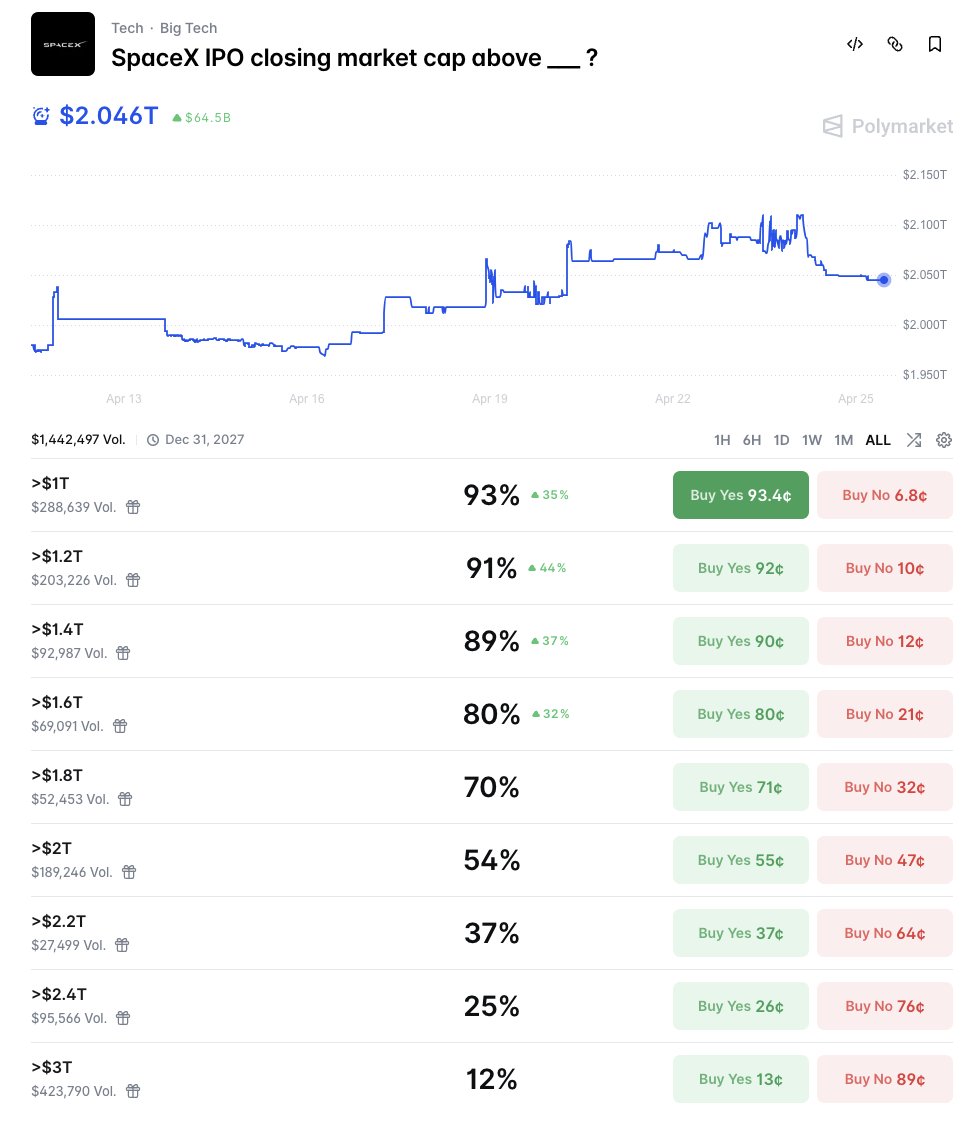
SpaceX now has a 92% implied chance of going public this summer which could become the forcing function for the space trade.
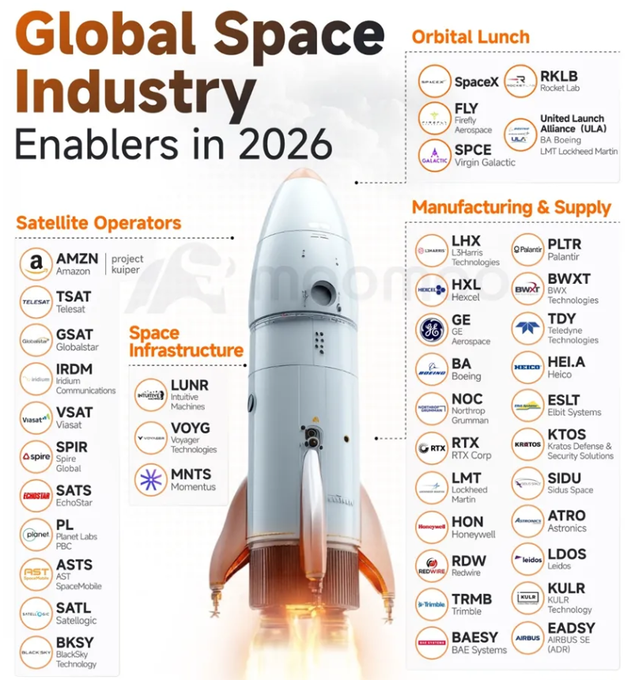
A rumored $2T valuation, Golden Dome & rising demand across launch, satellites & defense infrastructure are pushing investors to look beyond SpaceX & into the full space supply chain:
Orbital Launch (access to space)
• $FLY, $SPCE, $ULA add exposure across lunar, research & heavy-launch mission profiles
• SpaceX remains foundation of the ecosystem with Starship driving lower cost-per-kilogram economics & Golden Dome further validating the national-security demand layer
• $RKLB provides dedicated launch & integrated space services for small & mid-sized missions backed by its $805M SDA Tracking Layer contract, ~$1.9B backlog, Neutron roadmap & SHIELD eligibility
Satellite Operators (demand layer)
• $PL, $BKSY capture earth observation & defense intelligence demand
• $VSAT, $SPIR, $SATL, $TSAT support aviation, maritime, spectrum & specialized communications
• $AMZN Leo builds broadband & D2D layer with Globalstar spectrum, $AAPL satellite services and customers like Delta, AT&T, Vodafone & NASA
• $ASTS building space-based cellular broadband with carrier partnerships across AT&T, Verizon & Vodafone, $1.2B in contracted 2027 revenue & BlueBird constellation expansion
Space Infrastructure (on-orbit systems & services)
• $MNTS sits in orbital transport & in-space logistics
• $LUNR owns lunar & deep-space mission infrastructure
• $VOYG anchors commercial space station transition through Starlab backed by partners like $PLTR & Airbus
• $RDW supplies key space infrastructure components including solar arrays, payload facilities, robotics & in-space manufacturing systems
Manufacturing & Supply (industrial backbone)
• $KTOS, Anduril sit at intersection of autonomous defense, missile defense & space-enabled systems
• $BWXT brings nuclear exposure across space power, defense systems & broader nuclear renaissance
• $LMT, $NOC, $RTX, $BA anchor defense prime layer across spacecraft, launch systems & national-security platforms
• $LHX, $TDY, $HON supply sensors, avionics & mission-critical hardware needed across defense space programs
20 orbits down, 22 more to go!
The Sun is on a long, slow journey around the center of the Milky Way galaxy. Each full orbit takes about 225 million years.
Our Sun resides in the Orion Arm (also known as the Local Arm), one of the Milky Way’s four main spiral arms. It’s positioned about 27,000 light-years from the galactic center, where a supermassive black hole, Sagittarius A*, lies. The Milky Way itself is home to roughly 200 billion stars, all of which orbit the galactic center in a vast cosmic dance, just like our Sun.
At 4.6 billion years old, the Sun has already completed around 20 orbits around the galactic core. It has roughly 22 more to go before it runs out of hydrogen in its core. This will happen in about 5 billion years, when the Sun will enter the next phase of its lifecycle.
As it depletes its hydrogen, the Sun will expand into a red giant, possibly engulfing the inner planets, including Earth. After shedding its outer layers, it will leave behind a dense core known as a white dwarf – a remnant of its former self. This is the final stage in its transformation.
Our Milky Way is just one of the hundreds of billions of galaxies in the observable universe, each with its own stars, planets, and black holes. Every galaxy, including ours, is in constant motion, orbiting its respective center. The Sun’s orbit through the Milky Way serves as a reminder of the vastness and complexity of the universe.
Time dilation means the faster you move or the stronger the gravity, the slower time passes for you—so a space traveler could return younger than people on #Earth.
We’ve been looking for alien life the wrong way.
For decades the search has been simple: find one planet, look for signs of biology. Oxygen. Methane. Water. A biosignature.
One problem. We haven’t found anything.
Researchers in Japan just proposed something different. Don’t look at single planets. Look at patterns across thousands of them.
The idea: if life spreads between star systems, it leaves a statistical fingerprint. Not on any one world.
Across all of them.
Like looking for a forest by studying the distribution of trees across a continent rather than examining one leaf.
We may have been staring at the leaves for 60 years.
Gandalv / @Microinteracti1
🚨 BREAKING:
Electrons just stopped behaving like particles,
and started flowing like a perfect liquid.
In graphene, scientists just observed a Dirac fluid
a state where electrons move collectively
with almost zero resistance.
Even crazier?
It breaks a fundamental law of physics
(the Wiedemann–Franz law)
by over 200x.
This isn’t just a material discovery.
It means:
Electricity can behave like fluid dynamics
Heat and charge can decouple
Quantum systems can act like perfect liquids
Now think bigger:
If electrons can flow like this.
what else in physics isn’t actually “particle-based” at all?
Follow me this is where physics starts rewriting itself.