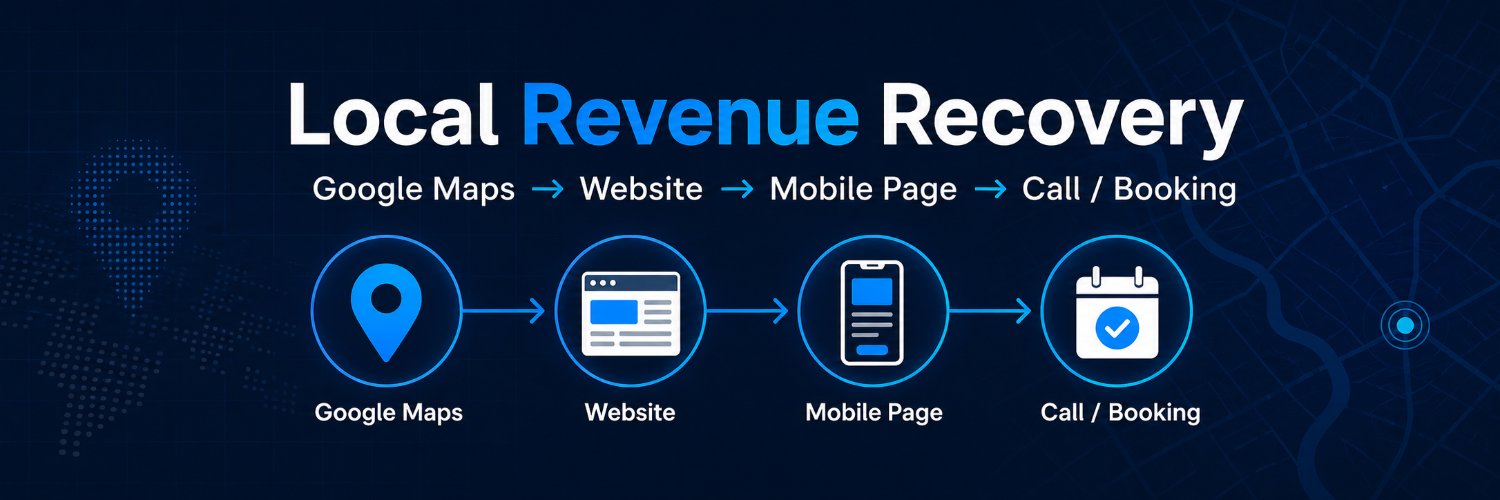
Building Local Revenue Recovery.
I find public Maps → website → call friction for local service businesses.
$49 sample audits. No login. No private data.
I find where local service customers drop before they call or request.
I check the public path:
Google Maps → website → mobile page → call/booking.
$49 Lost Customer Audit.
3 public drop-off points.
3 fixes to make this week.
No login. No private data.
No revenue guarantee.
For HVAC, plumbing, electrical, roofing, restoration, and similar local service businesses.
A click is not a conversion.
Uncertainty after it can stop one.
Before asking someone to call or submit, show the path:
1. Tell us the issue.
2. We confirm fit and timing.
3. You get the next step before work begins.
Make the after-click path visible before the click.
Hiding price does not remove price anxiety.
It moves it into the buyer's head.
You do not need a fake universal price. Give one anchor:
- diagnostic fee
- starting visit fee
- estimate before work
- scope confirmed before charge
Uncertainty is friction. Price the process.
A local-service page rarely needs 10 contact options.
It usually needs 2:
Primary: Call now for urgent help.
Fallback: Request an estimate.
Phone-only loses people who cannot call.
Form-only loses urgent buyers.
One main path. One backup. Match the visitor's state.
Long forms do not kill conversions.
Long forms shown too early do.
Before asking for an address, phone, job details, and preferred time, prove 4 things:
You solve this problem.
You serve their area.
Your response time.
The next step.
Sequence trust before commitment.
@HeyAnjula This is the right use of an expensive model: convert judgment into reusable operating rules. One strong session should leave behind skills the cheaper sessions can actually follow.
@AiCamila_ Yes. Every agent needs an identity boundary. The safest default is simple: least privilege, check before action, log the decision, and make credential use visible.
@XAMTO_AI The useful part is not "scrape everything." It is controlled public-context intake: source, limits, fallback path, and a clear line between read-only research and account actions.
@KirkDBorne@PacktPublishing@PacktDataML C++ still matters when AI leaves the notebook. Once latency, memory, and deployment cost become real constraints, the model is only one part of the system.
@smratitiwa86867 The useful way to read lists like this is not "autopilot income." It is: which repo removes one manual bottleneck in a workflow someone already pays for?
@Etudecn This is the real shift: not chatting with AI line by line, but designing the work loop around it. Plan, run, test, inspect logs, repeat. The leverage is in the loop, not the prompt.
@DanKornas This is useful because it includes the boring parts too: data, storage, connectors, config, and a way to control the run. Finance demos fail when the lab around the model is missing.
@smratitiwa86867 The loop is the product. A prompt can create one good run. A loop creates repeatable work: plan, build, test, remember what failed, then try again with less guesswork.
I check this kind of public-page friction in a $49 Lost Customer Audit.
Public path only:
- discovery -> website -> call/estimate step
- 3 visible drop-off points
- 3 fixes to make this week
- no login
- no account access
- no private data
- no revenue guarantee
Details:
https://t.co/OAPSGacJ9b
Want one sample friction point first?
Send one public business URL:
[email protected]
Most emergency service pages do not lose calls because the phone number is hidden.
They lose calls because the visitor has to decide which button is real.
Picture this:
Garage door stuck half-open at 11:40pm.
The house is exposed.
The page says:
"24/7 emergency repair"
Then the hero button says:
"Request service"
Nearby:
"Business hours: 8am-5pm"
Another button:
"Get an estimate"
That visitor is not shopping.
They are trying to answer:
"Will this wake someone up now, or am I filling out a tomorrow form?"
Rule:
Emergency and normal service should not share the same first CTA.
Bad:
Request service
Better:
Stuck open now? Call 24/7 emergency dispatch.
Planning a repair? Request an estimate.
If your page makes urgent customers classify themselves, some will choose the competitor with one obvious next step.