Open weights move the safety work; they don't remove it.
Microsoft and NVIDIA's guide gets one thing right: risk depends on the use case, permissions, data access, tools and runtime, not the license label.
"Runs locally" is an architecture choice, not a security review.
NVIDIA's ASPIRE treats robot learning like a debugging loop: write control code, run it, inspect failure traces, then store the fix as a reusable skill.
Version 1.0 is now on GitHub. The README warns that generated Python isn't sandboxed. That matters as much as the benchmark.
ChatGPT can now turn a chat or file into an editable deck and export it to PowerPoint, PDF or Google Slides.
OpenAI says Slides is rolling out to eligible Pro, Business and Enterprise Space users.
The useful part is editability. A slide image isn't a presentation workflow.
DeepSeek's V4.1 Flash update includes something model launches often skip: prompt plumbing.
The deepseek-recipe library converts Messages, Chat Completions and Responses into V4/V4.1 prompts, then parses outputs back.
Less glamorous than a benchmark. More useful in production.
Local AI gets awkward when several agents share one GPU.
Base Compute's Apache-2.0 Superfluid puts a scheduler and durable sessions in front of llama.cpp, MLX and baseRT. Interactive requests can preempt batch work.
It's pre-1.0, with project-run benchmarks.
Meta's new open-weight model has a license tripwire.
Muse Spark Open requires "Built with Muse Spark Open" attribution. If your company tops $20M in revenue over 12 months and offers it as a model API, Meta requires a separate agreement.
Open weights, custom terms.
GitHub can now stop a coding agent from adding a package your company policy forbids.
Its new API checks dependencies against an enterprise-wide license policy before the agent recommends or adds them. Useful guardrail, but it requires GitHub Enterprise Cloud and Code Security.
JetBrains moved Junie Local's Windows support from experimental to stable.
It runs a 27B coding model on Ampere-or-newer RTX cards with at least 24GB VRAM. No credits or cloud inference.
That's still serious hardware, but the local coding-agent floor is getting more ordinary.
Beam's weights are live. The self-hosting recipe needs 16 H200s.
Reflection released the 501B MoE under Apache 2.0. Only 23B parameters are active per token, but Hugging Face's BF16 vLLM setup still spans two 8x H200 nodes.
Open-weight isn't the same as local-friendly.
Google's reworked ADK recipe repo is built for coding agents, not just human readers.
Each example gets a machine-readable manifest, AGENTS.md instructions, CI validation and runnable tests. That's a useful pattern for making agent setups reusable instead of tribal knowledge.
A 74B local-agent model now fits in 24GB.
NVIDIA says Nemotron 3.5 Bolt activates 9B parameters per token and uses 2-bit quantization. It ships for llama.cpp, Ollama, vLLM and LM Studio, with open weights, training data and recipes. The useful bit is the memory budget.
GitHub's security agent now reruns CodeQL before asking you to trust its fix.
Agentic Autofix is GA for Enterprise Cloud security customers. It explores the repo, iterates, then opens a draft PR. Catch: default-branch alerts only, with AI credits and Actions minutes billed.
An agent can return a polished answer after looping, wasting tokens or calling the wrong tool.
Google's useful eval advice: freeze test sets, inspect traces, prefer pass/fail checks, and track latency, cost and tool calls beside answer quality. The prose is only one output.
Arabic-first local agents now scale from phones to GPU clusters.
MBZUAI's Institute of Foundation Models released Jais 3 under Apache 2.0: six open models from 0.9B to 375B, trained for tool use, MCP and Arabic file work. The 3.7B model targets laptops and local assistants.
GitHub Actions can now keep readable version tags without trusting them to stay put.
GitHub's new workflow lockfiles pin actions, transitive dependencies and reusable workflows to reviewed commits. Good supply-chain hardening, with a catch: the preview is Enterprise Cloud only.
Google DeepMind and Singapore's GovTech built a Gemma scam detector that keeps chat analysis on the phone.
A lightweight classifier screens messages; Gemma checks the suspicious conversations. Smart privacy/battery tradeoff. The missing numbers: accuracy and false positives.
Local AI on Windows just lost most of its setup tax.
Hugging Face and llama.cpp released Llama Windows, a free open-source tray app that downloads GGUF models, manages llama.cpp, and exposes a local OpenAI-compatible server. You don't need a terminal or admin rights.
GPT-5.5 retires from ChatGPT and Codex today, but not the OpenAI API.
If a Codex setup still pins gpt-5.5, OpenAI says to update workspace defaults, saved settings, custom agents, scheduled tasks and scripts. The easy thing to miss is an old model ID hiding in automation.
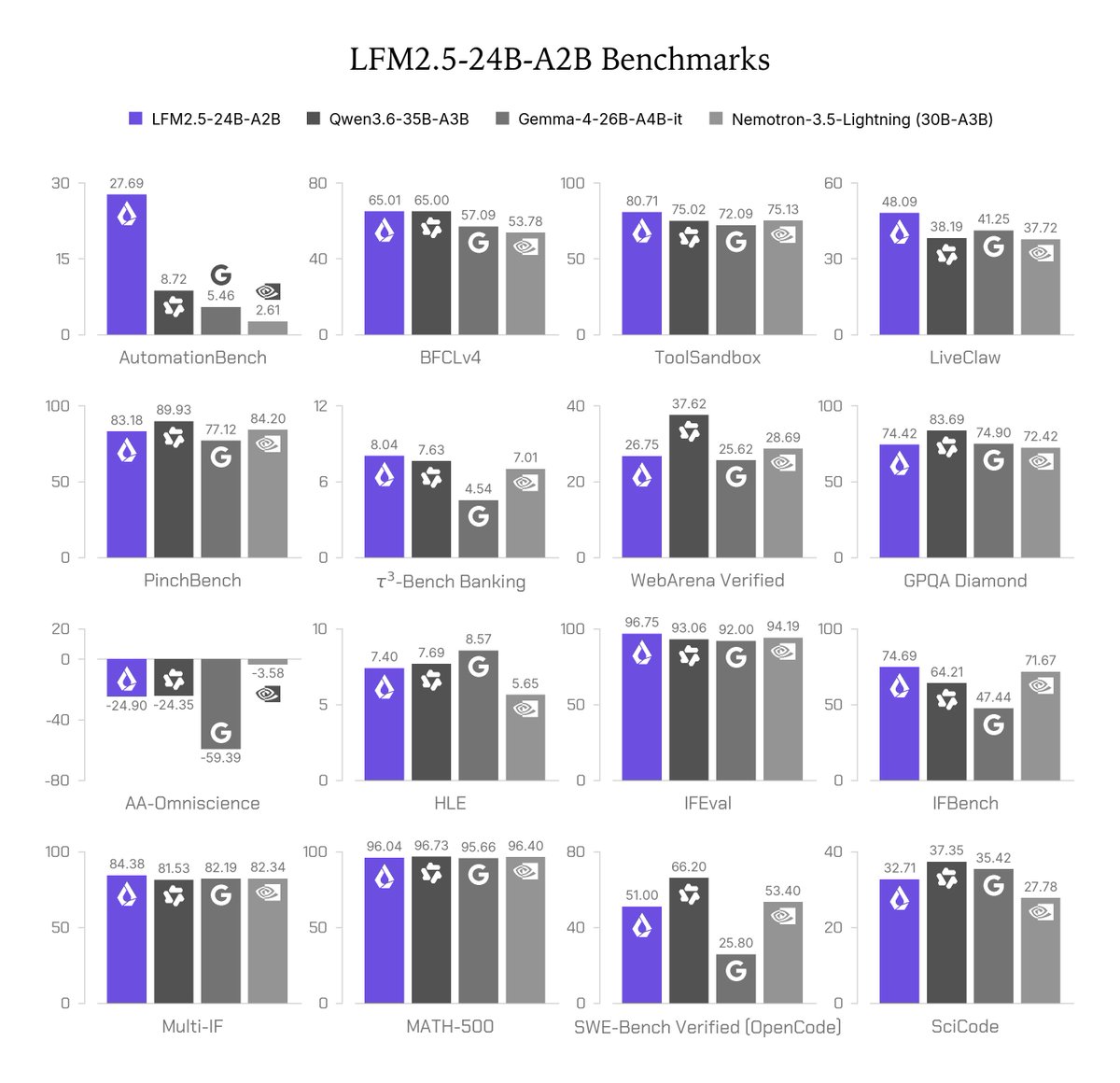
Liquid AI's new local-agent model has 24B parameters but activates 2.45B per token.
It ships in GGUF and MLX, supports 131K context, and was trained inside agent harnesses including Hermes. Liquid reports 184 tok/s on an M5 Max. Qwen still leads on SWE-Bench.
Primary docs behind this framework:
llama.cpp backends: https://t.co/Fps5rfpKrr
Ollama context/memory: https://t.co/6sNDtegssc
Apple MLX shared memory: https://t.co/viVKNyixVt
Which constraint decides your next machine?
Buying a computer for local AI? Don't start with the chip. Start with the largest model and context you actually need to keep resident.
A practical order: workload → model format → memory → backend support → measured speed. Shopping by TOPS alone is an expensive guess.
Only then compare benchmarks. Use the exact model, quantization, context and app you plan to run. Track prompt processing, generation speed, memory use, power/noise, and whether the model stays fully accelerated. A benchmark on a different setup is a clue, not a buying answer.