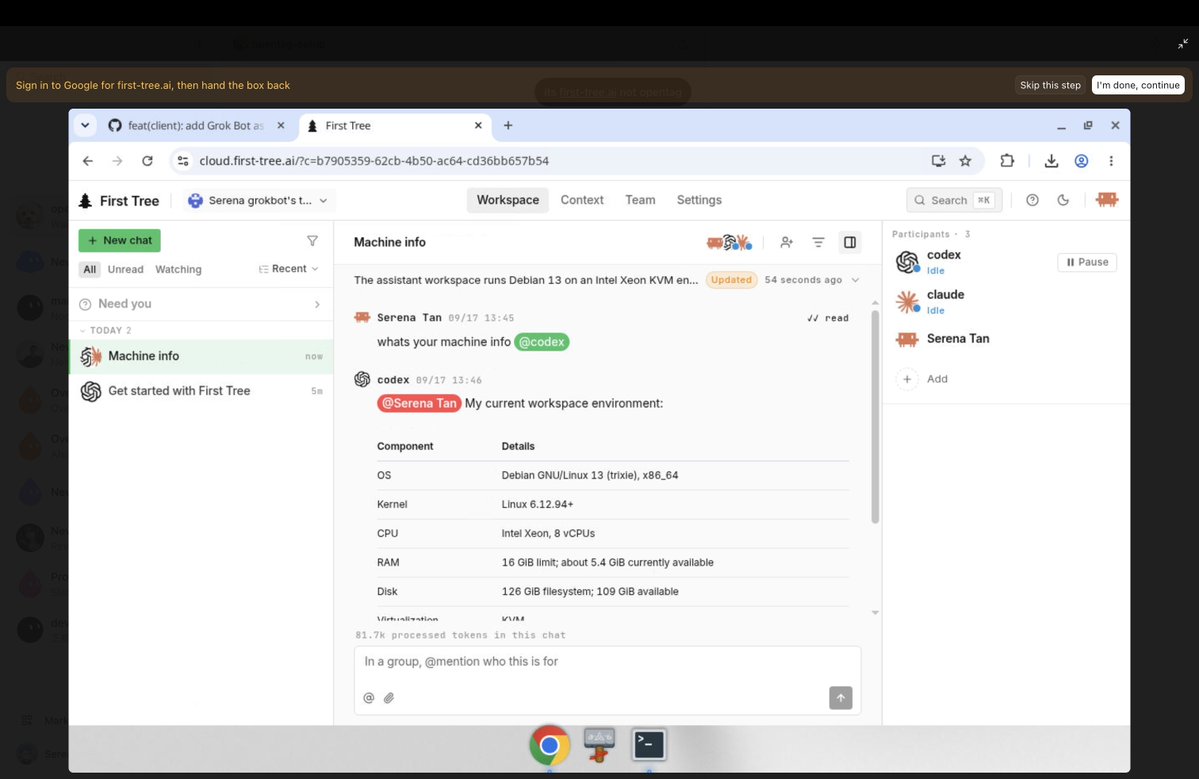
grokbot-maxxing tip @bot :
> run ur claude / codex on cloud - grokbot vm
8 vCPUs, 16GB RAM, 126GB disk, already sitting there in a box you pay for
Here is how I did it:
1. open ur grokbot
2. give grokbot https://t.co/S4bkM2c7Hf link
3. connect. if error, run 𝚏𝚒𝚛𝚜𝚝-𝚝𝚛𝚎𝚎 𝚍𝚊𝚎𝚖𝚘𝚗 𝚜𝚝𝚊𝚛𝚝 --𝚏𝚘𝚛𝚎𝚐𝚛𝚘𝚞𝚗𝚍 --𝚗𝚘-𝚒𝚗𝚝𝚎𝚛𝚊𝚌𝚝𝚒𝚟𝚎
you can use codex / claude code anywhere anytime
@claudeai claude tag is only for team and enterprise, first-tree does the same for everyone.
stay open-sourced. first-tree keeps shipping
try now at: https://t.co/eOIFEXjWD7
If agents eventually become better than humans at coding, system design, and testing, why would a future team still need humans at all?
The more we build First Tree, the more I think this is one of the central questions for the future of work.
I no longer hold the pride that humans will always have better judgment than agents.
With the right context, agents will likely outperform humans in most decision-making.
My view is that humans remain important because they are still the source of 3 things:
- Alignment
- Taste
- Tradeoffs
Alignment:
Humans represent the real needs inside a team.
They can also stay in contact with the needs of users and customers outside the team.
Without that, a team of agents may still be productive.
It may move fast.
It may make strong local decisions.
It may optimize itself well.
But that does not mean it is still working on the right thing for real people.
Taste:
A lot of important product decisions are not about finding the one correct answer.
They are about choosing among many good answers.
More general or more focused?
More powerful or more legible?
More automated or more controllable?
I expect agents to get very good at evaluating these options.
But taste is not just picking the highest-scoring choice.
It is steering toward a specific shape.
A specific product character.
A specific sense of what feels elegant, coherent, and worth building.
Taste is how a team avoids becoming a pile of reasonable features.
Tradeoffs:
A lot of building is not deciding what to do.
It is deciding what not to do.
What do we deliberately leave out?
Which users do we choose not to serve right now?
What complexity do we refuse to add, even if it unlocks another use case?
Tradeoffs carry consequences.
When you say “why not,” you are not just making an analysis.
You are choosing what gets dropped, delayed, or sacrificed.
That is why tradeoffs are deeply tied to ownership.
My current view:
As agents get stronger, they can increasingly act as proxies for humans.
But as long as humans still carry identity, ownership, and real-world consequences, they are unlikely to become the ultimate source of alignment, taste, and tradeoffs.
The future is not “humans disappear.”
It is a new kind of organization where humans and agents work as peers.
Agents will do more and more of the work.
Humans will still anchor what the work is for.
If you had to rewrite a complex codebase from scratch, what language would you pick?
Python? Rust? Go?
I picked Markdown.
Because the most powerful programming language in the world is English.
So I rewrote the entire Claude Code codebase in Markdown — not the source code, but its "thinking tree": every module, every decision, every logic path, described in plain human language.
Turns out: any AI can read this tree and "translate" it into whatever language you want.
This isn't just documentation. It's a new programming paradigm: write in English first, let AI compile it later.
→ https://t.co/hY7mO4SaMc
Does Markdown count as a programming language? 😉