The Charging Disparity: A Costly Reality.
Check out our latest article where we unravel the economics of EV charging and the urgent need for smarter energy management
https://t.co/i9FhDcLU1s
2025 VC landscape analysis: AI/deep tech deals show larger check sizes despite lower transaction volume. Key success factors: B2B focus, clear path to profitability, proven unit economics. Founders need robust financial models and clear AI implementation strategies to secure funding in this selective market.
Investors spend 2.7 minutes average on pitch decks. Critical success factors:
1. Data narrative alignment
2. Market sizing validation
3. Financial projection credibility
4. Team capability evidence
Common error: 82% of founders lead with product, not problem.
Start with market pain point analysis.
Impact metrics are no longer optional in your pitch deck. 85% of young investors prioritize sustainable investing in 2025. Founders: your value proposition must clearly articulate both financial returns and measurable impact. The funding landscape has evolved - adapt your pitch accordingly.
Understanding startup valuation is critical; it directly dictates the equity you exchange for capital and sets the stage for future growth. In 2025, this isn't a straightforward calculation, especially for early-stage ventures with limited revenue and inherent uncertainty. There's no single ‘best’ method, rather a suite of tools, each with its own pros and cons, best applied depending on your startup’s maturity and context.
Let’s break down the core methods:
1. Discounted Cash Flow (DCF): This method projects your future cash flows and discounts them back to a present value. Pros: It's theoretically sound and highly flexible, allowing for detailed financial modeling. Cons: It's heavily reliant on accurate, long-term projections, which can be highly speculative for early-stage startups. However, advanced DCF models can mitigate this by considering multiple scenarios (best, base, worst-case) to provide a weighted-average valuation.
2. Venture Capital (VC) Method: Widely favored by VCs, this method works backward. It estimates a future exit value (e.g., in 5-7 years) and then discounts that value to the present based on the investor's desired high rate of return. Pros: Directly aligns with investor return expectations and accounts for the high risk inherent in startup investing. Cons: Can be overly simplistic, often ignoring interim cash flows, and highly sensitive to the chosen exit multiple and discount rate.
3. Comparable Company Analysis (CCA): This involves comparing your startup to similar companies that have recently been valued or acquired in your industry. Pros: Market-driven and relatively easy to understand. Cons: Finding truly 'comparable' private companies with publicly available valuation data is often challenging, and it can be pro-cyclical, reflecting market highs and lows rather than fundamental value.
4. Qualitative Methods (Berkus & Scorecard): These are particularly relevant for pre-revenue startups. The Berkus Method assigns value based on key milestones (e.g., strong idea, prototype, strong management). The Scorecard Method adjusts the average pre-money valuation of similar startups in the industry based on qualitative factors like management team strength, market size, and technology. Pros: Useful when traditional financial data is scarce. Cons: Inherently subjective and less precise, relying heavily on experienced judgment.
Factors like strong traction (customer acquisition, revenue growth, user growth), unique product innovation, the size of your addressable market, the strength and experience of your management team, and even broader macroeconomic influences all significantly impact your valuation. The most robust approach typically involves a blend of these methods. By using multiple valuation techniques, you gain a more comprehensive, reliable, and defensible assessment of your company's worth, which is crucial for successful funding rounds and strategic decision-making.
Strong company culture directly impacts valuation. Analysis of Series A rounds shows startups with documented culture frameworks achieve 2.4x higher valuations. Key metrics investors evaluate: employee retention rate, leadership transparency score, and organizational health index. These indicators predict scaling potential with 89% accuracy.
Early-stage startup funding in 2025 remains robust. Data shows AI startups reaching $1M revenue in 11 months, 5x faster than traditional SaaS. Pre-seed and seed rounds are exceeding 2022 levels. Key driver: Revenue efficiency metrics now outweigh growth-at-all-costs narrative in valuations.
AI startup valuations in 2025 have shifted fundamentally. Key success factors:
1. Clear commercial milestones
2. Technological differentiation
3. Efficient resource utilization
Founders: Your ability to demonstrate these metrics matters more than your pitch deck visuals. Focus on substance over style.
Valuation isn't just about numbers - it's about proving sustainable value creation.
Startup metrics that matter for fundraising:
1. Growth Metrics
- MAU growth rate
- MRR acceleration
- Market penetration velocity
2. Financial Health
- Burn rate vs runway
- CAC to LTV ratio
- Gross margin trends
3. Operational Efficiency
- Revenue per employee
- Automation rate
- Process scalability index
Track these systematically. Poor metrics tracking is the top reason founders fail to secure funding. Your numbers tell your story.
Measure what matters. Update weekly. Present monthly. This is your fundraising foundation.
#ICanPitch #Fundraising #Tips #startup #founderlife
Savvy founders see a market dip as an opportunity to accelerate product velocity and win customers. Leverage AI-powered tools like @belthan22821 to optimize your fundraising strategy and own the next cycle. #StartupFundraising#ProductDevelopment
Our AI just analyzed 2025 funding data. 35% of VC money goes to AI startups. The other 65%? Probably building AI to get into the 35%. Time to update those pitch decks.
Nine out of ten new cars sold in Norway last year were powered by battery only, registration data showed, placing the country within reach of its target of only adding cars that are electric on the road by 2025.
EPA grants California's request to ban sales of new gas cars by 2035!
The EPA has just granted the state's request to ban sales of new gas-powered cars by 2035. This move is part of California's plan to reduce emissions and combat climate change.
According to EPA Administrator Michael Regan, California has had the authority to request waivers to protect its residents from air pollution. Regan stated that the EPA is committed to partnering with states to reduce emissions and address the climate crisis.
This decision is a significant step towards a more sustainable future, and it's likely to have a ripple effect across the country. California's rules, which have already been adopted by a dozen other states, require that 80% of all new vehicles sold in the state be electric by 2035 !
Source: https://t.co/6zLctcAC8T
California is accelerating its transition to electric vehicles with a massive $1.4 billion investment in EV charging infrastructure.
The California Energy Commission's initiative aims to deploy 17,000 new chargers over four years, targeting 250,000 chargers statewide.
Additionally, the DOE has announced a $1.25 billion loan guarantee to EVgo Swift Borrower(operators of the nation's largest EV charging networks) to support the installation of 7,500 fast chargers nationwide.
Source: https://t.co/rPp85VO4D5
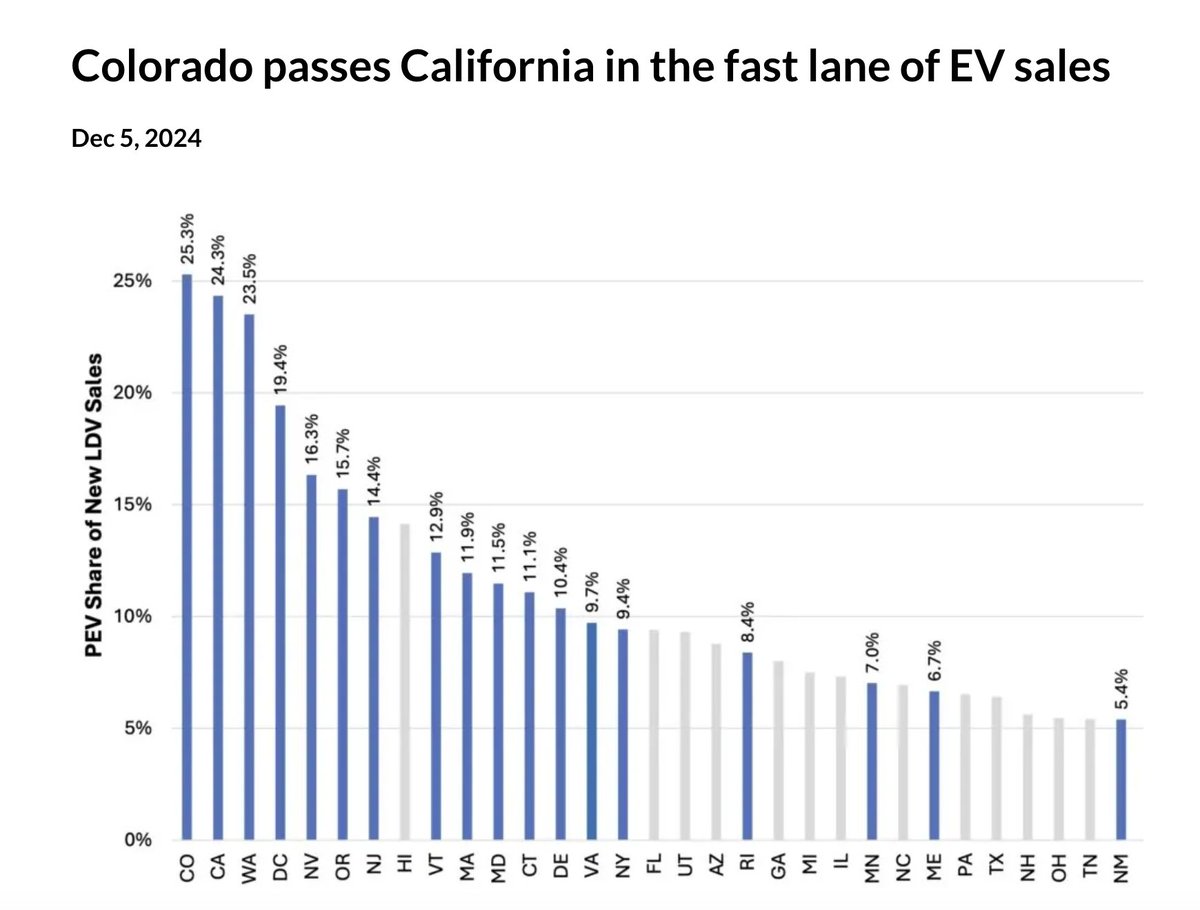
Colorado just passed California in Q3 EV sales Generous incentives and 5,500+ public chargers have spurred growth, but with state credits dropping in 2025 and federal support uncertain, can the momentum keep up?
The future hangs in the balance.
Mercedes-Benz is working on solar paint that could power EVs with sunlight, offering up to 12,500 miles/year in sunny areas. While exciting, it’s unlikely to replace EV charging entirely. It may work as a supplementary energy source, extending range slightly or powering smaller systems like climate control or infotainment, but charging stations and home chargers will remain essential to EV infrastructure.
Source: https://t.co/JZ72iLK38z
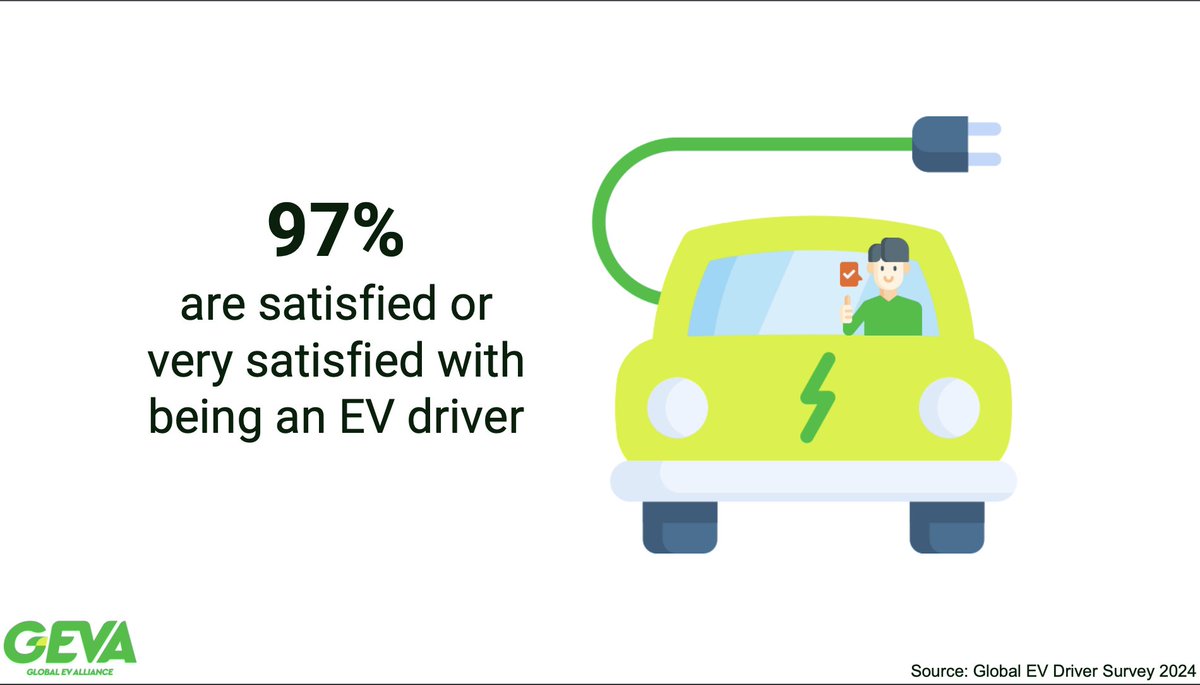
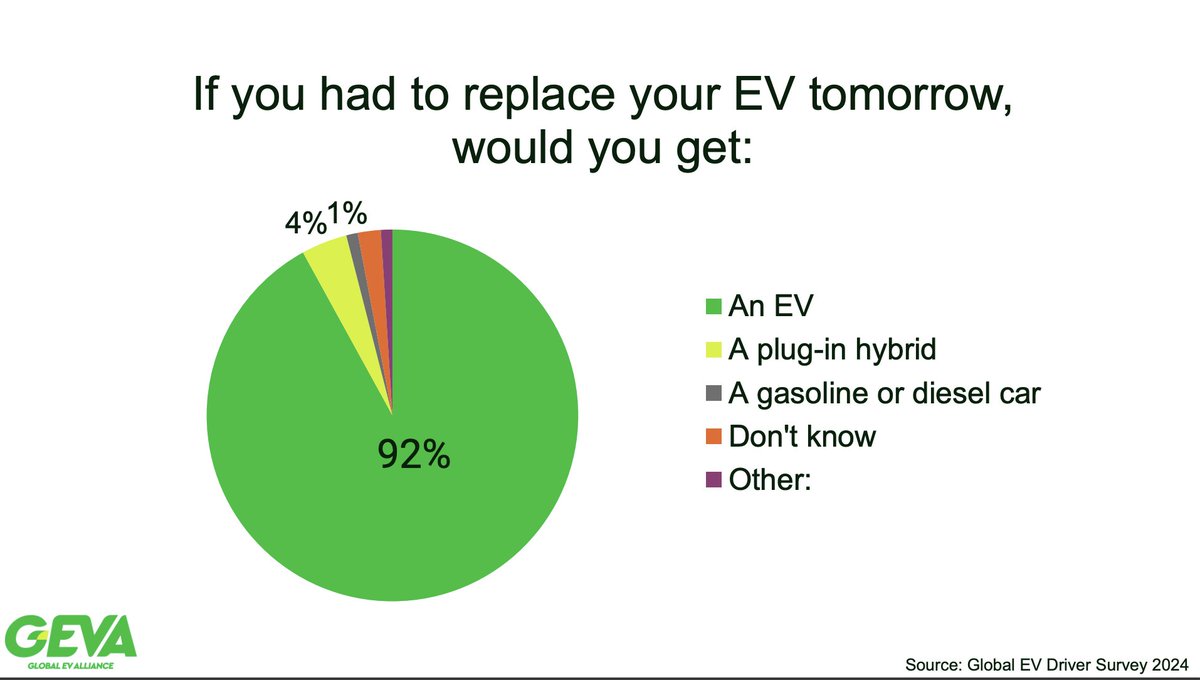
The Global EV Alliance (GEVA) Survey covered EV drivers across 18 countries, including Austria, Brazil, Canada, Costa Rica, France, Germany, Hungary, India, Ireland, the Netherlands, Norway, Poland, Portugal, Slovenia, Sweden, Switzerland, the United Kingdom, and the USA. The results are impressive: 97% of respondents are satisfied or very satisfied with their EV driving experience. Even more telling, 92% would choose an EV again if they needed to replace their vehicle tomorrow.
The future is undeniably electric!
Impressed by the EV charging infrastructure in Dubai! Seeing chargers conveniently located next to petrol stations shows how seamless the transition to EVs can be. Convenience and innovation at its best.
It’s great to see more public chargers becoming available! But a single site with 4 medium-speed (150kW) and 4 L2 chargers costing $2.46M is a heavy burden on taxpayers. Superchargd focuses on home chargers to provide cost-effective, community-driven solutions.
Source in thread: