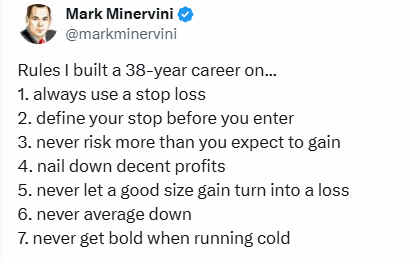
You can focus on all the names you missed and carry that negative energy or be grateful for all the opportunities that you got and this incredible market.
The choice is yours.
“If what you attempt is not to change yourself but to observe yourself, to study everyone of your reactions to people and things, without judgment or condemnation or desire to reform yourself, your observation will be nonselective, comprehensive, never fixed on rigid conclusions, always open and fresh from moment to moment. Then you will notice a marvelous thing happening within you. You will be flooded with the light of awareness, you will become transparent and transformed.”
“Simple can be harder than complex: You have to work hard to get your thinking clean to make it simple. But it's worth it in the end because once you get there, you can move mountains." — Steve Jobs
Never been more relevant than in today’s world imo
A millionaire friend once told me...
"People don't have the patience to dedicate 3 years to building their own business, but they have the patience to work for others for 40 years.
There's a lesson there.
Successful traders do consistently what unsuccessful traders do occasionally. Trading rewards boring discipline, not occasional brilliance. The problem is that the “right” behaviors are usually uphill (they require effort, patience, and restraint), while the “wrong” behaviors are downhill (they feel natural, fast, and emotionally relieving). Carrying this into trading means treating your edge like hygiene: it works because it is repeated, not because it is heroic.
What “uphill” looks like in trading (the good habits)
These are the actions that feel slightly uncomfortable but compound over time:
•Wait for A-setups instead of forcing action to relieve boredom.
•Predefine risk (entry, stop, position size) before you click buy.
•Take the stop without negotiation when the thesis breaks.
•Trade small when conditions are unclear; press only when conditions are favorable.
•Journal and review even after a green day (because comfort hides mistakes).
•Follow a process (checklist, rules, timing) instead of “feel.”
What “downhill” looks like (the habits that feel good now, cost later)
These are emotionally convenient, which is why they’re seductive:
•Chasing because price moved without you.
•Moving stops to avoid being wrong.
•Oversizing to “make it count.”
•Revenge trading to erase discomfort.
•Constant switching of strategy when the last trade hurt.
•Taking profits early to lock relief, not because the setup says so.
The key translation: consistency beats intensity
Most losing traders know the right moves. They just do them sometimes—usually when they feel calm. Successful traders do them especially when they don’t feel like it.
A useful rule: your discipline must be strongest at the exact moment your emotions demand the opposite. That is the uphill battle.
Make it practical: convert “uphill” into defaults
If you want this to show up in your P&L, you need systems that reduce decision fatigue:
•One-page playbook: 3 setups, 3 invalidations, 3 “no-trade” conditions.
•A trade checklist you must clear before entry (trend, liquidity, volume, location, risk).
•Hard risk caps: max loss/day, max loss/week, max positions, max correlation.
•If/then rules for the downhill moments:
•If I feel urgency, then I must wait 5 minutes and re-check the checklist.
•If I get stopped out, then I must pause 20 minutes before any new entry.
•If I want to move a stop, then I must reduce size instead—or exit.
Bottom line
The market doesn’t pay for what you know. It pays for what you can repeat. The edge is not a secret strategy—it is the ability to execute boring, correct decisions so consistently that your downhill habits don’t get a vote.
How price reacts to news is more important than the news itself.
Good news + up = strength
Good news + down = distribution
Bad news + up = accumulation
Bad news + down = weakness
This applies to individual stocks and the general market.
One of the biggest mistakes newer traders make is thinking there is one correct way to trade the day. The open gets a lot of attention, so it’s easy to assume that if you’re not active early, you’re doing something wrong.
But when you look at how successful traders actually operate, a different picture emerges. Many of them trade at very different times of day—and for good reasons.
They are not disagreeing about setups. They are trading different edges.
Traders Who Focus on the Open
Traders such as Qullamaggie rely heavily on early action. A significant part of that approach is built around opening-range behavior, early momentum, and rapid feedback.
This style works best when:
The market is in a strong uptrend
Breakouts have follow-through
Leaders separate quickly from the rest of the market
In those environments, waiting too long is a disadvantage. The best names often move early and don’t look back. If you hesitate, you either miss the trade or end up chasing it with worse risk.
For this style, the open is not noise—it’s information.
Traders Who Wait for Proof
Other traders structure their entire approach around waiting.
Jeff Cooper’s strategies are a good example. Many of his setups require a stock to put in an expansion bar or a strong up day first. That move is the signal. The trade only exists after the stock has already shown real strength. Entries often come late in the session or the next day.
@FelipeGuirao takes this even further by focusing heavily on end-of-day entries. The close matters most to him. A stock that finishes strong tells you buyers stayed involved. A stock that fades tells you the move failed. That information simply does not exist earlier in the day.
These traders are not slower. They are trading confirmation-based edges.
Same Market, Different Information
What’s important is that all of these traders are reacting to real information—just at different points in time.
Early traders are acting on urgency and momentum
Late traders are acting on confirmation and survival
Neither approach is “right” in isolation. Each depends on market conditions.
Why This Matters for Your Trading
The problem is not that traders wait. The problem is waiting in a market that rewards speed—or rushing in a market that punishes it.
Strong markets often reward traders like Qullamaggie:
Opening range breaks work
Momentum sticks
Pullbacks are brief
Weak or choppy markets often reward traders who wait:
Early moves fail
Strength fades
Only a few stocks can hold gains into the close
Trying to force an opening-range style in a weak market is just as costly as waiting all day in a runaway bull phase.
Time of Day Is Part of Risk Management
The market changes the cost of being wrong.
In strong markets, early mistakes are often forgiven. In weak markets, early mistakes compound quickly. Waiting becomes a way to reduce error, not a way to miss opportunity.
That’s why time is not just about entries. It’s about aligning your behavior with the environment.
The Real Lesson
Successful traders do not agree on when to trade because they are not trading the same edge. Some trade momentum as it appears. Some trade confirmation after it proves itself. Some trade the open.
Some trade the close.
Bottom Line
There is no universal clock in trading.
Qullamaggie’s focus on the opening range works when the market rewards speed. Jeff Cooper’s and Felipe Guirao’s patience works when the market demands proof.
The mistake is not choosing one style over the other. The mistake is using the wrong clock for the market you’re in.
Learn to recognize which environment you’re trading—and let the market tell you when to act.
MOST MEN A’RE ADDICTED TO FAKES:
- PORN is fake sex.
- ALCOHOL is fake fun.
- JUNK food is fake nutrition.
- DRUGS are fake happiness.
- SMOKING is fake calm.
- SOCIAL MEDIA is fake connection.
Don’t lose yourself chasing fakes.
Investing becomes so much easier once you realize the market never changes.
Fear and greed. Supply and demand. Boom and bust. Accumulation and distribution.
None of this is new.
These patterns have been the same for centuries.
Every generation thinks this time is different. And every generation gets reminded that it is not.
The tickers change.
The stories change.
But people do not change.
The market repeats because we repeat.
And once you see it, you can't unsee it.
Use it to your advantage.