I co-founded and then left a 7-figure consultancy because it felt like painting the Golden Gate Bridge over and over.
When a unicorn client wanted to pay us a hefty sum to clean up their Notion workspace, I said no. "I can do it, but it'll quickly turn to shit again."
Their response: "I don't care. It's a trash fire."
This was the catalyst for starting Falconer. I talked to about 100 engineering managers, tech leads, and founders about their internal docs. They were customers of Notion, Glean, and Confluence. The top complaints were related to document lifecycle management. "What's the source of truth? How does a document get updated? How can I find it quickly?"
The vision for Falconer needed to be fundamentally different, not just a beautiful Confluence. It all came down to accuracy and curation.
Notion is the everything app. Glean helps you search everything. Confluence is...well I'm not sure what Confluence is for.
Falconer is the accuracy app, obsessed with knowledge quality and curation. The app that lets you find the right thing, not just return everything.
Falconer is:
1. A knowledge graph built for accuracy
2. An AI-native library that curates your knowledge for you
3. A context monitoring and observability tool
None of our tools, UX, or aspirations mattered until we showed results.
Customer love has shown up in our Slack Connect channels and internal usage dashboards, but we needed public numbers to prove it. It's validating to share the winning results of our unique approach and architecture. And there's still so much more to come.
Until now, our customers migrated their entire knowledge base off legacy tools like Notion, Confluence, and Glean after trying @falconer_ai — based purely on the feeling of accuracy, speed, and trust.
Now we have the benchmarks to back that feeling up.
Everything you'd want in a markdown editor and more.
Built to scale. AI-native. Context aware.
- Multiplayer comments: synced and resolvable
- Author states: edit, suggestion + view modes
- Edit history: diff and roll back
- Multi-edits
@GergelyOrosz@OfficialLoganK@falconer_ai used to take inspo from G Docs for its simplicity. Now G Docs should take inspo from us. We collapse all the AI features if you just want to focus.
@payabli has built some of the best product docs in the world.
Their customers see it every day. Internally, they wanted to build the best writing culture, too. Knowledge was spread across Confluence, Google Drive, and Slack. Finding an answer often meant pulling an engineer out of their work.
Their move from Confluence to Falconer took just two days.
The impact showed up in new behavior. Teams that never had time for documentation — HR, finance, marketing — started writing more things down. And engineers now rely on Falconer instead of getting trapped in endless Slack threads.
When you're moving at startup speed, you don't have time to keep a log of all the projects you've worked on and forget what you did last week. Cool use case for maintaining this log, without having to do the digging yourself.
writing a self-review usually eats a whole weekend. this time mine took ~15 minutes.
and it came out more thorough than anything i'd have written from memory.
@falconer_ai pulled from six months of changelogs, PRs, and incident reports, so nothing got left out. i was confident every contribution made it in, even the wins i'd forgotten i shipped. all of it cited.
Onboarding a new engineer can take weeks of explaining how the codebase works. And when a senior engineer leaves, that context walks out the door.
Falconer Generate fixes the handoff, and it doesn't take a documentation sprint.
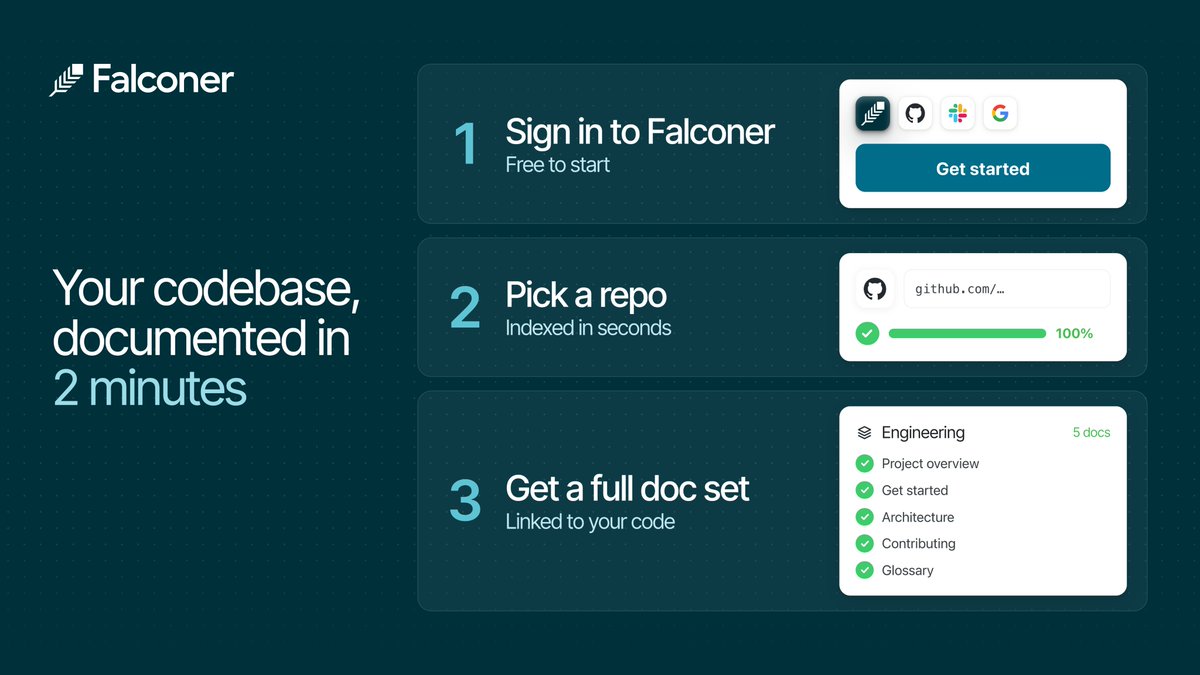
Point Falconer at any repo and get an initial doc set back in minutes: project overview, get started, architecture overview, contributing guide, and glossary.
Falconer also answers questions about the codebase directly, so new hires ramp from the docs instead of your staff engineer's calendar.
AI has turned engineer into the people manager they swore they’d never become:
- Hasn’t written code in months, but still says “we built this”.
- Can’t review PRs, so waits for AI and teammates to review them first.
- Treats bug triage as a sophisticated message-forwarding system.
- Technical feedback consists of “add tests”, “optimize performance”, and “improve docs”.
- When things go right, it’s leadership. When things go wrong, it’s execution.
Somewhere, your old manager is smiling and saying: “See? My job wasn’t that easy.”
Clever way to lower the barrier for non-technical people to automate with skills. No learning curve, same entry point... and the agent understands code in natural language.
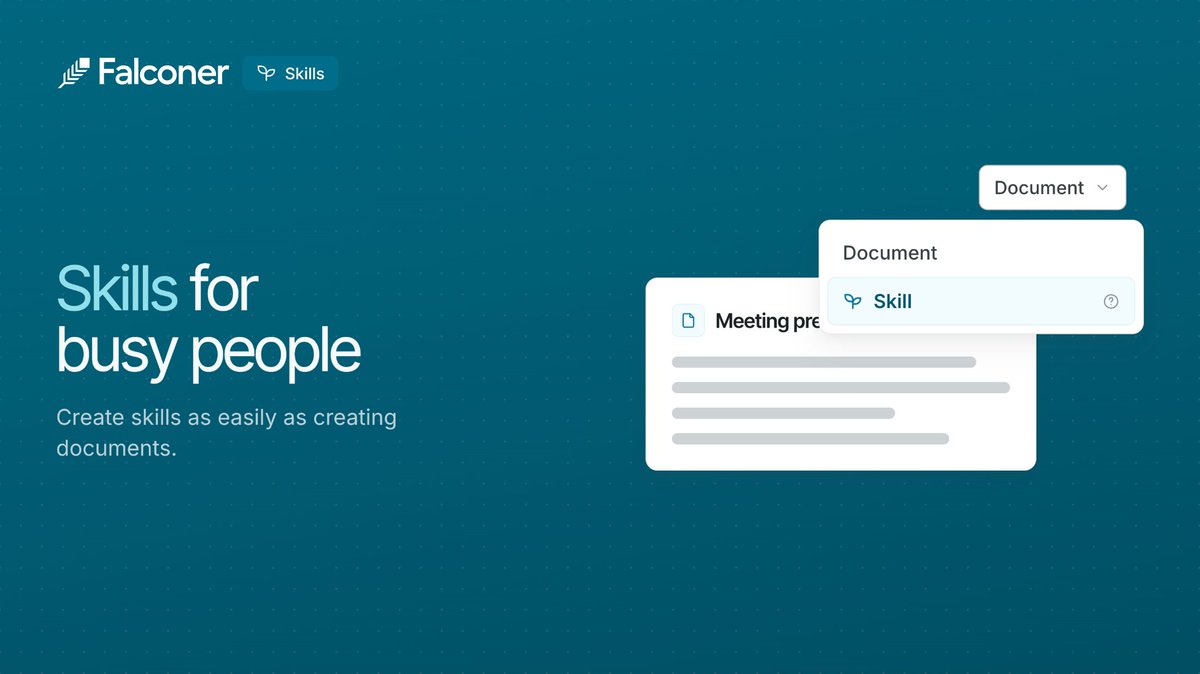
@falconer_ai turns docs into skills. Mark any doc as a skill and the agent takes care of the rest.
Falconer skills + your company brain = tasks that run themselves.
Tell Falconer what you want the skill to do, or write the instructions yourself.
Flip the doc type to Skill, and it's ready to be called with your context baked in — docs, code, Slack, tickets, and meetings.
Maintaining an open source project changes how you see software you depend on.
When we hit friction with the libraries @falconer_ai relies on, we did something unusual for a startup: rather than working around the issues, we fixed them at the source:
https://t.co/TkLi6FFyM6
We recently gave @falconer_ai agent git tools on a network file system built upon the new @awscloud S3 Files feature that came out last month.
Very happy to see it already helping our team with real regression diffing.
We hired a Communications major right out of college, and within a few months she was owning changelogs, the engineering blog, and doing the work of an entire marketing and ops team through Falconer + Claude Code + skills.
Writing our weekly changelogs and investor updates used to eat my Fridays. 2 hrs x 52 wks = 100+ hrs a year on work that produced nothing new.
I wrote up how that became roughly ten seconds, and the workflow that got me there: https://t.co/3CmCxFYmNW