Lead Support Engineer | 20 yrs Silicon Valley, sharing raw stories from the trenches. Brutally Honest Elite Support, Business efficiency, Motivation & Humor.
Autism in the Workplace
(Or: Why Your Most Valuable Engineer Sometimes Needs a 47-Page Instruction Manual for Small Talk)
I've been in tech support long enough to know that roughly 40 % of the best engineers I've ever worked with are somewhere on the spectrum.
The rest just hide it better.
We're the ones who can debug a nightmare cluster while everyone else is panicking, but we'll also spend 25 minutes in a meeting wondering if "sounds good" was sarcastic or if we're supposed to reply with an emoji. We're brilliant at systems. We're occasionally terrible at humans.
And the workplace? It's a minefield designed by extroverts who think "read the room" is helpful advice instead of a cruel joke.
Here's the honest, slightly uncomfortable truth from someone who's lived both sides of it:
The superpowers are real.
Autistic brains in support roles are absolute weapons. Pattern recognition on steroids. Hyper-focus that turns impossible tickets into solved ones. Zero tolerance for BS processes. We remember the one obscure log line from three years ago that just saved the customer's entire production environment. Companies literally profit from this wiring.
The challenges are also real.
We sometimes say things that land like a brick through a window. We miss sarcasm. We take instructions literally. We get overstimulated in open offices and need to go full hermit crab for 30 minutes just to reset. And yes - sometimes our "joke" is only funny to the three other autistic people in the building.
The comedy writes itself.
I once watched a very talented (and very autistic) colleague try to be friendly with a new female team member by saying:
"You have the energy of a well-optimized query."
She heard "you're giving database administrator vibes."
HR heard "potential micro-aggression."
The rest of us heard "this is why we can't have nice things."
He got the talk. She got an apology. The team got another hilarious story for the group chat.
So what actually works?
For the autistic/semi-autistic engineers (yes, I'm looking at you):
- Have one trusted "social translator" colleague. Run risky jokes or ambiguous messages past them first. Saves a lot of drama.
- Use the "explicit mode" when needed: "I'm not great at reading tone, so if I ever come across as blunt or weird, please tell me directly. I won't be offended - I'll be grateful."
- Build yourself a small "safe zone" (noise-cancelling headphones, focus time blocks, the ability to say "I need 15 minutes" without explanation).
- Own your strengths out loud: "I'm not great at small talk, but I'm excellent at finding the one line in 4000 that's causing the outage."
For managers and companies:
- Stop forcing everyone into the same extroverted mold. "Team building" that requires forced socializing is torture for some of us.
- Give clear, literal feedback. "Read the room" is useless. "Your last three messages came across as very blunt and the customer felt dismissed" is gold.
- Protect the quiet high-performers. The socially awkward genius who never speaks in meetings might be the one actually keeping your systems alive.
- Accept that some of your best people will never be "culture fits" in the classic sense - and that's a feature, not a bug.
The workplace doesn't need more sensitivity training.
It needs more honesty about how different brains actually work.
Because the same wiring that makes someone terrible at office small talk is often the same wiring that makes them exceptional at solving the problems nobody else can touch.
We're not broken.
We're just running a slightly different operating system.
And sometimes that operating system is exactly what your company needs when everything is on fire.
Ever worked with (or been) the socially awkward but technically brilliant colleague? What actually helped - or made things worse? Drop the real experiences below 👇 - the more honest, the better. We've all been in that meeting.
@alex_prompter We made our population dumber with a horrible "education" system and now we are selling them fake intelligence so they never have to think for themselves again. What could go wrong?
Teenagers have started calling AI art "boomer art" and consider it cringe, and YouTubers have stopped using AI-generated thumbnails because teenagers find them cringe and won't click on them. I honestly couldn't be happier.
Hi @xai Grok is making so many factual mistakes (in Expert mode) that it is basically doing the ChatGPT meme ("You are right, it seems like this mushroom is indeed deadly"). It is unusable now even for minor research.
1. Asked to search for toothpaste without menthol. First recommendation: toothpaste with menthol.
2. Asked for the maintenance interval of my ATV. Grok states it's 200 KM. I check the manual, and it is 1000 KM.
3. Asked for good speakers for my Samsung Galaxy A05s. Grok insists that it does not have an AUX port. But it does - I am holding it in my hand.
Every time it's like: "Oops, you got me *blush*. Here is the updated information (based on the input the user correctly provided)." Are you kidding me? Those were all details that could be easily Googled, yet Grok fails to do so. What are you doing over there?
@mrmikeMTL 2012 when the Occupy Wallstreet movement got too close to the sun and equality was pushed from TPTB to divert the force of the community to nonsensical social issues. Brilliant move, actually.
The Car That Arrived... And Then Ghosted Us
A few months ago our family outgrew our old car. We wanted something practical but a bit more comfortable - proper A/C, decent seats, and some modern safety features. Being the loving husband I am, I let my wife talk me into a German brand instead of my beloved "no unnecessary tech" Dacia special.
The sales guy at the dealership was actually great. Chill, honest about the budget, and patient when we changed our minds three times after the order was placed. We left the dealership excited. The car was ordered, a tracking link appeared, and we even bought accessories in advance like proud new parents.
Then the car arrived at the dealership... and the communication died.
For three full weeks the car sat there while we got nothing but radio silence.
I sent polite emails.
I called multiple times.
Every time the guy said the same thing: "I'll check and get back to you."
He never did.
The car was physically ready. The only thing missing was basic human accountability. All I wanted was a simple update - "It'll be ready in two weeks," "There's a small delay," or even "I don't know yet, but I'll check tomorrow." Instead we got ghosted by the very person who had been so helpful during the sales process.
The frustration wasn't about the delay itself.
It was the total lack of transparency and follow-through that turned an exciting moment into pure annoyance. We started to imagine all kinds of horror stories. "Did the car break during transport?", "did they forget to implement our changes?", "did our money transfer not arrive?". We stressed out without need over an issue that shouldn't be one.
We eventually picked up the car. It's great. But I can already tell you one thing with absolute certainty: when it's time for the next one, we won't be going back to that dealership - even though the car and the price were excellent.
The support lesson here is painfully simple:
Your customer can forgive delays.
They can forgive problems.
What they rarely forgive is being left in the dark with broken promises.
A fancy product or smooth sales process gets you the initial win.
Basic accountability and honest updates keep the relationship alive long after the sale.
In support terms:
- A customer who knows what's happening (even if it's bad news) stays calm.
- A customer who feels ignored or lied to starts looking for reasons to leave.
The dealership had a perfect car ready and a happy customer... and still managed to damage the relationship through simple neglect of communication.
Never underestimate how much goodwill you can destroy with radio silence.
A quick "I don't have an update yet, but I'll check again tomorrow" costs almost nothing and saves an enormous amount of frustration.
Your customers aren't angry because things take time.
They're angry because they feel forgotten.
Brutal. Accurate. And only half the story.
Yes, LLMs made code ridiculously cheap and fast. The "Yes Engineer" can now ship prototypes at light speed. But here's what almost nobody is saying out loud:
The bottleneck was never the developers.
It was (and still is) everything around the code:
- Decision latency
- Endless requirements meetings
- Scope creep protection
- Security audits
- Architecture reviews
- Stakeholder alignment
The 47 people who need to say "yes" before anything can go live
AI didn't remove those gates. It just made the developers faster at hitting them.
I have seen this myself. L7 Engineers moving to Thailand, Bali or Mallorca to open a bar or live a peaceful life of their savings. Some come back, but usually only when they run out of cash or BTC.
The Intern Who Came Back
A few years ago we had a quiet, slightly awkward intern named Kevin.
He was 19, carried a giant backpack that looked like it weighed more than he did, asked a lot of questions, and took notes like his life depended on it. One of our senior engineers - let's call him Mark - treated him like a mildly annoying office plant. Eye rolls in meetings, sarcastic little comments, the occasional "just watch and learn, kid." Classic "I'm too important for this" energy.
Kevin just smiled, worked hard, and absorbed everything.
He finished his internship, graduated, and left the company. We didn't think much of it.
Three years later he came back.
Not as an employee - as the new project manager for one of our largest and most important customers.
The same customer whose massive, complex environment we supported every single day.
Suddenly Mark - the same senior who had rolled his eyes at Kevin - was sitting on a bridge call where Kevin was politely but firmly telling us how the engagement was going to work from now on. Kevin had real leverage. He could influence which tools we used, how we escalated, how fast we responded, and even which engineers were allowed on his account.
Mark spent the entire call looking like he had swallowed a lemon.
The rest of us tried very hard not to smile too obviously.
Kevin was professional, fair, and actually a pleasure to work with. But every time he said something like "We'd prefer a more structured approach." you could see Mark remembering every dismissive comment he'd made three years earlier.
The irony was delicious.
The lesson is simple:
The intern you dismiss today might be the person who decides how your team works with their company tomorrow.
Tech is a small world. People move fast. The quiet kid taking notes in the corner can become the project manager, the decision-maker, the trusted advisor at your biggest customer, or your manager - sometimes faster than you expect.
How to treat your interns and apprentices the right way
👉Give them real work, not just coffee runs.
Let them shadow complex tickets. Let them fix small things. Let them feel useful. Bored interns learn nothing and remember everything. Give them real work and real respect.
👉Be patient when they ask "stupid" questions and answer their questions without the eye rolls.
Those questions usually come from a place of genuine curiosity. Those "dumb" questions often come from fresh eyes.
👉Protect them from the office jerks (including yourself).
If someone is dismissive or mean to the intern, call it out immediately. You're shaping how they see the entire profession (and company).
👉Celebrate their wins, no matter how small.
A "great catch" or "nice fix" from a senior can stay with them for years.
👉Remember they're watching everything.
How you treat the intern tells the whole team what kind of culture you really have - not what the posters on the wall say.
👉Be the kind of senior you would have wanted when you were starting out.
Even if you had a bad first impression or bumpy start in your career, there is no need to repeat those negative experiences for others. Be the hero who breaks the cycle.
The intern you roll your eyes at today might be the leader who decides your next promotion, your next project, or whether your team even exists in five years.
Treat them like the future colleague they actually are.
Be nice.
Be fair.
Be professional.
Because the industry is smaller than it looks, memory is long, and karma has an excellent sense of timing.
Ever had an intern or apprentice come back years later in a position of power - or been the intern who remembered exactly how people treated you? Drop the story below 👇 - the more satisfying or the more awkward, the better. We've all seen the circle close.
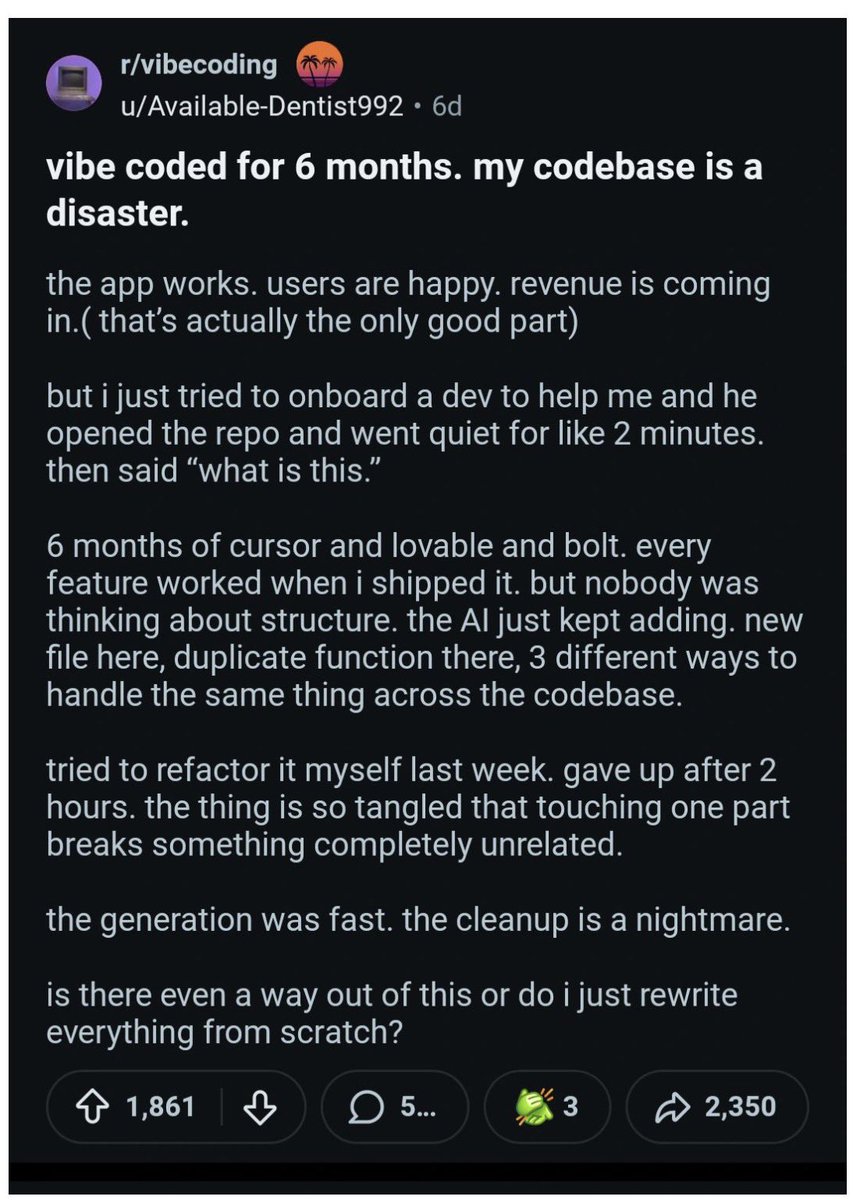
Talking to smarter folks than me, I'm convinced many of the AI folks in my timeline are full of shit.
Nobody is "running 20 agents over night" and building stuff for actual users. Maybe some are building internal tools or disposable software. Maybe.
But building software people like using? That doesn't get hacked on day one or blow up after the 3rd user? Nope.
I don't even understand what that's supposed to look like. Do you work out a 57 pages document that perfectly describes what you want to build and then summon 14 agents and have them run wild for 6 hours? And what comes out on the other end isn't a broken pile of shit?
Nope. Not buying it.
PS: it may also be that I have an IQ of 82 and can't figure it out.