If two people start a company and one contributes 90% of the capital while the other contributes just 10%, when the business starts struggling, who do you think is more likely to walk away first? Exactly, Now apply that same principle to your relationships
New week!
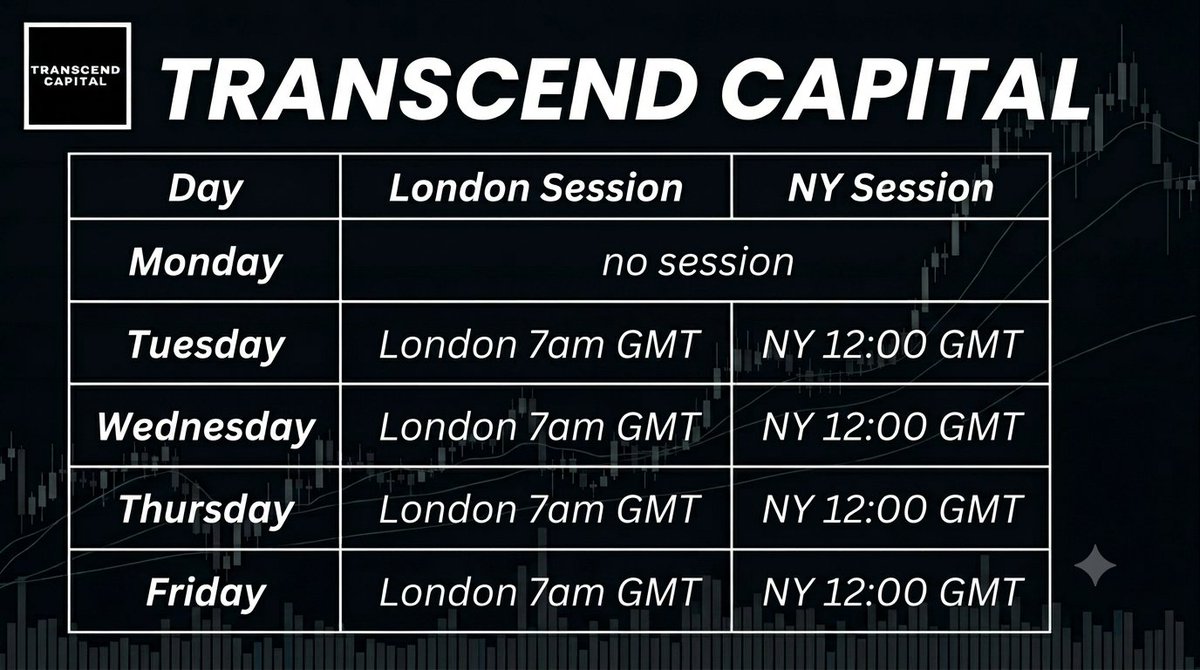
My only criteria for trading on Monday is
If Thursday/Friday forms a H/L in direction of order flow and fails to expand then I'd look for an execution on Monday. In the absence of that I usually stay flat and study price.
👇tap in band$ SZN.
https://t.co/tUWzAEzBM6
Having both your father and mother alive, hale and hearty.
Not on any medications, not paying hospital bills, no chronic illness.
Ask anyone. They'd kill for this.
If you have both be grateful.
I reached the maximum allocation at two prop firms, @FTMO_com and @E8Markets, and I did it within 10 days.
Understand this clearly.
Before this, I had never traded with a prop firm, because of some prop firms shady rules after going through their terms and conditions.
I had never been affiliated with, promoted, or represented any prop firm in my 9 years of trading.
I researched the most reputable firms in the industry and specifically looked for the firms offering the highest maximum allocations. That research led me to @FTMO_com and @E8Markets.
I spent almost $10,000 to purchase the required accounts, pass the evaluations, and reach a combined maximum allocation of $1.3 million. I did not do it to chase quick payouts.
I did it to destroy the claim that traders who manage real money cannot replicate their performance on prop firms. People constantly claim that prop firm risk rules are tighter and will humble any trader who is used to managing real accounts.
I achieved in 10 days what only a few traders have managed to accomplish after several months.
The point is simple.
A trader is a trader.
I am a private fund manager. I trade real capital for real people. Managing real funds does not mean I cannot trade successfully under tighter prop firm risk rules.
When the rules are tighter, tighten your risk. Refine your entries. Take your profits with greater precision.
It is that simple.
If you are truly a trader, you can trade. The account type, risk rules, charts, and market conditions do not erase your skill.
Trading is a skill. Once mastered, it stays with you, just like singing, dancing, or any other skill built through years of discipline, repetition, and experience.
The platform may change. The rules may change. The account may change. The market conditions may change. But a real trader remains a real trader.
Step 1: Collate all necessary information and data
Step 2: Verify all necessary data. Discard data that does not align with other correlating data
Step 3: Create a decision workflow on when and how discarded data will be the current narrative. These become “risk factors”
Step 4: Create a decision workflow on how to qualify/disqualify information that aligns or deviates from said data, and engage when info is qualified, making sure to create clear protocols of risk engagement
Step 5: If current information does not align with data; walk away. If current information aligns and is qualified, pull the trigger without overthinking. If current information deviates from data, let the risk protocols do its job.
Step 6: Collate all necessary information points and compare with data, what decision-making protocols would’ve yielded a more positive performance?
Wednesday: 12 midnight
&
Thursday:12 midnight for CPI and unemployment claims on #AUD
Tap in let's make bands together.
👇
https://t.co/6ml0pGRGyn
https://t.co/tUWzAEzBM6