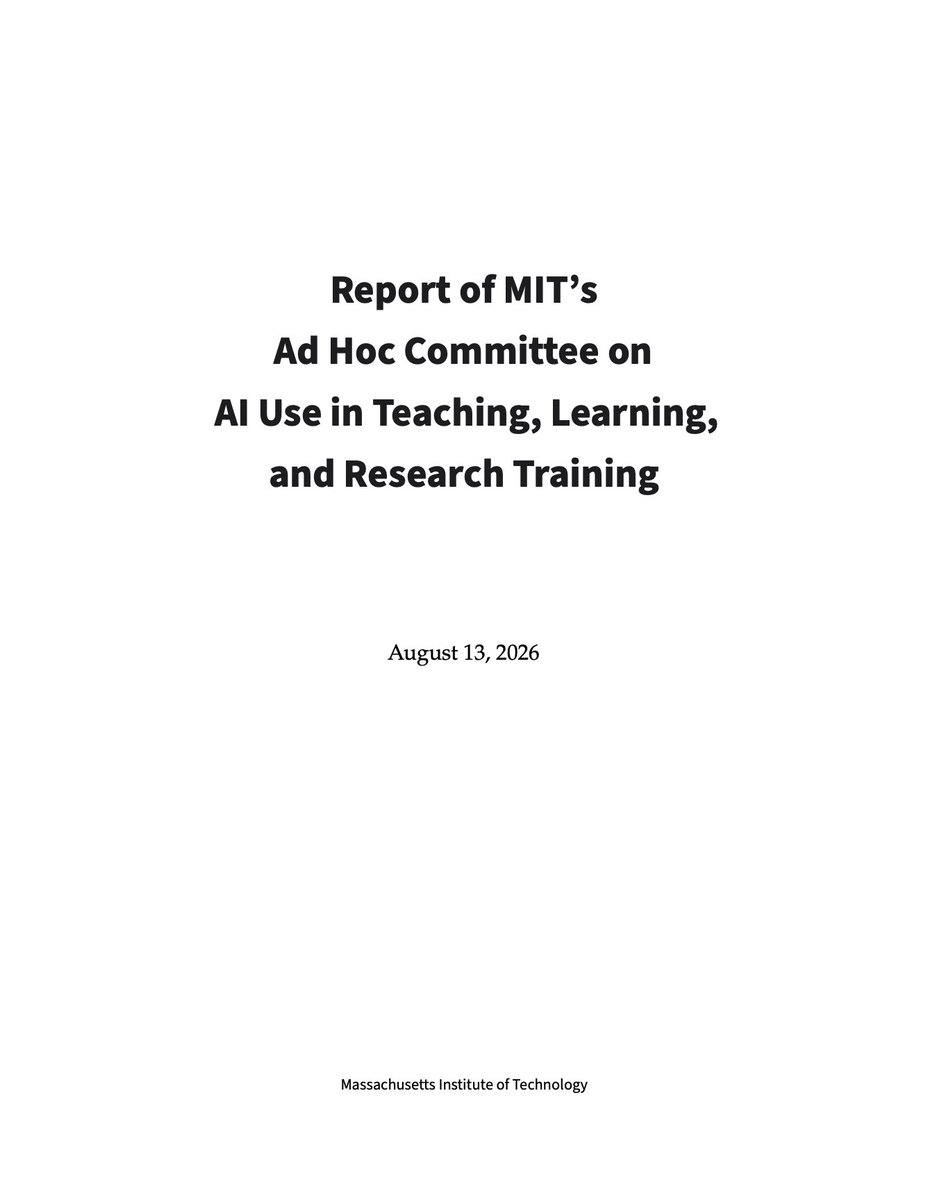
MIT published a brutally honest report on what AI is doing to students.
A committee of professors and students spent five months studying how AI changed learning on campus, and the findings read like a warning to every university on the planet.
Study groups are disappearing. Office hours are emptying out. Problem sets and take-home exams no longer prove anything, because AI can produce credible solutions to almost any written assignment in the undergraduate curriculum. Students who lean on chatbots lose mastery and confidence, and some slip into what the report calls cognitive surrender, reaching for AI at the first hint of struggle.
The numbers are rough. 46 percent of surveyed MIT undergrads use LLMs daily. 90 percent worry about their own overreliance. Undergrads who feel AI makes them replaceable now outnumber those who feel it makes them capable.
The committee's answer surprised me. They refused to fight AI with surveillance. The report calls AI detectors unreliable, says lockdown browsers feel like spying, and warns that policing students builds a classroom atmosphere of mutual distrust.
Instead, MIT wants to rebuild education around the things AI can't replace. That means oral exams, semester portfolios, in-person project work, and a required social component in every subject. The report even floats the idea of rethinking grades entirely, since without a GPA to optimize, much of the incentive to cheat with AI evaporates.
The committee warns professors against replacing undergrad research assistants with AI agents just because they're cheaper, because a university exists to grow people, not output.
The most famous tech school on earth admitted the machines broke its way of teaching. Its answer is more humans, not more software.
As an ER doctor I hate these e-bikes…
Please wear a helmet
Don’t drink alcohol and e-bike
Don’t carry a baby while riding an e-bike
Don’t e-bike after taking your blood thinners and reminiscing about your last hip fracture
Work has never been able to provide people with the kind of value that a vocation, spiritual belief system or community once did. But AI might change that. | Aaron Horwath in @NoemaMag https://t.co/9vfnrHPuow https://t.co/Z4mPFQT3WS
Bill Maher blames porn for millions of men leaving the workforce
Bill Maher points to nearly 7 million able-bodied men who aren’t working and aren’t even looking for work, saying that’s different from being unemployed.
Mike Rowe says the number is historically unusual and points to Nick Eberstadt’s Men Without Work.
“That exact number right now is like 6,990,000 able-bodied men, not only not working, not looking. That’s never happened in our country. Not in peacetime.”
Maher then asks why they aren’t looking for work and gives a provocative answer.
“Why aren’t they looking? I think it’s because the porn is too good.”
Rowe agrees, but says the bigger question is what these men aren’t doing outside of work.
“The question doesn’t start with what are they doing? It starts with what what aren’t they doing?”
He points to volunteering, community organizations and other forms of involvement before highlighting their screen time.
“On average, they’re spending between 2,000 and 2,100 hours a year on their screen.”
The conversation then turns to how some of these men can afford not to work.
Maher argues that money from previous generations plays a role.
“They just hate our generation, except when we give them the money. That’s always okay.”
Then he delivers the final jab:
“So, it’s always okay when you get daddy’s money, then the boomers aren’t so bad.”
Doctors are sounding the alarm.
Thousands of peer-reviewed studies have examined the health effects of cannabis. According to the physicians of the International Academy on the Science and Impacts of Cannabis (IASIC), the evidence points to serious public health concerns—including addiction, psychosis, impaired driving, suicide risk, cannabis hyperemesis syndrome (CHS), and harms to the developing brain. The organization also notes that high-potency cannabis can place substantial demands on healthcare and addiction treatment systems.
Read the full physician statement and explore the scientific references:
🔗 https://t.co/plsSHhJBSe
Learn more about IASIC:
🌐 https://t.co/PFmokvCGVe
#IASIC #CannabisScience #PublicHealth #BrainHealth #AddictionMedicine #MentalHealth #EvidenceBased #Psychosis #CHS #Healthcare
I'm a cardiologist. For the first time in modern American history, more people get high every day than drink every day. 17.7 million Americans now use cannabis daily or near-daily — versus 14.7 million daily drinkers. Thirty years ago it was the reverse, ten to one the other way. A Carnegie Mellon analysis of 40 years of federal data confirmed the flip.
We are running a civilization-scale experiment in real time. And I don't think most people have looked honestly at the science, because it's become culturally impossible to criticize weed without sounding like a narc.
So let me be the doctor who says it plainly. This is not the mild plant of the 1970s.
Then, cannabis was 1-3% THC. Today's products run 15-25%, and concentrates — dabs, vapes, wax — hit 70-90%+. When people say "it's natural, it's harmless," they're defending a product that no longer exists. We didn't legalize the old plant. We industrialized a far more potent one.
Here's what the strongest evidence actually shows, and I'll keep it to what's real:
The developing brain is the real casualty. The Dunedin study — following 1,000 people for decades — found that persistent cannabis use starting in adolescence was associated with a lasting decline of several IQ points that didn't fully recover after quitting. The prefrontal cortex, the seat of judgment and impulse control, is still wiring until about 25. Heavy THC during that window appears to leave a mark.
The psychosis link is not fringe anymore. Daily use of high-potency cannabis is associated with roughly a 3-5x higher risk of psychosis. A major European study found high-potency products alone accounted for a substantial share of new psychosis cases in some cities. This is one of the most replicated findings in the field, and it's the one people most want to ignore.
And cannabis use disorder is real — up to 3 in 10 users develop some degree of dependence, higher when use starts young. "You can't get addicted to weed" is simply false.
Now the honest caveats, because I won't overstate to make a point.
Correlation isn't proof — some of the psychosis link may run both directions, with vulnerable brains drawn to heavier use. Cannabis has genuine medical uses: chemo nausea, certain seizure disorders, some chronic pain. A moderate adult using occasionally is in a very different category than a 16-year-old dabbing daily. And alcohol and tobacco still cause vastly more total death. This isn't "weed is worse than everything." It's "weed is not harmless, and the dose has changed."
Here's my concern as a physician watching the culture. We swung from "reefer madness" hysteria straight to "it's basically a vitamin," and skipped the honest middle entirely. The truth is that a high-potency daily habit — especially in a young brain — quietly lowers the ceiling. Flattens drive. Blurs the sharpness a person needs to build a life.
If you're an adult who enjoys it occasionally, that's your call. But if it's daily, if it's high-THC, and especially if it's anyone under 25 — the science is asking you to reconsider.
Go outside. Sweat. Build something. Sleep hard. Stay sharp. The clearest mind in the room is about to become the rarest one. Make sure it's yours.
1/8
I'm a cardiologist. Same drug. One shot a week.
20% fewer heart attacks and strokes.
24% fewer kidney failures.
38% fewer heart-failure deaths.
Lower dementia risk.
And in a human trial this year — biological aging measurably reversed.
If a pharma rep pitched me one molecule doing all of that, I'd have called it a scam and walked out.
It's #Ozempic. #GLP And it stopped being a weight-loss drug somewhere along the way — we just kept calling it one.
@bryan_johnson , who spends millions trying not to die, just put microdosed GLP-1s in his longevity stack. Mock him if you want. Here's the science that made a skeptical cardiologist take this seriously.
There’s more to the youth mental health crisis than social media. A key culprit is perfectionism.
307 studies, 35 years, 83k students: Young adults feel growing pressure to be flawless.
It's a risk factor for depression and anxiety—and it began a generation before smartphones.