His name was Govindappa Venkataswamy.
He qualified as a doctor in 1944 and joined the Indian Army Medical Corps.
Within a few years, severe rheumatoid arthritis crippled his hands. His fingers became permanently deformed. He could no longer perform the work he had trained for and was discharged from service.
Most people would have stopped there.
Instead, he chose ophthalmology, one of the most delicate fields in medicine, despite hands that could barely hold a surgical instrument.
He had special tools designed to fit his fingers and painstakingly taught himself how to operate again.
In time, he was performing as many as a hundred cataract surgeries in a single day and became one of the most respected eye surgeons in India.
Then, at the age of fifty-eight, he reached the mandatory retirement age for government service.
His career was supposed to be over.
Instead, it was just beginning.
He had spent years seeing poor patients lose their eyesight to cataracts that could be cured with a simple operation.
The problem was not medicine.
The problem was access.
He wanted to build a system that would restore sight at scale and never turn away the poor.
In 1976, he mortgaged his house and opened an eleven-bed eye hospital in a rented building in Madurai.
He called it Aravind.
Patients who could afford treatment paid for it. Their fees covered the cost of treating those who could not.
No one was turned away.
Over the decades, Aravind grew into the largest eye care provider in the world.
It has treated tens of millions of patients and restored sight to millions more. Its model is now studied by institutions around the world, including Harvard Business School.
A doctor whose own hands had been ruined by disease spent the rest of his life giving sight back to people who had lost theirs.
Follow for stories India deserves to remember.
How continuous our civilisation is?
Here's a hint.
Kid : *swings his legs while sitting on a chair
His parents : Stop swinging your legs!
Āpastamba Dharmasūtra (~3rd century BCE) : One shouldn't swing legs.
Such a small detail has survived to this day.
[Sūtra 2.8.20.13]
The pilot in this video is trying to thread a 4-inch probe into a 2-foot basket while both aircraft are moving at 350+ mph. That's the easy part.
The basket trails behind the tanker on a 50-foot hose. The instant the probe makes contact, the drag force on the basket drops because the probe blocks airflow through it. The hose goes slack. The basket starts whipping. The pilot has to hold position through the exact moment the system is most unstable.
Meanwhile, the receiving aircraft is flying less than 100 feet behind and below a plane four times its size. Every vortex shedding off the tanker's wings is hitting the fighter's control surfaces with invisible rolling forces the pilot has to correct for in real time. The turbulence changes with every gust, every altitude shift, every speed adjustment either aircraft makes.
Then the physics gets worse. As fuel transfers, the receiving aircraft gets heavier. Its flight characteristics change mid-operation. The trim shifts. The power required to hold position increases. The pilot is manually compensating for a center of gravity that's moving while trying to stay connected to a hose that's oscillating in three dimensions.
With the boom system the Air Force uses, a dedicated operator on the tanker flies a rigid tube into the receiver. With probe-and-drogue, which is what this video shows, the receiving pilot does everything alone. No operator helping. Just a human eyeballing a metal basket in turbulent air, making corrections measured in inches at six miles a minute.
Fighter pilots train for months before their first live contact. The failure rate on early attempts is high enough that every military refueling system has an emergency breakaway procedure memorized as a boldface item, no checklist, pure muscle memory, because the margin between a successful fuel transfer and a probe snapping off into a jet intake is about two feet of hose slack.
Vishwaroopam. Arjuna Saw it and earlier Prahlāda saw it.
We represent vishwaroopam as below (inspired by first line of purushasukta of Rigveda - thousands of hands, thousands of eyes, thousands of heads….).
Here is what my guruji told me. There is a verse which we use during routine poojas which ends in “sarvam vishNumayam Jagat (everything in this existence is invested in by vishNu - that is also the literal meaning of the word vishNu)
Vishwaroopam is seeing this all pervading vishNu right up to the puruSha - pervading not just spatially but also temporally. Pervading entire adhibhautika and adhidaivika existence. Not just one body with thousands of limbs. Its entire existence from antahkaraNa (manas-buddhi-chitta-Ahamkāra) of even minutest living beings to bahyakaraNa (everything made of 5 mahabhūtas - from bacteria to galaxy clusters and beyond). Seeing Vishnu investing everywhere at once all the time and still transcending it all (इंद्रस्य युज्यः सखा).
That indeed must be an overwhelming experience. But Prahlāda reacted to this very differently (in fact that was the varadāna he asked from Shree Hari) than Arjuna did (my guruji said he asked it from position of small lingering doubt).
That doubt made it a “not very pleasant” experience for Arjuna but for prahlāda this was epitome of his achievements which he really enjoyed as long as he existed in his mortal body (moksha thereafter).
यत् विशितो भवन्ति तद्विष्णुर्भवन्ति (one who invests (entire existence) is vishNu.
German Author Herman Hesse touched upon this briefly in the climax of his novel Siddhartha using metaphor of River (that’s when the protagonist achieves kaivalya pada when he knows the all pervading nature of the river).
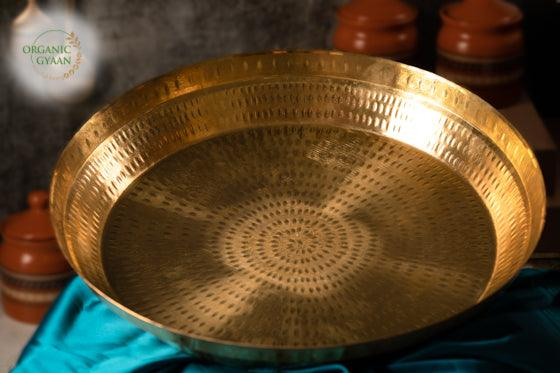
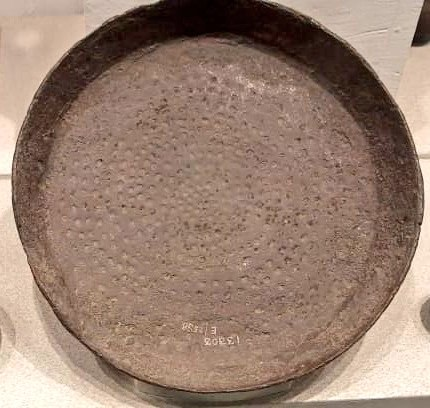
Can you guess what is common in these three images?
The first is a SSC era Bronze plate/parat. The second is a brass parat one sees in a shop today. The third is the inner view of an LNG tanker.
Separated by almost 4000 years, all three use one simple technique to add strength.
The indents/waffles/corrugation that you see works on the principle where area moment of inertia is increased so that a simple plain sheet becomes stiff and resist easy bending or buckling.
This is how very thin stainless steel sheets can be used to build light weight, yet strong LNG tankers.
So next time anyone says, 'how did our ancestors create such and such temple/building/structure thousands of years ago?', remember that our ancestors were just as smart as we are. We are doing more or less the same tasks but with a very high degree of automation and mechanisation.
Everytime i kind of feel tired/weak/ i read this small story from Ramayana, written by Madhvacharya & it instantly gives me strength
Lord Rama single-handedly defeated the entire Moola Bala army of Ravana, containing 1 Decillion, 10^60 warriors, within hours
This was the 1st time Lord Rama had shown the Vishwaroopa form (unlike Mahabharata's Vishwaroopa, Rama was in million forms across the battlefield)
I get goosebumps every time i read this- This was the strength of our Gods- show this to your kids
(Link here> https://t.co/21zzfZbsjR)
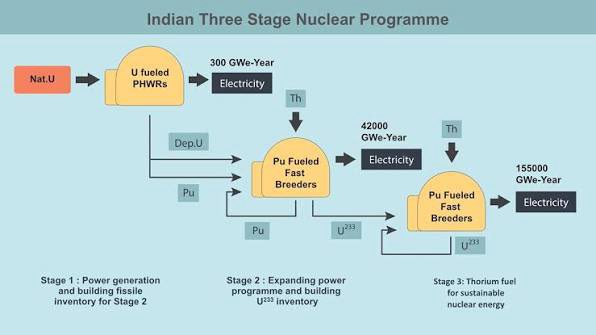
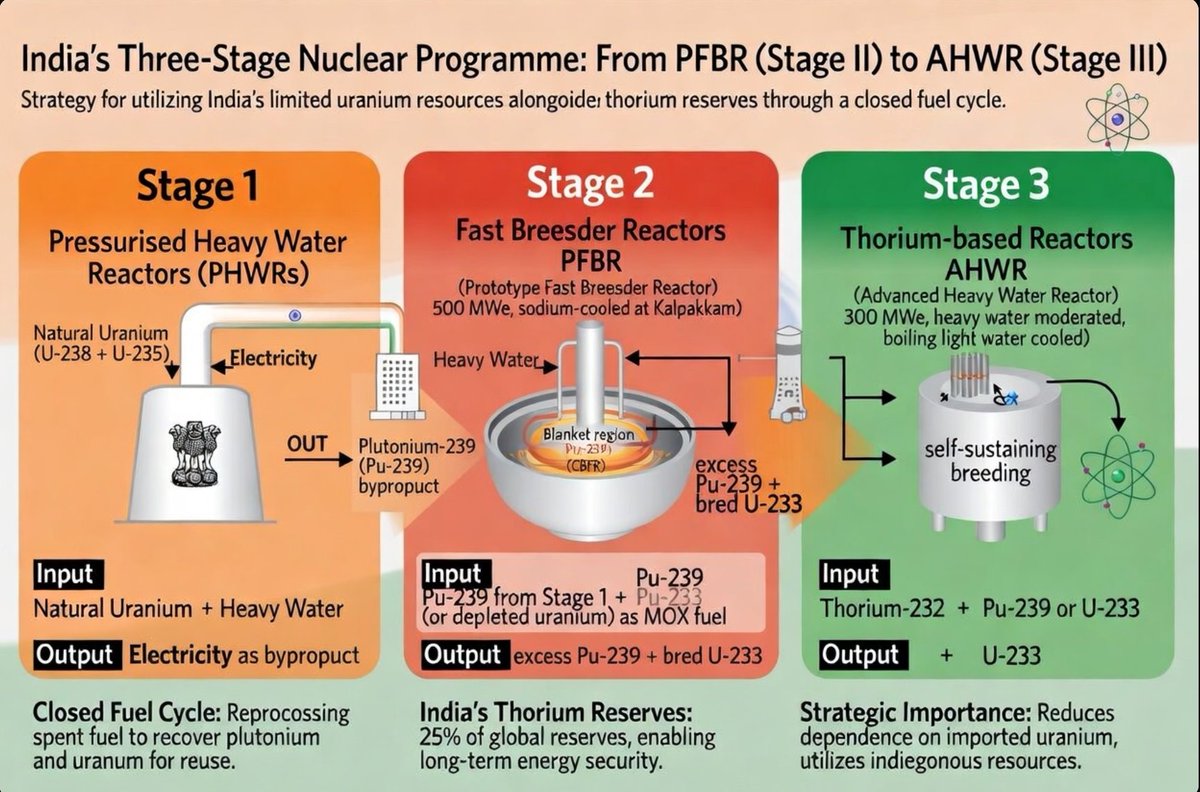
The famous 3 stages of India’s nuclear energy program. (Today we cracked 2nd stage here - BARC calls it 3rd as 2nd was PFBTR (prototype))
Stage 1 : Convert uranium into plutonium..
Natural uranium has very little fissile U-235. In PHWRs, U-235 undergoes fission to produce energy, while the abundant U-238 absorbs neutrons and converts into plutonium-239 (Pu-239).
You generate power and create fissile material for the next stage.
Examples: Rajasthan Atomic Power Station, Kakrapar Atomic Power Station, Narora etc
Stage 2 : Breed more fuel using fast neutrons
Fast breeder reactors use Pu-239 as fuel. When it fissions, it releases high-energy neutrons that convert surrounding U-238 or thorium into more fissile material (Pu-239 or U-233).
Net effect: you create more fuel than you consume (breeding).
Examples: Fast Breeder Test Reactor (critical today and Modi ji called it out, Prototype Fast Breeder Reactor - Base tech demonstrator)
Stage 3 : Thorium to Uranium-233 cycle
Thorium-232 is not fissile, but it absorbs a neutron → becomes Uranium-233, which can sustain a chain reaction.
👉 This enables long-term energy using India’s vast thorium reserves.
Example: Advanced Heavy Water Reactor (planned)
In one line:
Uranium → Plutonium → Thorium → U-233 → Sustainable nuclear fuel cycle
Don't want to sound pedantic but Indian PFBR does not use Thorium 232. It's not required.
Th232 is planned to be used as blanket in AHWRs (Third stage)
The FBR "breeds" in the sense it produces more plutonium than it consumes. And it also produces U-233 isotope. The "breeding" has nothing to do with thorium !
On an interesting note, the higher yield of plutonium will serve as inputs for our A-series & K-series projectiles and would help set up more FBRs
The mastery of stage 2 would mean a network of good no of commercial PFBRs (~15-20) working across the country !
Today, India takes a defining step in its civil nuclear journey, advancing the second stage of its nuclear programme.
The indigenously designed and built Prototype Fast Breeder Reactor at Kalpakkam has attained criticality.
This advanced reactor, capable of producing more fuel than it consumes, reflects the depth of our scientific capability and the strength of our engineering enterprise. It is a decisive step towards harnessing our vast thorium reserves in the third stage of the programme.
A proud moment for India. Congratulations to our scientists and engineers.
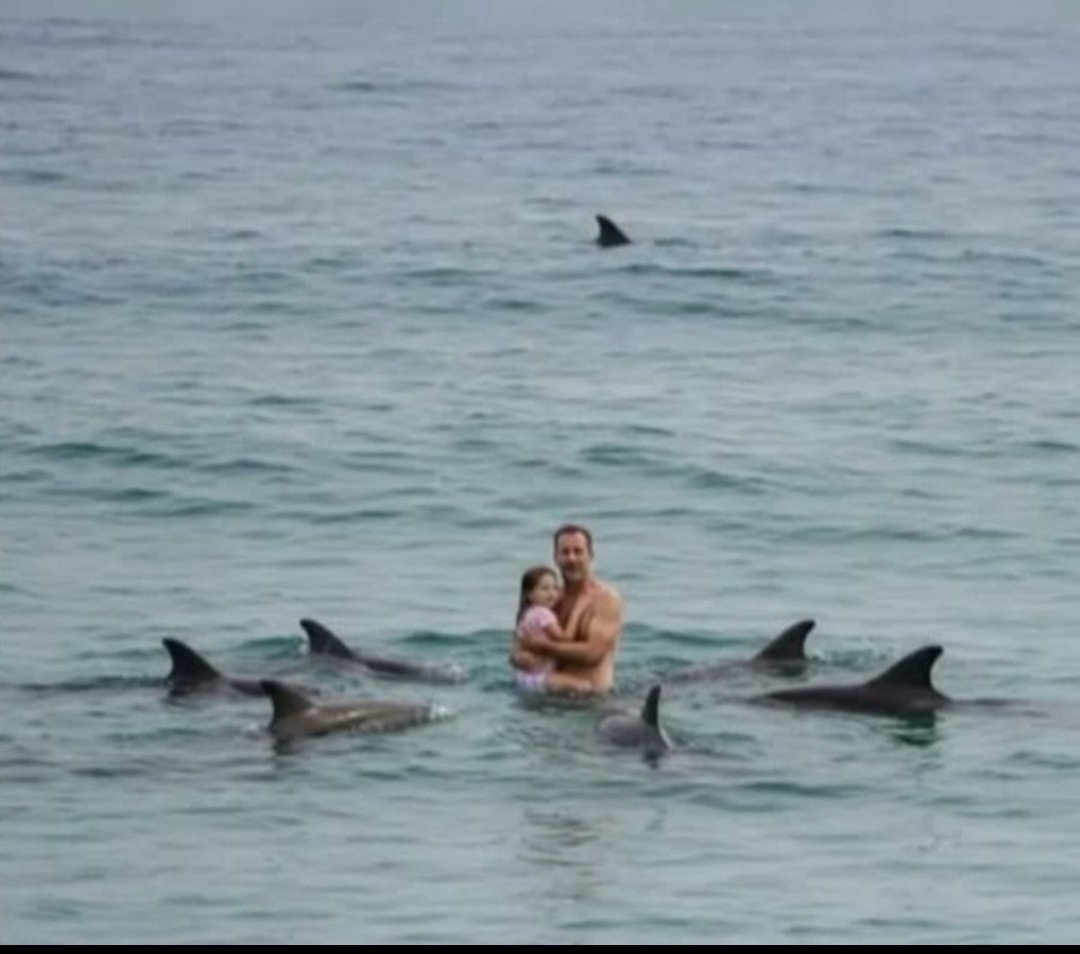
British swimmer Rob Howens was in the water with his young daughter off New Zealand's North Island when a pod of dolphins unexpectedly surrounded them. According to witnesses and lifeguards, the dolphins formed a tight circle around them, repeatedly guiding them toward shore. Shortly after, a great white shark, approximately three meters long, was spotted nearby. For about 30 to 40 minutes, the dolphins maintained their formation, using tail slaps and jerky movements to scare the shark away. They only dispersed when the animal swam away, allowing the swimmers to return safely. This encounter is often cited as a powerful example of dolphins' social intelligence and their coordinated protective behavior toward humans.