Primary #mathsteacher | teacher educator @ Monash_Education | Researching ways to make maths more enjoyable | Passionate about sharing teacher and student voice
@mminas8@misterwootube Love this game. Interesting to consider variations once students have identified key strategies: What if the gameboard consisted of the first 20 even numbers. How does this change your game strategy (or not)? What about the first 20 composite numbers?
Happy World Teachers Day!
To celebrate we're sharing an all-time classic
game called Juniper Green that we learnt from @misterwootube
Best for middle primary all the way up to adults, lots of fun to play and all you need is something to write with.
Enjoy!
https://t.co/D8LKmChx6J
@mathematize4all@MathforLove@FedericoChialvo It looks like a great research project Rachel (and an engaging professional learning experience for teachers). I'd love to hear more about what you discover as it unfolds.
Here are five games which situate retrieval practice of number facts and strategies within a bigger, meaningful context.
We've enjoyed playing across a broad range of ages levels and can attest to curiosity they spark through play.
https://t.co/GaIydEVOYJ
#Maths#Play#MTBoS
Australian primary school teachers have strong preferences for using non-digital games over digital games to support maths instruction... and not because they are Luddites :) @tobyrusso@kath_cartwright@mminas8@helenjwc@leicha@JBayWilliams https://t.co/T6OtFqAy0O
Descriptions for each session for our upcoming conference have been uploaded to our website . Lots of people have asked for this info, so figured it was worth a social media post.
On a side note, I'm very excited about the topics. It's shaping up to be a great day of maths PL!
We're planning for next conference on 24/3. I'd love to hear what topics people would like our presenters to cover on the day?
Thanks in advance for anyone who takes the time to share their thoughts with us, I know this will be very helpful for our planning.
@kath_cartwright My experience as a teacher is if I regularly connect the prelim and main tasks, then students are anticipating/ looking for these connections... I am interested in others thoughts about this though, as it is clearly an important consideration.
@kath_cartwright Thanks Katherin. In terms of making connections between the prelim task and the main task, I tend to use prompting (perhaps even leading :) ) questions. For the scaled number line problem from the article for example: "Does a number line have to begin at zero? How do you know?"
This is wonderful to read. I hadn't used Questioning Scenarios in many years so it's rewarding to see it resonate.
You can learn more and download them here: https://t.co/GifgiK3LSl
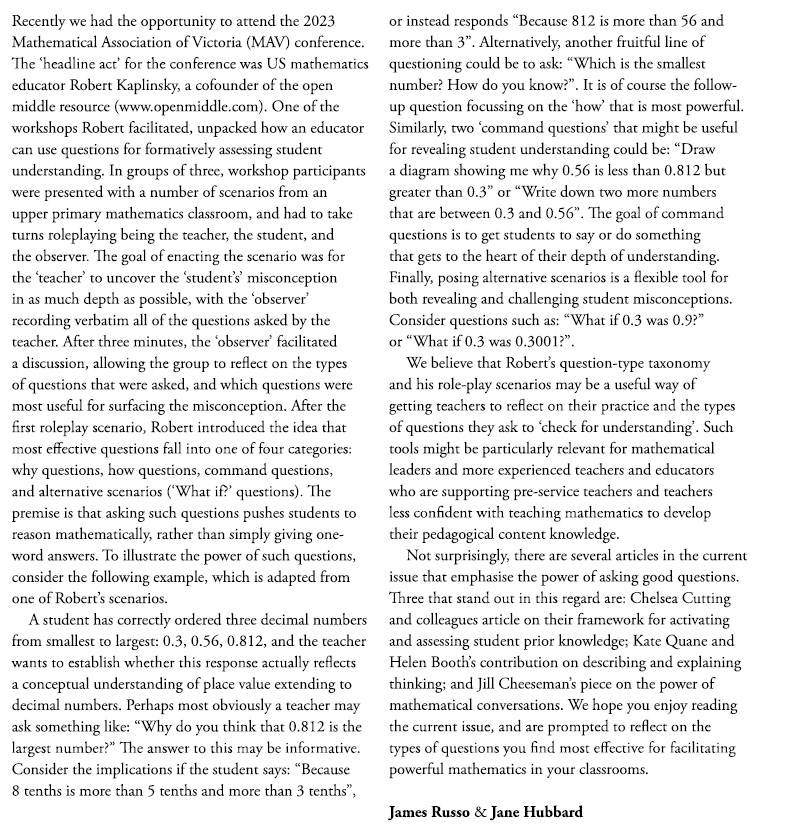
Thanks to @robertkaplinsky for headlining this year's MAV conference in Victoria. We've dedicated most of our editorial for this issue of Australian
Primary Mathematics Classroom to his stimulating session on questioning @maths_vic@mminas8@aamtinc@mic_epstein@misterwootube
One of the biggest shifts in my practice over the past few years when teaching maths through structured inquiry is the consideration given to the preliminary task. We discuss some of our ideas here: @tobyrusso@kath_cartwright@10001angela@helenjwc https://t.co/G9P8yn5ybd
NEW: Infinite 100 square.
What numbers go in the highlighted squares? How do you know?
https://t.co/yBaMal0ZDl
Inspired by a post from @berniewestacott
Primary teachers: Looking for a whole class place value game focussed on connecting representations and mathematical reasoning. You might want to check out Guess My Number: Two Questions and a Clue @tobyrusso@kath_cartwright@10001angela@helenjwc https://t.co/dtJIgzS4OQ