Every aneurysm is different.
The neck, the dome, the branch vessels, the angle of approach — small anatomical details can change the entire strategy.
That is why practicing on a generic model is not always enough.
At @SurgeonsLab, we convert patient DICOM scans into ultra-transparent, patient-specific aneurysm models, so INRs can hold the exact anatomy in their hands before the procedure.
From scan to simulation model:
DICOM upload
Secure anonymization
3D anatomy reconstruction
Accuracy validation
Physical model production
The goal is simple.
Let the interventionists study the case better.
Plan the safest approach.
Anticipate challenges before the patient enters the operating room.
Because in complex aneurysm procedure, preparation is not optional.
It can change the way a case is performed.
Upload your scans → https://t.co/sCp3joekCp
Learn more → https://t.co/2TwFtOq6to
#MedicalSimulation #HealthcareInnovation #DigitalTwin #3DPrinting #PatientSpecific #NeuroInterventional #SimulationTraining #EndovascularSurgery
Every trainee knows this feeling.
The wire reaches a 90° turn…
and suddenly your hands become very careful.
Too much force, you lose control.
Too little, you cannot cross.
These are the moments that build real endovascular skills.
We built this model to practice exactly that — sharp turns, difficult navigation, wire control, and hand movement repetition.
Not on patients.
Not for the first time during a procedure.
Just repeated practice until your hands start understanding the movement naturally.
It is also a simple way for companies to show how their micro catheters, microguidewires behave during challenging navigation.
Because in interventional procedures, small movements make a big difference.
https://t.co/FoUh3efzif
https://t.co/fpV8giOOuR
#InterventionalRadiology #Endovascular #MedicalSimulation #Microguidewire #CathLab #Neuroradiology #InterventionalCardiology #MedicalTraining #SurgeonsLab
"This felt as close to real surgery as it gets."
A neurosurgeon told us that after training on our aneurysm clipping neurosurgical simulator.
Brain aneurysm clipping doesn't forgive hesitation. There's no pause button in the Operation Theatre. One clip, one angle, one decision — and a patient's life hangs in the balance. Residents know this. Attendings know this. And yet, for too long, the first time a surgeon truly felt that pressure was during a live case.
We think that has to change.
That's why we built a training environment where surgeons can sit with the complexity of a real aneurysm — its geometry, its fragility, its risk — and work through it. Again and again, until the decision isn't uncertain anymore.
Not a shortcut. Not a shortcut dressed up as tech. Just honest, rigorous repetition on cases that actually challenge you:
→ Realistic aneurysm anatomy that doesn't simplify what shouldn't be simplified
→ Hands-on microvascular practice that builds real muscle memory
→ Real-time decision-making under surgical conditions
→ The freedom to fail, learn, and go again — without a patient in the room
Surgical confidence should be earned before the OR. Not found there for the first time.
That's the standard we hold ourselves to at SurgeonsLab. Because the surgeons training with us today will be someone's only option tomorrow.
#Neurosurgery #SurgicalSimulation #AneurysmClipping #MedicalEducation #PatientSafety #NeurovascularSurgery #SurgeonsLab
Every interventionalist remembers the moment.
Sweaty hands.
A moving catheter.
A difficult vessel.
And the realization that there’s no pause button in the cath lab.
But what if there was?
CathTrainVR by SurgeonsLab allows physicians to repeat complex vascular procedures again and again before ever touching a real patient.
Not watching.
Not observing.
Actually doing.
→ Feel catheter resistance with haptic feedback
→ Navigate tortuous anatomy in VR
→ Practice contrast injections in real time
→ Train with bi-plane fluoroscopy
→ Upload patient-specific DICOM cases
→ Learn complication management without patient risk
Because experience should come before the live case, not during it.
Question for Interventional Radiologists👇
What was the most intimidating part of your early cath lab experience?
Gaining vascular access?
Navigating anatomy?
Managing complications under pressure?
Explore CathTrainVR: https://t.co/GR2JK8XA6e
Bring it to your institution: https://t.co/x6wTRihCf5
#InterventionalRadiology #EndovascularTraining #CathTrainVR #SurgeonsLab #MedicalSimulation #CathLab #PatientSafety #MedTech #IRlife #SimulationBasedLearning
We developed an integrated backlight and pump platform for liquid embolic simulation, compatible with disposable and reusable MMA, AVM, and Dural Fistula models.
This platform enables sales representatives to deliver efficient, effective demonstrations.
Portable and backpack-sized, the platform offers quick setup.
- Integrated pump and light source removes the need for extra equipment
- Realistic blood-like flow closely simulates real-life
- Backlight improves visibility of devices and guide catheters- Perfect for tradeshows and demonstrations
Designed for easy transport to hospitals, conferences, fellowships, and training centres worldwide.
Whether you are training future interventional neuroradiologists or looking to enhance your skills, we are available to demonstrate the capabilities of the integrated pump and backlight setup.
Ready to experience our platform firsthand? Visit https://t.co/g5rUCuBjQP to learn more or contact us at https://t.co/fpV8giOOuR to schedule your personalised demonstration today.
#SurgeonsLab #MedicalSimulation #NeurovascularTraining #InterventionalNeuroradiology #SurgicalEducation #MMAEmbolization #BacklightMMA #MedTech #ClinicalTraining #Neurosurgery
Patient-specific 3D printed models for neurovascular interventions—built to help you plan, practice, and perform with confidence. From realistic vessel feel to patient-specific anatomy and flow, SurgeonsLab enables you to rehearse complex aneurysm cases before entering the OR.
Upload your case: https://t.co/sCp3joeSrX
Learn more: https://t.co/TTadJVto44
#MedTech #Neurovascular #Simulation #InterventionalRadiology
Every neurosurgeon remembers their first ACOM aneurysm clipping.
The anatomy wasn't textbook. The pressure was real. Every decision mattered.
What if that moment didn't have to be the first time you felt it?
The choice:
1 case. No margin for error.
OR 50 reps. Built control. Confidence through repetition.
Confidence doesn't come from theory.
You can study cerebrovascular anatomy for months. Watch 100 clipping procedures. Memorize every surgical approach. But real confidence comes from:
→ Dissecting the Sylvian fissure under magnification
→ Navigating perforators around complex aneurysm necks
→ Applying temporary clips during rupture
→ Managing intraoperative hemorrhage before it happens in the OR
The kind of learning that only comes from doing it. Repeatedly.
High-fidelity Neurosurgery simulation changes everything:
You don't just observe, you operate.
Practice microsurgical technique in real-time.
Learn from mistakes without patient consequences.
Refine control until precision becomes instinct.
Train. Repeat. Perfect.
If the first real case is where everything counts…
Why not prepare like it already does?
For neurosurgeons:
What aneurysm location was most challenging in your early cases, ACOM? PCOM? Basilar tip?
For training directors:
How many simulation reps should residents complete before their first aneurysm clipping?
Aneurysm Simulation: https://t.co/wUm23loYlt
Learn more: https://t.co/T3nOXikjj7
hashtag#Neurosurgery hashtag#AneurysmClipping hashtag#SurgicalTraining hashtag#NeurosurgicalSimulation hashtag#MedicalSimulation hashtag#MedTech hashtag#Microsurgery hashtag#SurgeonsLab
“I wish I’d seen this anatomy before my first real case.”
Every interventional radiologist has thought this at least once.
That first renal artery embolization.
Unexpected vessel tortuosity.
Flow dynamics that didn’t behave like the textbook promised.
The reality?
Your first attempt at a complex embolization shouldn’t be on a patient.
But where do you practice when:
❌ Cadavers don’t have realistic blood flow
❌ Live cases are too high-stakes for experimentation
❌ Anatomical variation is impossible to predict
That’s why we built the Renal Vascular Flow Model.
Not a static plastic model. Not a computer screen.
A fully perfused, anatomically accurate renal vascular system where you can practice embolization with real instruments, real flow dynamics, and real consequences—without patient risk.
Why it works:
👉 Realistic kidney vessel architecture from main artery to segmental branches
👉 Physiologic flow, pressure, resistance, and perfusion
👉 Compatible with real IR devices—coils, liquid embolics, particles, catheters
👉 Repeatable scenarios—practice until hesitation becomes instinct
From catheter selection to endpoint assessment, reflux control to full occlusion—
practice the procedure dozens of times before performing it on a patient.
Who uses this:
→ IR fellows building confidence
→ Experienced radiologists adopting new techniques
→ Simulation centers developing programs
→ Device companies training teams
Question for the IR community:
What renal intervention do you wish you had practiced 20 times before your first live case?
Selective embolization
Hemorrhage control
Tumor embolization
AVF/AVM treatment
Something else?
👇 Comment below
We’re designing the next models based on what you actually need.
Explore: https://t.co/yKJ30kBEZO
Connect: https://t.co/fpV8giOOuR
Because practice makes permanent.
And your first attempt should never be on a patient.
#InterventionalRadiology #Endovascular #MedicalSimulation #Embolization #MedTech #IRTraining #PatientSafety
A cardiologist once told us something that stayed with us:
“The procedure I train for 100 times on a simulator, I perform once on a patient. That patient deserves those 100 repetitions.”
That idea is at the heart of everything we build at SurgeonsLab.
This April, the global electrophysiology community gathers in Chicago for Heart Rhythm 2026 — the world’s premier EP event, where 10,000+ professionals come together for late-breaking science, innovation, and the future of arrhythmia care.
📍 McCormick Place Convention Center, Chicago, IL
🗓 Conference: April 23–26 | Exhibition: April 24–26, 2026
📌 Booth 740
From ablation and device therapy to mapping innovation and complex arrhythmia management, procedures are becoming more precise—and more demanding than ever.
But one question remains: how do physicians master these procedures before stepping into the lab?
That’s what SurgeonsLab is built to solve.
Leaders shaping this year’s agenda—Dr. Dhanunjaya R. Lakkireddy, Dr. Daniel P. Morin, and Dr. Vivek Y. Reddy—represent a generation pushing electrophysiology toward greater precision, faster learning curves, and better patient outcomes.
At SurgeonsLab, we’re building the infrastructure that supports that vision: simulation environments where clinicians train at the level modern medicine demands.
Our advanced simulation models for endovascular and structural heart interventions deliver physiologically accurate flow, realistic anatomy, and tactile feedback that bridges the gap between theory and practice.
At our booth, experience:
→ Advanced endovascular & structural heart simulators
→ Realistic fluid dynamics that mirror procedural challenges
→ Hands-on training designed to build confidence before real procedures
The vision of Heart Rhythm 2026 is to end death and suffering from heart rhythm disorders. Simulation is how we prepare clinicians to achieve it.
We’ll see you in Chicago.
#HRS2026 #HeartRhythm2026 #MedicalSimulation #Cardiology #Electrophysiology #SurgeonsLab #CardiacTraining #MedTech #StructuralHeart #EPTraining
Redefined Precision in Structural Heart Training
Successful structural heart procedures rely on precision, control, and confidence.
Gaining such skills is possible only through training in the environment that simulates real complexity of the procedure.
SurgeonsLab introduces the Septal Defect Occluder Training Model, designed to link theory and practice in a realistic simulation experience for clinicians.
Training with the Septal Defect Occluder Training Model provides clinicians with the opportunity to train on:
✔️ Accurate anatomical orientation and positioning of the occluder
✔️ Realistic placement of the occluder under control
✔️ Consistent and repetitive practice, while minimizing risk for patients
✔️ Compatibility with standard devices used in the procedures
With hands-on and highly realistic simulation practice, clinicians will develop an accurate technique and improve decision making and procedure efficiency.
More details about the product:
https://t.co/whuN9SF3pI
To get in touch with us:
https://t.co/fpV8giOOuR
Find out other innovative solutions by SurgeonsLab:
https://t.co/GduxHd2e2m
#StructuralHeart #InterventionalCardiology #MedicalSimulation #MedTechInnovation #CardiologyTraining #HealthcareExcellence #SimulationBasedLearning #MedicalEducation #ClinicalTraining #SurgeonsLab
We're thrilled to bring hands-on endovascular simulation to #SIR2026 in Toronto.
Three full-session workshops — carotid stenting, PAD-CLTI mechanical thrombectomy, and embolics training — running April 11 & 13 at the Metro Toronto Convention Centre.
If you're attending SIR this year and want to sharpen real procedural skills in a zero-risk environment, come find us.
Spots are limited — tag a colleague who should be there.
#InterventionalRadiology #MedicalSimulation #SurgeonSlab #EndovascularTraining
SurgeonsLab will be at the SIR 2026 Annual Scientific Meeting @Society of Interventional Radiology in Toronto, Canada!
We are pleased to present our latest developments in endovascular simulation, digital and physical twins, and advanced training models. These innovations are intended to enhance interventional radiology education and facilitate procedural planning.
April 11 to 15, 2026
Booth #1233
Sales leaders, marketing professionals, and research and development engineers are invited to visit our booth to explore how we can transform your concepts into practical simulation solutions.
Explore more:
https://t.co/VIE0kuFLHO
https://t.co/WkPmoFqqAL
We look forward to meeting you and working together to shape the future of interventional radiology training.
#SIR2026 #InterventionalRadiology #MedTech #Simulation #Endovascular #Innovation #SIR26 #SocietyOfInterventionalRadiology #SurgeonsLab #HealthcareInnovation #PeripheralFlowModel #EndovascularTraining #VascularSimulation #PeripheralIntervention
Achieve Precision in MMA Embolization with Real-Time Flow Simulation
Middle Meningeal Artery (MMA) embolization requires exceptional accuracy, particularly when navigating vessels under 1 mm in diameter and using liquid embolic agents.
SurgeonsLab’s MMA Flow Model with Real-Time Simulation replicates ultra-fine anatomical pathways and realistic flow dynamics, providing accurate procedural training.
🔹 Anatomically accurate MMA model (Sub-1 mm vessel precision)
🔹 Liquid embolic training platform
🔹 Compatible with DMSO
🔹 Seamless microcatheter & guidewire navigation
🔹 Real-time flow simulation for procedural feedback
🔹 Ultra-transparent vessels for enhanced visualization
🔹 Compatible with standard neurovascular stents & devices
From Navigate → Position → Evaluate, every step is simulated to help clinicians build confidence and refine technique in a controlled environment.
Train with precision. Practice with purpose. Enhance clinical outcomes.
🔗 Explore the MMA Model: https://t.co/gpDtJfGw8w
🌐 Visit our website: https://t.co/g5rUCuBjQP
📩 Contact our team: https://t.co/dnzCd2F2a3
#SurgeonsLab #MMAEmbolization #NeuroIntervention #EndovascularTraining #MedicalSimulation #InterventionalRadiology #MedTech #LiquidEmbolics #HandsOnTraining
From Scan to Pre-op Endovascular Simulation in Just Hours
A patient gets diagnosed. An angiogram is performed. A digital twin in seconds
Within hours, that critical data becomes a patient-specific physical twin.
Here’s how it works:
DICOM Upload | https://t.co/sCp3joeSrX
The interventionist or technical staff uploads patient scan data to our platform.
Smart Anonymization
All data is anonymized to ensure privacy and compliance.
3D Digital Twin Creation
We convert the scan into a patient-specific 3D digital model.
Precision Validation
Micro-anatomical details verified for anatomical accuracy
Physical Twin 3D Printing
A physical replica is produced and shipped, ready for hands-on planning.
• Safe pre-operative planning
• Lower to no procedural risks
• Significant improvement in patient outcomes
• Allows quick intra-operative decision-making
This process connects diagnostic imaging with precision patient care.
Upload your scans now: https://t.co/sCp3joeSrX
Learn more: https://t.co/2TwFtOqEiW
#MedicalSimulation #HealthcareInnovation #DigitalTwin #3DPrinting #PatientSpecific #SimulationTraining
We’re excited to be present at the American College of Cardiology (ACC) 2026.
We advance cardiovascular training with high-fidelity simulation. Explore our flow-based and virtual simulation platforms for training, research and development, and device validation.
If you are attending, we invite you to connect with us and experience our latest innovations.
🔗 Explore Flow Models: https://t.co/TgIKDRS7jI
🔗 Explore CathTrain VR Simulator: https://t.co/TpsKN3uzJS
#ACC2026 #Cardiology #Cardiovascular #InterventionalCardiology #MedTech #MedicalSimulation #HealthcareInnovation #DigitalHealth #MedicalEducation #SimulationTraining #Endovascular #CardioInnovation
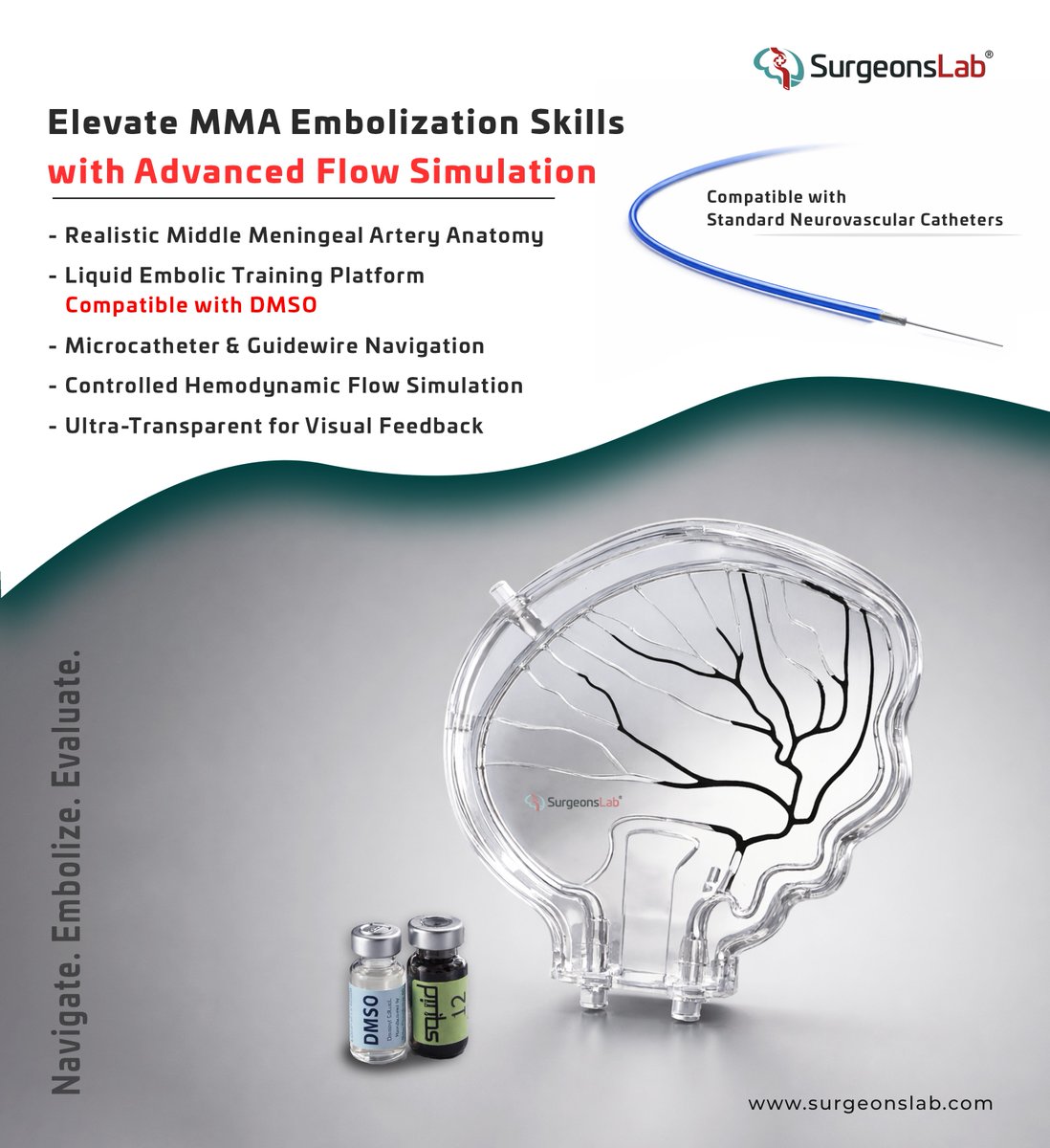
Elevate MMA Embolization Skills with Advanced Flow Simulation
Middle Meningeal Artery (MMA) embolization requires precision, control, and confidence — especially when working with liquid embolic agents.
At SurgeonsLab, we’ve developed an advanced MMA Embolization Training Model that replicates realistic anatomy and controlled hemodynamic flow to deliver true-to-life procedural training.
🔹 Realistic Middle Meningeal Artery anatomy
🔹 Liquid embolic training platform
🔹 Compatible with DMSO
🔹 Microcatheter & guidewire navigation practice
🔹 Controlled flow simulation
🔹 Ultra-transparent vessels for full visual feedback
🔹 Compatible with standard neurovascular catheters
From Navigate → Embolize → Evaluate, every step can be practiced repeatedly in a safe, controlled environment.
Train with confidence. Refine technique. Improve outcomes.
🔗 Explore the MMA Model:
https://t.co/gpDtJfGw8w
🌐 Visit our website:
https://t.co/g5rUCuBjQP
📩 Contact our team:
https://t.co/fpV8giOOuR
#SurgeonsLab #MMAEmbolization #NeuroIntervention #EndovascularTraining #MedicalSimulation #InterventionalRadiology #LiquidEmbolics #MedTech
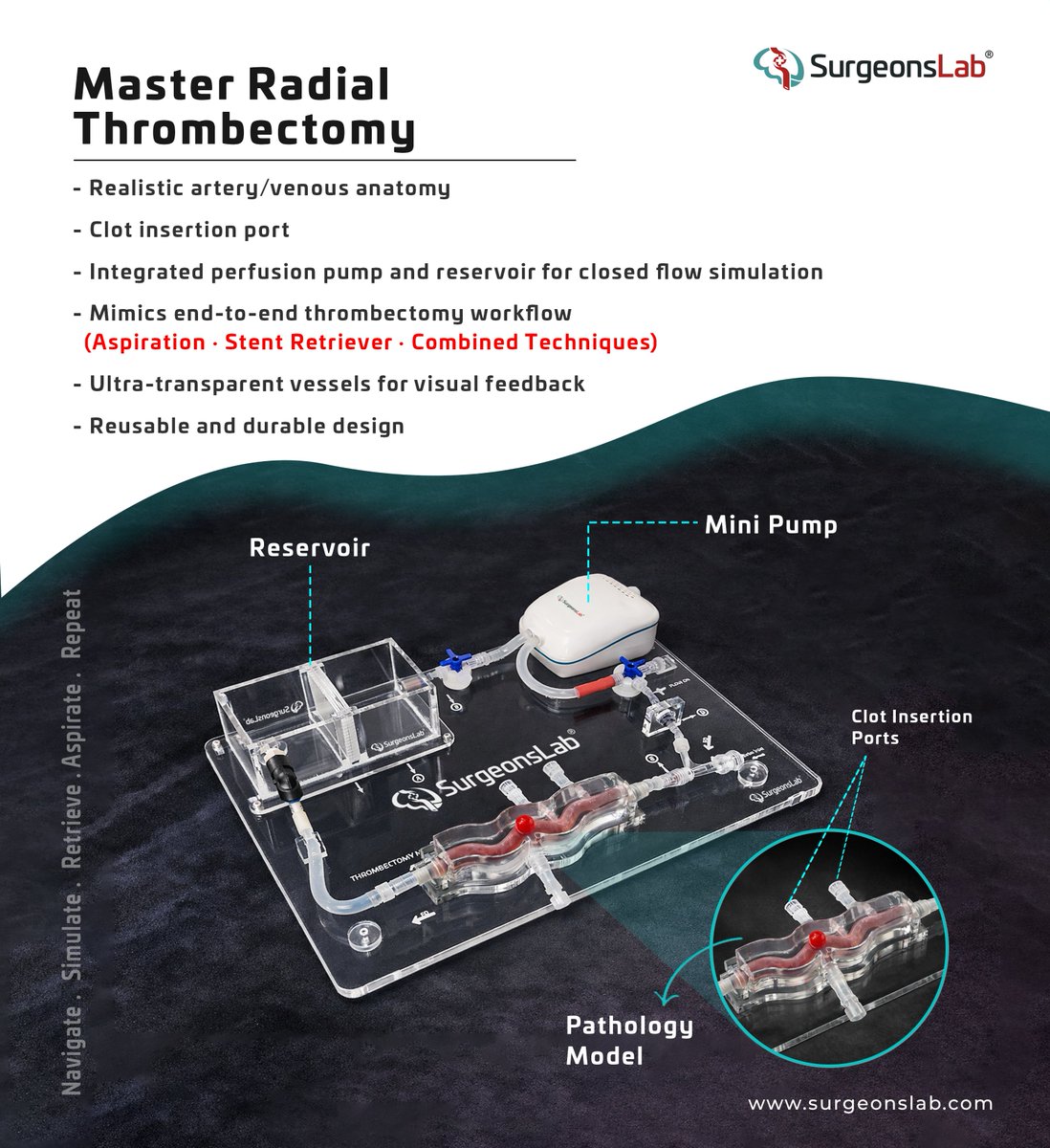
Master the art of Radial Thrombectomy with precision and confidence.
Our Master Radial Thrombectomy Model replicates realistic radial artery anatomy and offers true-to-life clot simulation for hands-on training.
✅ Realistic radial artery anatomy
✅ True-to-life clot practice
✅ Integrated reservoir & mini pump for controlled flow simulation
✅ Supports aspiration, stent retriever & combined techniques
✅ Ultra-transparent vessels for visual feedback
✅ Reusable & durable design
Simulate, aspirate, and repeat each step from navigation to retrieval in a controlled learning environment.
Ideal for interventional cardiology and vascular training programs seeking to elevate procedural proficiency.
🔗 Explore our full range of Training Flow Models:
https://t.co/TgIKDRS7jI
📩 Get in touch with us:
https://t.co/fpV8giOOuR
🌐 Learn more:
https://t.co/GduxHd2e2m
#RadialThrombectomy #EndovascularTraining #MedicalSimulation #InterventionalCardiology #VascularTraining #SurgicalInnovation #ClotRetrieval #HealthcareEducation #MedTech #SurgeonsLab
Advance Your MMA Embolization Training with Reusable Simulation
Effective Middle Meningeal Artery (MMA) embolization training demands precision, realism, and repeatability. The Reusable MMA Embolization Simulator from SurgeonsLab meets these requirements.
Designed for realistic flow-based embolization training, the simulator enables clinicians to practice catheter navigation and embolic delivery in a controlled setting. Its transparent vessel provides clear visualization of embolic distribution during training.
Key highlights:
• Reusable model designed for repeated training cycles
• Compatible with standard neurovascular catheters
• Supports DMSO-based embolic agents
• Transparent vasculature for clear embolic visualization
• Easy cleaning and reassembly for continuous practice
Clinicians can refine their technique and build confidence by repeating the cycle of embolization, evaluation, cleaning, and practice using realistic procedural simulation.
Learn more about the simulator:
https://t.co/gpDtJfGw8w
For questions or collaboration opportunities, please contact us
https://t.co/fpV8giOOuR
#Neurointervention #MMAEmbolization #MedicalSimulation #InterventionalRadiology #NeurosurgeryTraining #MedTech #SurgeonsLab
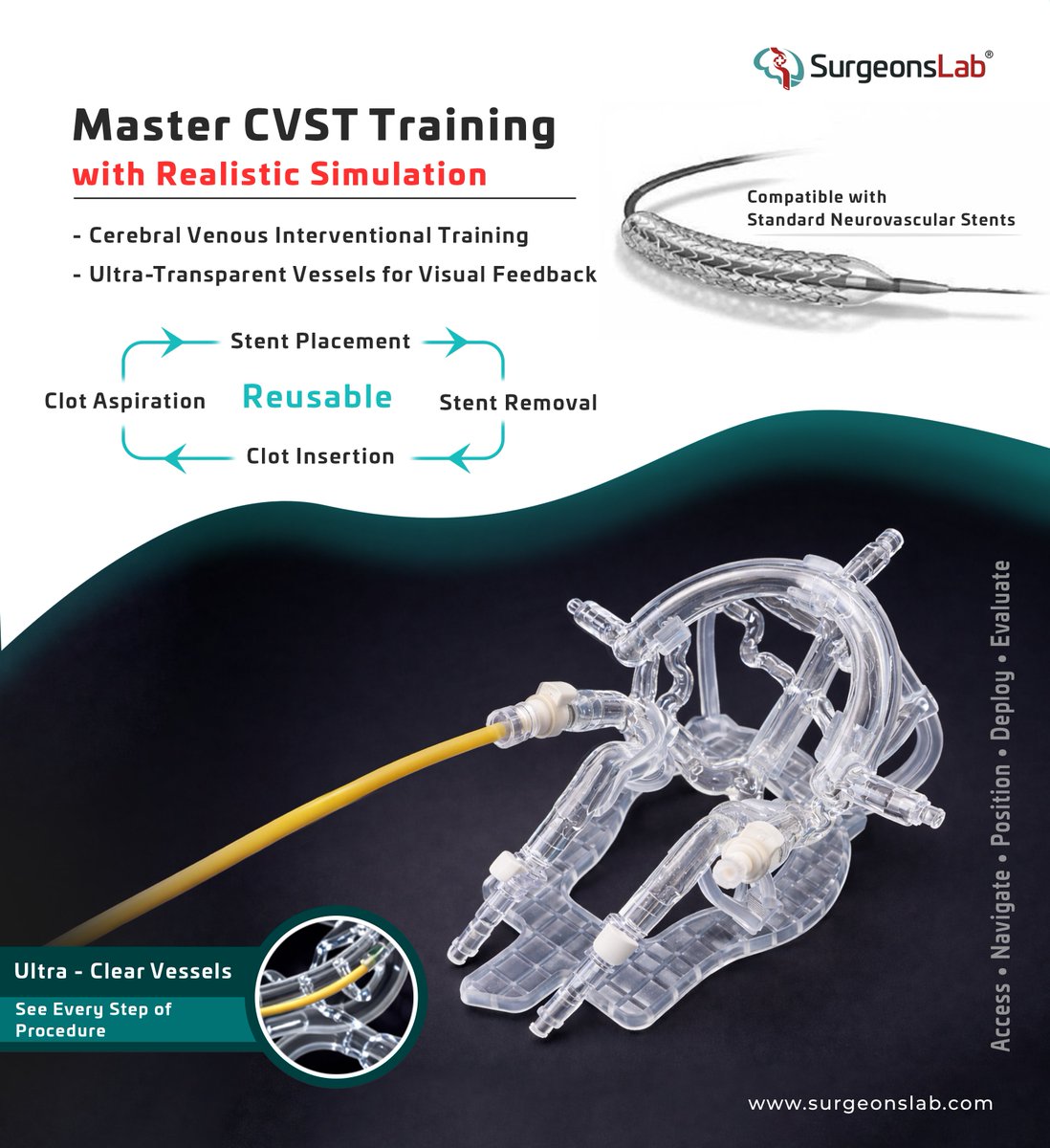
Master CVST Training with Realistic Simulation
Cerebral Venous Sinus Thrombosis (CVST) intervention demands precision, control, and deep anatomical understanding. At SurgeonsLab, we bring you a highly realistic Cerebral Venous Interventional Training Model designed to bridge the gap between theory and hands-on expertise.
🔹 Ultra-transparent vessels for complete visual feedback
🔹 Realistic clot insertion & aspiration practice
🔹 Stent placement and removal training
🔹 Compatible with standard neurovascular stents
🔹 Reusable, durable, and simulation-ready
From Access → Navigate → Position → Deploy → Evaluate, every step can be practiced in a controlled, repeatable environment.
This model empowers interventionalists to refine their skills, improve procedural confidence, and enhance patient safety — before entering the cath lab.
🔗 Explore Our Venous Models:
https://t.co/VIE0kuFLHO
🌐 Visit our website:
https://t.co/g5rUCuBjQP
📩 Get in touch with our team:
https://t.co/fpV8giOOuR
#SurgeonsLab #CVST #NeuroIntervention #MedicalSimulation #EndovascularTraining #InterventionalRadiology #Neurovascular #HandsOnTraining #MedTechInnovation