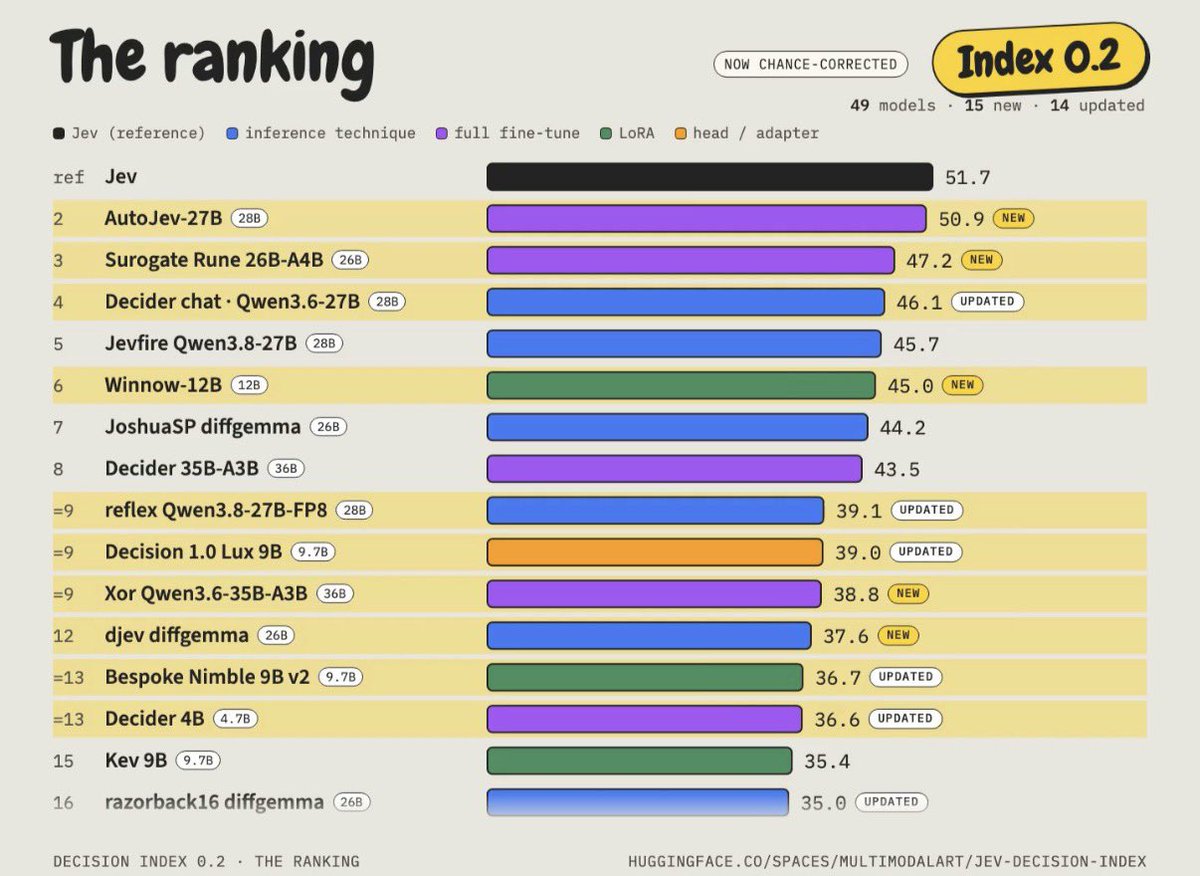
Rune v2, our decision model, on Decision Index 0.2: 52.61, against 51.67 for Jev 1.13. Read the row before the number. Ours is our own run on the leaderboard's harness, not a submission, and the other rows are the board's as of 24 September.
4 Levels of AI using solutions.
Where is your team currently?
Prompting is level 1.
Most teams are stuck here & can not move beyond it. Then they wonder why AI just feels like a faster way to write emails.
There are three levels above it.
Level 1. Prompt.
👉Talk to the model better.
👉Clear instructions.
Share Examples & right format.
Good for one-off work — an email, a summary, a first draft.
Level 2. Context.
Give it the right information.
Your Detailed docs.
Your company & success history.
Your CRM Data.
Your transcripts.
Now it stops guessing - creates business specific output.
Level 3. Loop.
Make it check its own work.
It executes work cycles.
Scores the result.
Retries what failed.
Learns from every attempt.
Level 2 just answers questions but level - 3 finishes the task.
Level 4. Harness.
Build the system around it - connect tools.
Guardrails on what it can send, and to whom.
Evals against a real test set.
Human approval before anything goes out. Monitoring. A kill switch. A schedule.
That's the level you can leave running.
Here's the thing most people miss.
AI disappointment is not a AI model problem.
It's a level problem.
Level 1 approach does not deliver Level 4 solutions.
#Surogate has levels 2 to 4 already built — knowledge bases, connected agents, guardrails, human approval.
Comment "Surogate" and I'll send you the full breakdown.
#AIagents #Multiplyyourself #ChatGPT #Claude #Gemini #Fable5.5
The fresh sandbox is the part I would pin down first. The harness is only as reproducible as the image under it, so if that image drifts between rollouts then some of what the policy learns is the environment shifting underneath it rather than the task. Version the image next to the tasks the same way you version the dataset
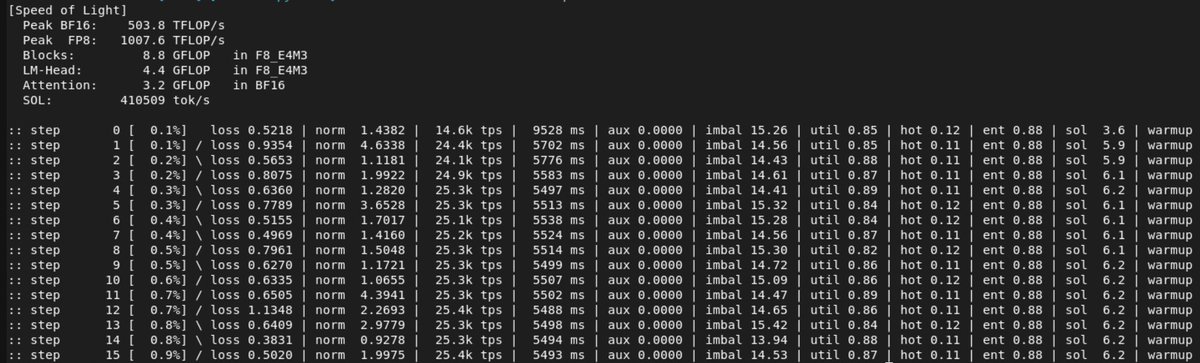
25.3k TPS on fp8 tensor cores. For scale, the same engine measures 53,900 tok/s BF16 on one H100 and 136,200 on four RTX 5090s, config in the repo. The precision recipe is what makes the second number possible.
The beast is training at 25.3k TPS on native fp8 tensor cores. Only with the surogate trainer, nothing else comes even close.
Guess the GPUs :)
https://t.co/L13mvofYCL
Live view is table stakes. What decides whether you can trust it is whether the same stream is also the record. Ours is one append-only session log, so the takeover you watched is the replay you audit later.
You can now watch your agents work live as Hermes Desktop streams the screen of any bot's screen or session in real time.
Watch it drive a browser, type into a terminal, or open a window. Take over anytime to interact with the Bot Screen or type credentials and seamlessly hand back off when you're done.
Since the launch post went out we have newer numbers on the board this one points at: Decision Index 0.2, Rune v2 at 52.61. That row is our own run on the leaderboard's harness and not a submission, so read it as our measurement, not a ranking.
Surogate Rune is out: an open-weights decision model.
It answers with a decision, not prose: which option, how likely, how it rates on your scale. From text and images.
Top open model on the Decision Index. 42 ms decisions on your own GPU. Apache 2.0.
https://t.co/ku9jNwQLJJ
@UnslothAI@NVIDIARTXSpark@danielhanchen@NaderLikeLadder@Dell Congrats on the DGX Station. Real question, because you will hit it: how are you handling the NVFP4 gate? On Blackwell it needs the part and a matching build, and for us the tooling around that gate was the annoying half, not the kernels.
@Av1dlive@DhravyaShah Right instinct, and files are the substrate: our agents' memory lives as files in the session workspace, so it diffs and versions like anything else, and it survives a worker dying mid-session because the session is an append-only log the next worker replays.
The feed spent the week discovering that the expensive layer sits between model calls. Two ways to answer that. Move the decision into the loop, or keep paying a per-call bill for it and call the bill engineering.
The part a screenshot leaves out: four-card scaling is sub-linear. 36,400 tok/s on one RTX 5090, 136,200 on four. That is 3.74x, not 4x. FP4 also needs Blackwell, and training needs SM89+.
Training throughput, with the config attached: Qwen3-0.6B, 53,900 tok/s BF16 on one H100 against 21,300 for Unsloth on the same row. One RTX 5090: 30,100 against 22,100. Config: 10k samples, seq 2048, LoRA r16 over 7 modules, packing on.
@realSamHu@filip_hric The log has to be the run, not a summary of it. Every browser call we make clears governance before it executes and lands in the session log with its result, so a failure replays as the branch it actually took, not a reconstruction. Summaries lose the thing you needed.
@StoyanBuilds Fast hands, slow brain is an architecture choice, and it is fixable. Put the decision in the loop: a typed choice with a calibrated probability in one forward pass, branch on the threshold, no prose to parse. That is what we built Rune for.
@NousResearch Takeover is the part people get subtly wrong. While a human holds the browser, the agent's input is blocked outright, every browser tool call returns paused_by_user with a wait, and release resumes the same browser with the login still live. Only the holder can release.
@ggerganov@nopainkiller Same wall here, and the wall is hardware: FP8 needs SM89+, native NVFP4 needs a Blackwell part and a matching build. SM120a is our default target. The Ada port compiles, runtime validation is still pending, and that gating is the annoying half, not the kernels.
What we will claim, and not more: 26B parameters, 4B active, 262k context, Apache 2.0, one pass, one of your options plus a probability over all of them. On one RTX PRO 6000, bf16, four concurrent clients: 353 ms median, 2.85 s at p95.
Rune v2, our decision model, on Decision Index 0.2: 52.61, against 51.67 for Jev 1.13. Read the row before the number. Ours is our own run on the leaderboard's harness, not a submission, and the other rows are the board's as of 24 September.
Automate 90% of your work in 30 minutes
You can automate 90% of your work using a team of AI agents - But you don't know how to build them??
So we made it easy for you.
Set up a working AI agent team for your business in 3 steps — no code, no development project, no technical hire.
Most businesses delay AI because they assume deployment is a months-long build.
It isn't. This is the whole process.
STEP 1 — SET UP
Sign up free. Describe your business operations and goals. Share the documents and information your agents need. Choose from 88 prebuilt AI agents based on the tasks you want handled.
STEP 2 — CUSTOMISE
Select which AI models or LLMs run which tasks even the free ones. Share examples of the output you expect. Connect agents into workflows so entire processes run end to end. Add human verification at any point you want approval before action.
STEP 3 — PUT IT TO WORK
Activate agents for marketing, content, legal, accounting and more. Add custom knowledge bases so agents answer from your own material. Create sub-agents for smaller tasks. Connect tools like Slack and Figma, plus any third-party tool via MCP and CLI connectors. Keep giving feedback so the agents keep improving.
Surogate is an AI agent platform with 88 prebuilt agents that connect and work as a team — built for doctors, lawyers, accountants, consultants, marketers and business owners who run multiple functions at once.
Comment "Surogate" for the full setup guide, free.
Get started: https://t.co/k6yyc5zvU9
#AIagents #AIautomation #NoCode #SmallBusiness #BusinessAutomation #ArtificialIntelligence #Surogate
Single AI Tool vs AI Crew
Why Your AI Tool Doesn't Actually Save You Time??
One AI tool finishes a step. A crew of AI agents finishes the job. Same enquiry, same clock — watch the difference.
A new patient enquiry arrives at 9pm. On one side, a single AI tool drafts a perfect reply and then waits — for someone to check the calendar, book the slot, prepare the file and send the confirmation. Four stops, and every one of them is a human.
On the other side, four AI agents carry the same job between them: Intake, Scheduling, Records, Follow-up. It's booked before midnight.
By 8am one inbox holds a to-do list. The other holds a confirmed appointment.
This is the difference between automating a task and automating the work — and it's why single-tool automation so often fails to free up any real time for doctors, lawyers, accountants, consultants and business owners.
Surogate is an AI agent platform with 88 prebuilt agents that connect and work as a team, so an entire process runs without a handover at every step.
Build your first agent team: https://t.co/k6yyc5zvU9
#AIagents #AIautomation #SmallBusiness #Productivity #ArtificialIntelligence #Surogate