As long as companies grow as expected, stock prices will follow eventually.
Once the companies are back on a growth track, market participants will look into these stocks.
We have seen it in Capital goods stocks recently.
Cycles |
Direct plans save costs, but the big issue is whether investors can stay disciplined through volatility. A good adviser earns his fee simply by stopping you from taking bad decisions. Cost matters, but please note that 'Behaviour' matters even more in a world full of noise !
Must Read ! Sanket Dhanorkar shared this amazing insights in the recent edition on @ETMONEY
The crorepati formula is still the same, as ever.
Those who bought Bajaj Finance, Eicher, Titan, TVS Motors or HDFC Bank in its early years made it large, really LARGE ! Those who had the courage to hold Adani group through all the noise have also done really well. They just spotted a real business early, understood what it could become & gave it time without letting instant gratification take over.
That same opportunity is sitting right in front of us today & especially with this recent correction. India is in the middle of a structural shift that happens maybe once in a generation & the mid & small cap space is where the real wealth creation stories are gradually getting written right now.
The themes worth tracking over the next 5-10 years in my view are:
— Digital finance & fintech
— Indigenous defence & aerospace
— Clean energy & renewables
— Next gen pharma & biotech
— AI driven tech & digital services
— Electric mobility & battery ecosystem
— Modern logistics & supply chain
— Specialty chemicals & advanced materials
— Medical devices & diagnostic infrastructure
— Semiconductor & electronics manufacturing
— Consumer brands going from regional to national
— Water treatment & environmental services
— Agritech & food processing innovation
— Space tech & satellite services
— Premium real estate & urban infrastructure
I am not saying everything will click but what I am saying is that as an investor do your own deep research, find the 2 or 3 stories that genuinely excite you, understand the business well enough to hold through the bad quarters & then just give compounding the time it needs to do its job.
Your future self & your family will thank you for the patience you showed today.
Which of these themes are you most excited about right now & are there any names you are already tracking that the rest of us should be watching ?
Do share & yes BOOKMARK this post !
We all have a Plan A.
Very few have Plan B.
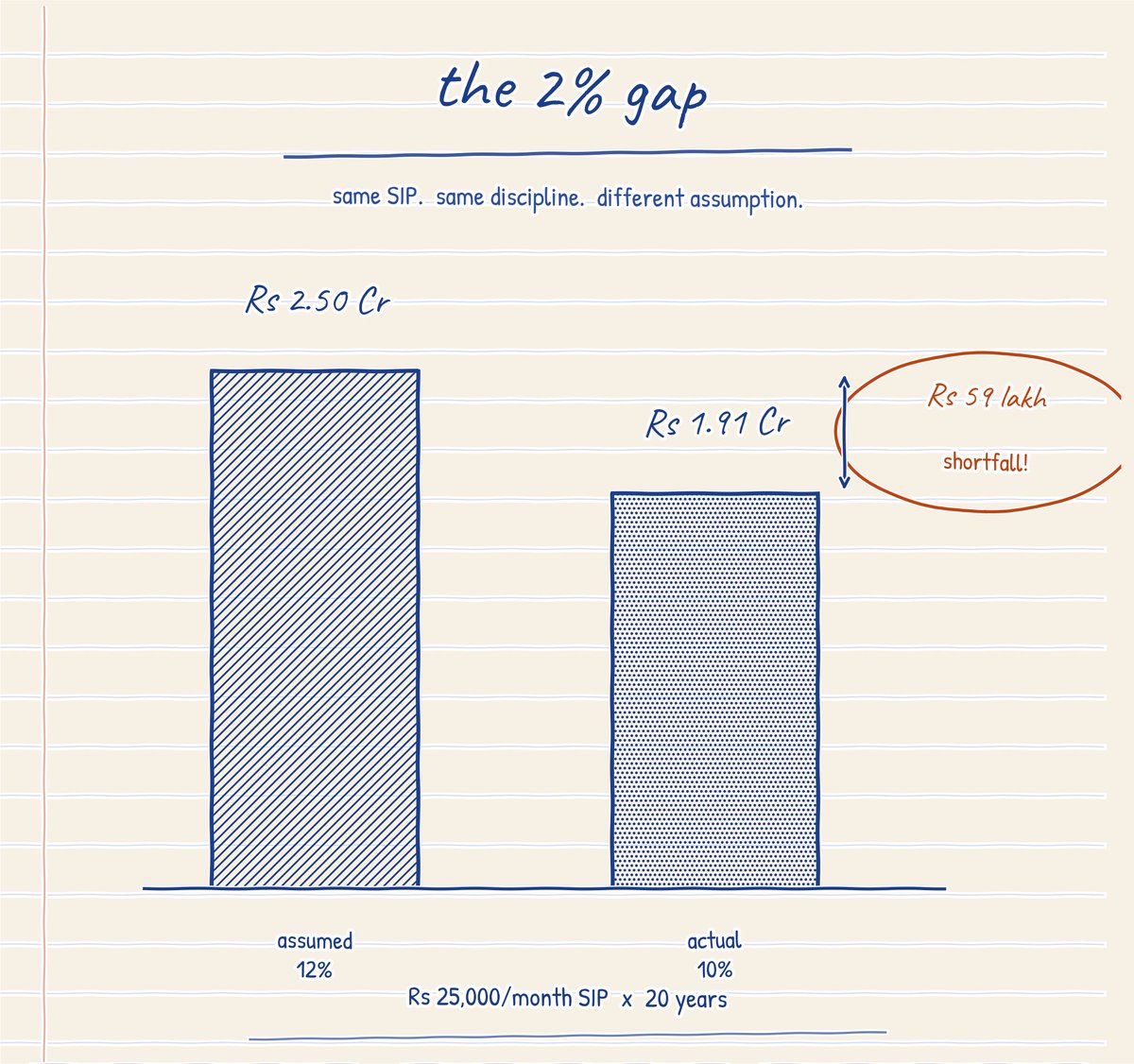
Most long-term financial plans are made on one simple assumption that equity will generate ~12% returns in the long run.
But what if the market gives you 10% instead? Not a crash. Not a crisis. Just... 2% less over long period.
Here's what that 2% gap does over 20 years:
SIP of ₹25,000/month for 20 years
• At 12% = ~₹2.50 crore
• At 10% = ~₹1.91 crore
That small 2% gap = ₹59 lakh. Nearly a quarter of your goal gone without a single bad decision on your part.
So what's the Plan B? You have three ways to makeup:
1. Save more. To still reach ₹2.5 crore at 10%, your SIP needs to be ~₹32,600 — about 30% higher. Painful, but doable if you start early.
2. Stay longer. At 10%, the same ₹25,000 SIP reaches ₹2.5 crore in about 22.5 years. Sometimes Plan B is just 2–3 more years of patience.
3. Step up annually. A 10% yearly increase in your SIP quietly absorbs the return shortfall, and matches your income growth anyway.
The lesson isn't to abandon your return assumptions. It's to stress-test them.
Plan for 12%. But make sure your plan survives 10%. Because markets don't know our assumptions.
The first ₹50 lakh is the hardest.
Not because the market is against you.
But because your SIP is doing most of the heavy lifting.
At a ₹30,000 monthly SIP (12% return assumption):
✅ ₹0 to ₹50L: 8 years 3 months
✅ ₹50L to ₹1 Cr: Just over 4 years
✅ ₹1 Cr to ₹1.5 Cr: Less than 3 years
✅ ₹2 Cr to ₹2.5 Cr: Just 1 year 8 months
That's the power of compounding.
Stay invested. The snowball gets bigger with time.
Forget stock tips or ideas, this is the real funda of wealth creation.
People spend lot of time, energy & effort looking for the next multibagger, but in reality big wealth isn't created by finding 1 magical stock. It is actually created through a few important boring habits followed consistently for decades.
Start early. Invest regularly. Increase your investments as your income grows. Stay invested when markets fall.
It sounds simple because it is. The difficult part is sticking to it.
Here is what the numbers actually tell us.
1. Starting early is your biggest advantage
If a 25 year old invests ₹10,000 every month in a broad market index fund earning an average 12% annual return, the corpus can grow to roughly ₹3.5 Crores by age 55.
Now compare that with someone who starts at age 35 with the exact same monthly investment. By age 55, the corpus is only about ₹1 Crore.
Nothing changed except starting 10 years later.
That single delay can cost more than ₹2.5 Crores because time is doing most of the compounding.
2. The biggest gains usually come in the final years
Many investors quit too early because the early years feel slow.
With a ₹10,000 monthly SIP earning 12% annually, you invest about ₹12 Lakhs in the first decade and build a portfolio worth around ₹23 Lakhs.
By the end of the second decade, that grows to nearly ₹1 Crore.
Then something interesting happens.
During the final 10 yrs, the same portfolio grows from around ₹1 Crore to almost ₹3.5 Crores!!
Over 70% of the final wealth is created in the last decade, only if you stay invested long enough to experience it.
3. Small annual increases can make a huge difference
Yes salaries do increase over time, but many SIPs never do.
A flat ₹10,000 monthly SIP for 20 years at 12% grows to around ₹1 Cr.
Now imagine increasing that monthly investment by just 10% every year.
Your total investment becomes roughly ₹68 Lakhs, while your final portfolio grows to nearly ₹2.3 Cr
4. Every EMI has an opportunity cost
A car loan with a ₹25,000 monthly EMI for 5years means paying ~ ₹15 Lakhs for an asset that keeps losing value.
Instead, if that same ₹25,000 is invested every month for five years and then allowed to compound for another 15 years, it can grow to more than ₹1.2 Cr
Avoiding the wrong expense is super vital in making wealth.
5. Surviving market crashes is part of investing
Market corrections are normal : A 20% to 40% fall has happened many times before and will happen again.
The investors who usually suffer the most are not the ones who picked bad companies but the ones forced to sell during difficult times.
Keeping 6 to 12 months of expenses in liquid funds or fixed deposits gives you the freedom to leave your long term investments untouched while markets recover.
👉 Here's the bigger picture:
History has shown that India's equity markets have rewarded disciplined investors over long periods. Even after taxes and inflation, diversified equity investments have delivered attractive real returns over multi decade periods.
You don't need to predict market moves or cycles and yes you certainly don't need to trade every week.
You don't need to find the next hidden multibagger.
Save consistently & agressively & make sure you top up your investments as your income grows. Stay invested through the ups and downs.
Over time, those simple habits have created far more wealth than chasing the latest market trend ever has.
A introspective few questions for you:
• At what age did you start your very first SIP?
• What do you find harder: handling market volatility or resisting lifestyle inflation?
• Do you increase your mutual fund SIP every year or is it still the same as when you started?
THERE'S A CATEGORY ON YOUR IPHONE CALLED "SYSTEM DATA" AND APPLE NEVER TELLS YOU WHAT'S ACTUALLY IN IT.
On a lot of iPhones it quietly climbs past 20, 40, even 60GB.
I had 31GB of it. Cleared in 9 minutes, cost me nothing.
Here is exactly what I did:👇