No one gets a warning before uncertainty arrives.
The people who navigate it best aren't the ones who predicted it; they're the ones who prepared for it.
Whether it's building an emergency fund, staying diversified, or investing consistently, small actions today can make a big difference tomorrow.
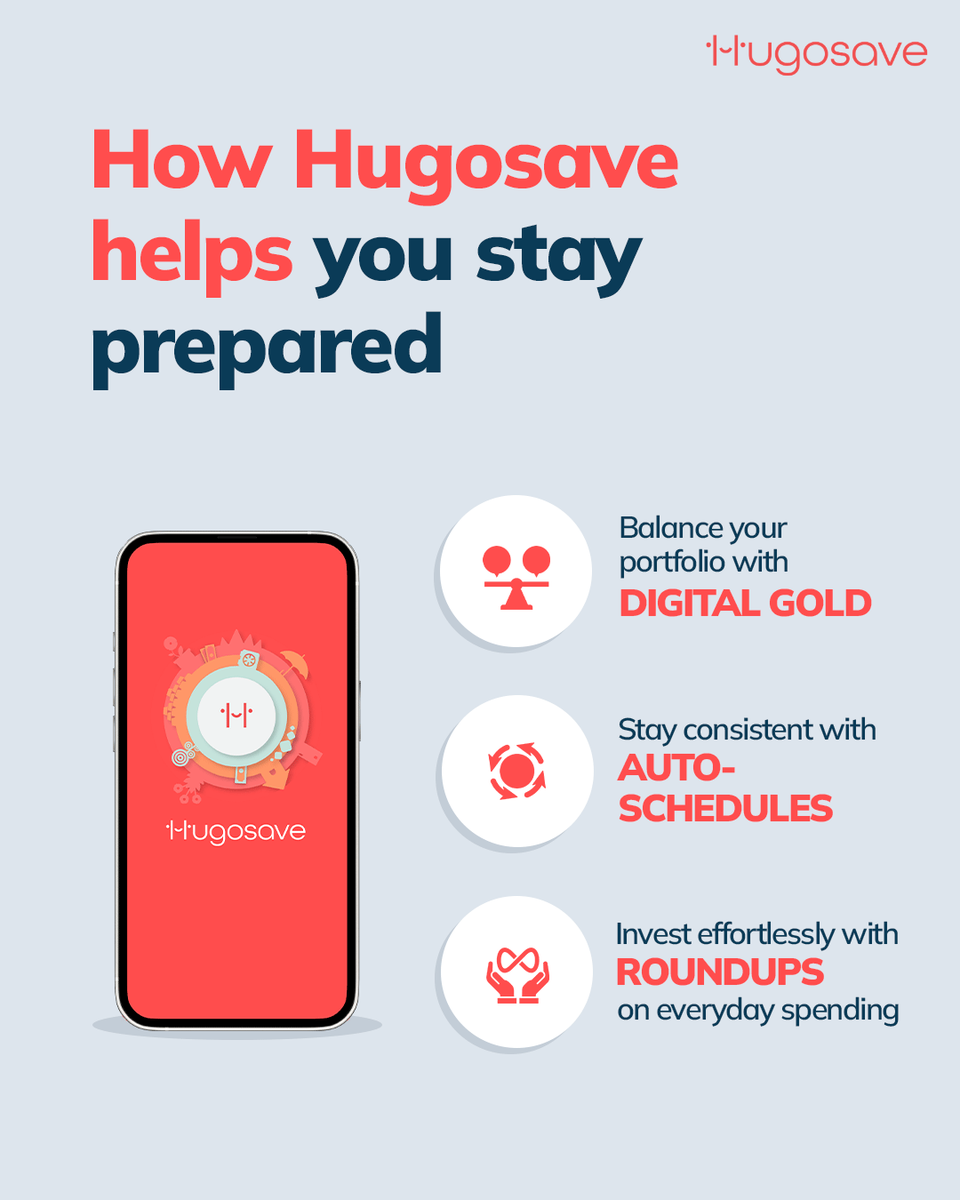
Here's how Hugosave helps you stay prepared:
• Build your emergency fund with Money Pots
• Diversify with Digital Gold and ETF portfolios
• Automate investing with Schedules
• Invest your spare change with Roundups
Save Often. Little. Early.
Download Hugosave
Your S.O.L.E. financial advisor.
🚨BREAKING: Anthropic just published a study mapping exactly which jobs its own AI is replacing right now.
The workers most at risk are not who anyone expected. They are older. They are more educated. They earn 47% more than average. And they are nearly four times more likely to hold a graduate degree than the workers AI is not touching.
The argument is straightforward. Anthropic built a new metric called "observed exposure." Not what AI could theoretically do. What it is actually doing right now in professional settings, measured against millions of real Claude conversations from enterprise users.
For computer and math workers, AI is theoretically capable of handling 94% of their tasks. It is currently handling 33% of them. For office and administrative roles, theoretical capability is 90%. Current observed usage is 40%. The gap between what AI can do and what it is already doing is enormous. The researchers are explicit about what comes next. As capabilities improve and adoption deepens, the red area grows to fill the blue.
The demographic finding is what makes the paper uncomfortable. The most AI-exposed workers earn 47% more on average than the least exposed group. They are more likely to be female. They are more likely to be college educated. This is not a story about warehouse workers or truck drivers. It is a story about lawyers, financial analysts, market researchers, and software developers. The exact group whose education was supposed to insulate them.
Computer programmers showed the highest observed AI exposure at 74.5%. Customer service representatives at 70.1%. Data entry keyers at 67.1%. Medical record specialists at 66.7%. Market research analysts and marketing specialists at 64.8%. These are not predictions. These are measurements of work that is already happening on AI platforms right now.
Then there is the pipeline finding nobody is talking about loudly enough.
Anthropic's researchers found a 14% decline in the job-finding rate for workers aged 22 to 25 in highly exposed occupations since ChatGPT launched. No comparable effect for workers over 25. Entry-level roles were never just jobs. They were the training ground where junior analysts became senior analysts, where junior lawyers learned how arguments hold together. If that layer disappears, nobody has answered the question of where the next generation of senior professionals comes from.
The detail buried in the paper that most coverage missed: 30% of American workers have zero AI exposure at all. Cooks. Mechanics. Bartenders. Dishwashers. The technology reshaping professional careers is completely irrelevant to roughly a third of the workforce. The divide is no longer between high skill and low skill. It is between presence and absence.
The company publishing this study is the same company selling the AI doing the replacing. Anthropic had every commercial incentive to soften these findings. They published them anyway.
If you spent four years and $200,000 on a degree to land a white collar career, the company that builds Claude just confirmed your job is more exposed than the bartender pouring drinks at your graduation party.
Source: Anthropic, "Labor market impacts of AI: A new measure and early evidence"
PDF: https://t.co/taYgsIfiTj
The only people who believe any of this are non-coders.
I tried to build a game (an area I’m an n00b in.) The results are amusingly disastrous - I never before coded a decent game.
But I’ll crack out backend services w AI rapidly - because I coded dozens of them before…
Some of the best management advice I ever received: Hold as high a bar for your team as you do for yourself.
You cannot effectively demand a level of craft you aren’t willing to practice. If you slack on the details, your team will eventually slack on the outcomes.
Disciplined teams aren't driven by top-down pressure, they are driven by the realization that the person at the helm cares about the work as much as they do.
But this goes both ways. It is easy to fall into the trap of being harder on yourself than anyone else. Taking it easy on a team out of a desire to be liked, or a fear of friction, is actually a form of neglect.
If you are obsessive about the details but let your team slide, you aren’t being a "nice" leader. You end up doing the work for them, or worse, letting the work suffer.
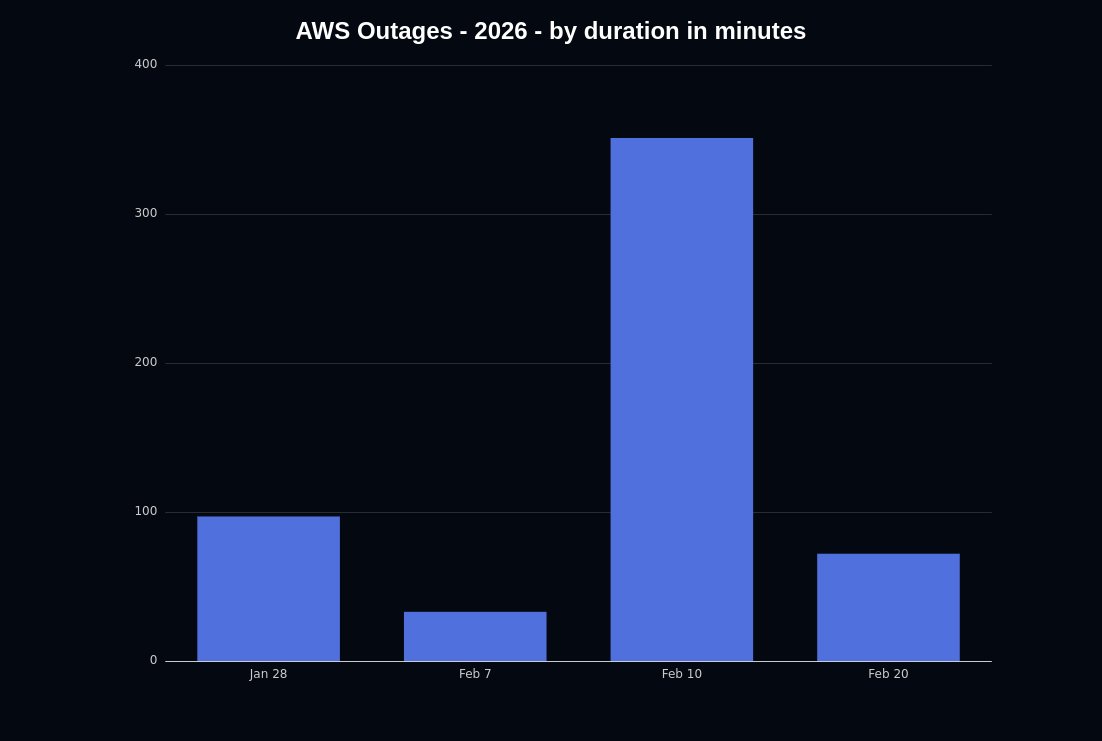
AWS experienced an outage with their Direct Connect service which lets customers link their private networks directly to AWS.
This is the 4th AWS outage this year, and the 35th in the last 12 months.
Although AWS is yet to publish a detailed RCA, status page updates indicate a bad deployment as the trigger.
The deployment took a while to rollout, which seems to be a good thing in this case:
"Our automated deployment takes approximately 12 hours so impact stayed limited to a subset of customers until we began observing broader impact".
Contrast this with last year's Cloudflare (Nov 2025) and Google Cloud (June 2025) outages where similar changes propagated across their global infrastructure very fast causing widespread damage.
So is a slower, controlled rollout strategy better? Experience would certainly make it seem so. Controlled rollouts are nothing new. They have been around for a while for application releases. Cloudflare adopted it last year for configuration changes too as part of their "Code Orange" plan - instead of propagating immediately, changes would be rolled out to a limited set of locations first. If health metrics indicate things are fine, it's rolled out gradually to more and more locations. Repeat the process until the changes are rolled out across the infrastructure.
If you pitched this as a screenplay, every studio would reject it for being too unrealistic.
A 28-year-old Vietnamese developer living with his parents programs a game over a single holiday weekend in his bedroom. He uses free ad monetization because he hopes to make a few hundred dollars a month. The game sits untouched in the App Store for eight months.
Then something inexplicable happens. With zero marketing spend, the game goes viral. Within weeks it tops the charts in 102 countries, hits 50 million downloads, and starts generating $50,000 per day in pure ad revenue. He’s making $18 million annualized from a game he built in three days.
So what does he do? He kills it. Not because Apple forced him. Not because Nintendo sued him. Not because a competitor acquired him. He kills it because he felt guilty that people were too addicted. The guilt was ruining his sleep. He tweeted “I cannot take this anymore” and pulled it the next day.
Within hours, people listed phones with the game on eBay for $99,900. Fans sent him death threats demanding he put it back. His only response was “And I still make games.”
The part nobody talks about: he turned down every acquisition offer afterward. A game generating $1.5 million per month, and a solo developer in Hanoi said no to everyone because he refused to compromise his independence.
Every founder in Silicon Valley talks about “mission over money.” Dong Nguyen actually did it, and the internet tried to destroy him for it.
I'll share one more story, this one a bit pithy but same vein, also coincidentally happened the same year:
I had just concluded a sales meeting with a Very Large Bank in London. Similarly, they had just announced a huge multi-year commitment to Azure. And similarly, I asked why. The CIO of the entire bank was present at the meeting. He leans forward and with a grin on his face says:
"Microsoft sent suits. Amazon sent hoodies. Google sent nobody."
10 years later, I still chuckle thinking about this interaction, and I still feel like despite the obvious humor, there's just so much underlying truth to it.
I share this story with founders of enterprise software companies, it's one of my favorite sales experiences and I think highlights some of the important non-technical aspects of sales:
I had just concluded a sales meeting with Very Large Company. This company had just publicly announced a huge commitment to Microsoft Azure.
The year is 2015 or so, and Azure is still very much an up-and-comer, so as the meeting concludes I ask the executive that was present "I'm curious, why Azure?" (As someone selling cloud agnostic tooling, I don't care one way or the other, but I was curious)
He says he'll show me on the way to the elevators. I consider that an odd answer to my question but go along with it.
As we near the turn to the elevators, we reach a hallway "intersection", and he points the opposite direction and says: "you see this hallway?" It was a standard corporate office hallway with small private offices flanking both sides as far as the building went. He continues, "Every single person in this hallway is a Microsoft paid employee."
And that's why they chose Azure. Because when something goes wrong, they don't have to submit a ticket or even call a phone number. They can literally knock on someone's door and get official, high tier support.
That's how Microsoft closed the 9 or 10 figure deal (multi-year, can't remember exact) to get this large company to go 100% into their cloud.
There's a lot of points to this story, but I think fundamentally the important thing is understanding the level of non-technical factors that lead to large enterprise deals.
People liked hearing the non-technical side of enterprise/B2B sales from a technical person so let's continue: another significant non-technical driver of sales is understanding that your buyer doesn't want to get fired, and ensuring buying your product is a safe choice.
Engineers hear this and think "the product needs to work well." This isn't the message. I mean, yes, the product needs to work well enough but that's not what I'm talking about here.
What I'm talking about is that the mainstream buyer (where 95% of the market value is) is incredibly risk averse and probably not for the reasons you expect.
People expect they're risk averse because these might be big important businesses that don't want to break. That's certainly a factor, but the reality is generally a lot more inward: the individual human buyer (or small group of buyers) is personally risk averse. They don't want to fuck up their own prospects.
Most working people are punching the clock. They're working a 9-5 to get paid and enjoy their non-work life. Work is just a means to that end. They want to get promoted, they don't want to make mistakes, and they most certainly do not want to get fired.
These types of people generally are not going to take a bet on new or uncertain solutions, technical merits notwithstanding. You know the old adage "you don't get fired for IBM?" This is where that rubber meets the road.
To sell to these people (again, the vast vast majority of the market), you need to become a safe bet. And again, that's not through technical capability alone. So how do you do it?
- Analyst relationships (showing up in things like Gartner reports make me throw up as an engineer but they're irrationally effective)
- Trade shows (not dev conferences, sorry, but the ones where I'd be wearing slacks probably)
- Whitepapers in an expected format/layout (again, puke, but they work)
- Fitting into a standard category (don't make a category, become the solution for an existing category)
- High touch sales and support -- the kind of obvious side so I won't get into details here.
There's a graveyard of excellent software startups that failed to make an impact because they got blinded by pursuing technical excellence at the cost of realizing businesses only care to a point.
@Cloudflare@CloudflareHelp
We were unable to upgrade from Zerotrust free plan to zero trust standard plan on cloudflare from the last 3 months. When we reqchouot top your team they suggest us moving to enprise plan to get a support.
How is this fair.
@facebook I am not able to login to my FB account as I am not getting my OTP. I tried many means to reach support, but not able to. Can someone from FB support can help me here
As you get ready to start a new company in 2025, make sure you truly absorb this 👇🏼from @PeterJ_Walker
Startups are not all glamour and riches...
The reality - startups are F*&%ing hard and getting harder.
It's a huge life commitment to embark on this journey which yeah, can be incredibly fulfilling and rewarding but also filled with lots of sacrifice and pain.
Huge respect for all founders building and plowing away 🫡
(1/) We are thrilled to announce a medical milestone–the world’s first live birth using our product, Fertilo, that matures eggs outside the body. https://t.co/p45YN8kuYG
🥳 Hugosave turns 3️⃣ today! 🎉
We're celebrating ALL MONTH LONG with contests, exclusive offers, and a trip down memory lane. Stay tuned!
Celebrating three amazing years of Spending, Saving & Investing Better.
#HugosaveTurns3#hugosave#sg#singapore
Why waste time building up a lump sum for investment? Invest every cent as EARLY as possible.
Use Hugosave to do that automatically. You sit back and relax.
#hugosave#singapore#sg#money#invest#savings#app