The best leaders are not at all competitive. They aren’t constantly trying to outdo their peers [even behind their backs], stamp their higher authority on their team or demonstrate their superiority. There is no need. The team & the collective achievement of outcomes is their job
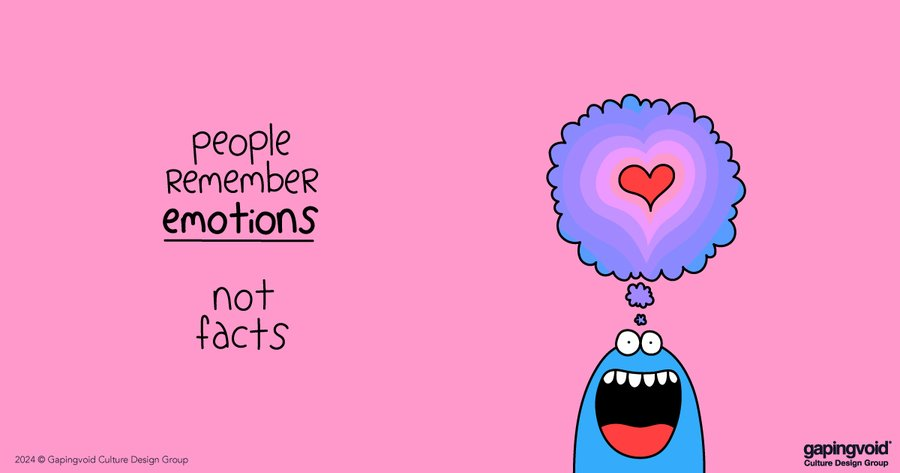
One of the things we often get wrong in health & care improvement is prioritising performance improvement (process-technical aspects) over the emotional experience of participants. We need to make consideration of emotional factors one of our highest priorities in change initiatives. This includes:
1) how we make connections with values, through emotions, to engage people in change &
2) appreciating emotions & related cognitions & behaviours surrounding events during change.
See: https://t.co/cpQsfsNVds Via @StevenHCady. Graphic: @gapingvoid
Adaptive leadership means shifting from being the leader who “knows it all” to the leader who's a “learn it all.” Five critical leadership skills for creating an environment in which learning things the organisation does not know how to do is valued over implementing flawlessly what it knows already:
1) Cross-cutting: leaders with more diverse networks create more value for the organisation.
2) Collaborating: fostering psychological safety to increase team performance.
3) Coaching: having critical conversations that develop others’ potential,
4) Culture shaping: shaping organisational culture by changing processes & systems.
5) Connecting: growing in empathy and authentic leadership.
https://t.co/7qTKh9F9lZ. By @HerminiaIbarra. Graphic: @tnvora
#Recruiting a #Sonographer to join our friendly forward thinking team. This is a new permanent position as part of our service expansion. For more info & to apply 🔗 https://t.co/pM2tuunvOu