I can't get enough of the brilliance and outstanding excellence in this girl's head. How can't any sane mind want to associate themselves with such kind of splendid brains.
Let me 'beat' a story, there is a leader in this country who was initially introduced to this girl Fredah. A young lady without a big name or fame, just from some remote village in Kisii County.
He asked, what is her profession? What does she do for a living? What is her political record and how much influential is she? He was told, she's an actress, in some vernacular plays back in the village!
She was dismissed, never to be given an opportunity to showcase her prowess in what she does best. The leader said that they'll accomodate her when they will be having rallies for her to be acting comedy skits.
Here she is, rawly offering what that particular leader is looking in Professors, Lawyers, PhD holders and well learned experts in expensive suits, purporting to bear experience in diverse academic fields on earth!
One thing I admire so much, in Linda Mwananchi, as much ordinary you can look like, as long as you have a brain that can produce results. You are embraced you and give you an opportunity to exploit your potential, no matter the size of your body or head, your physical appearance, how you are dressed, your background, social status or even experience!
Keep going my sister Fredah Kwamboka Onduso, my motherland and the entire world is so proud of you! Keep the discipline and humility, the future looks exactly like your brilliance!
The question is not whether France collects more tax. The question is what France gives its citizens in return. If you want to compare Kenya with France, then compare the entire bargain.
A French taxpayer can point to world-class roads and rail, functioning public transport, reliable water and sanitation, public schools, extensive social protection and public services that actually work.
What can a heavily taxed Kenyan point to?
Broken roads. Expensive healthcare. Overcrowded public schools. Unreliable services. Youth unemployment. Electricity and living costs rising. And a government increasingly asking citizens to pay privately for services they have already been taxed to receive.
You cannot hold up France’s tax-to-GDP ratio as evidence that Kenyans are undertaxed while conveniently leaving out the services attached to that taxation.
Taxation is not a competition over who can extract the most money from citizens. It is a social contract.
If you want French taxes, Mr President, then start delivering French-quality public value.
Kenyans are not opposed to paying taxes. They are opposed to being taxed like citizens of a developed welfare state and served like subjects of a failed one.
THE PEOPLE MUST NOT REPAY ILLEGAL DEBT
Kenya’s people cannot be made to repay every loan simply because someone signed a document in the name of the Republic.
Before taxpayers are asked to pay, we must ask basic questions: Was the borrowing lawful? Were the constitutional and statutory procedures followed? Where did the money go? What was it used for? What public benefit did it produce?
And where #odiousdebt is alleged, we must ask what the lenders knew, or reasonably ought to have known.
Public debt is not a blank cheque. The Constitution, the law and the Kenyan people must come first.
#DeniBandia #ReKe
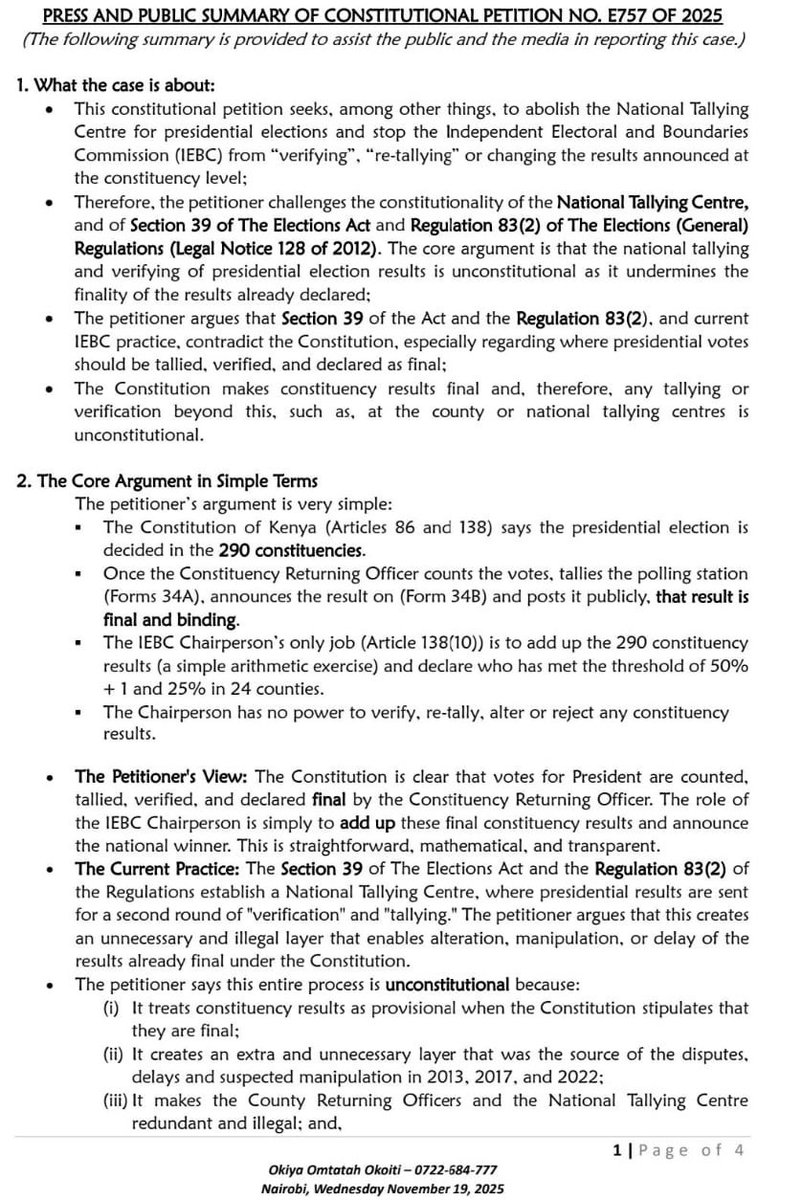
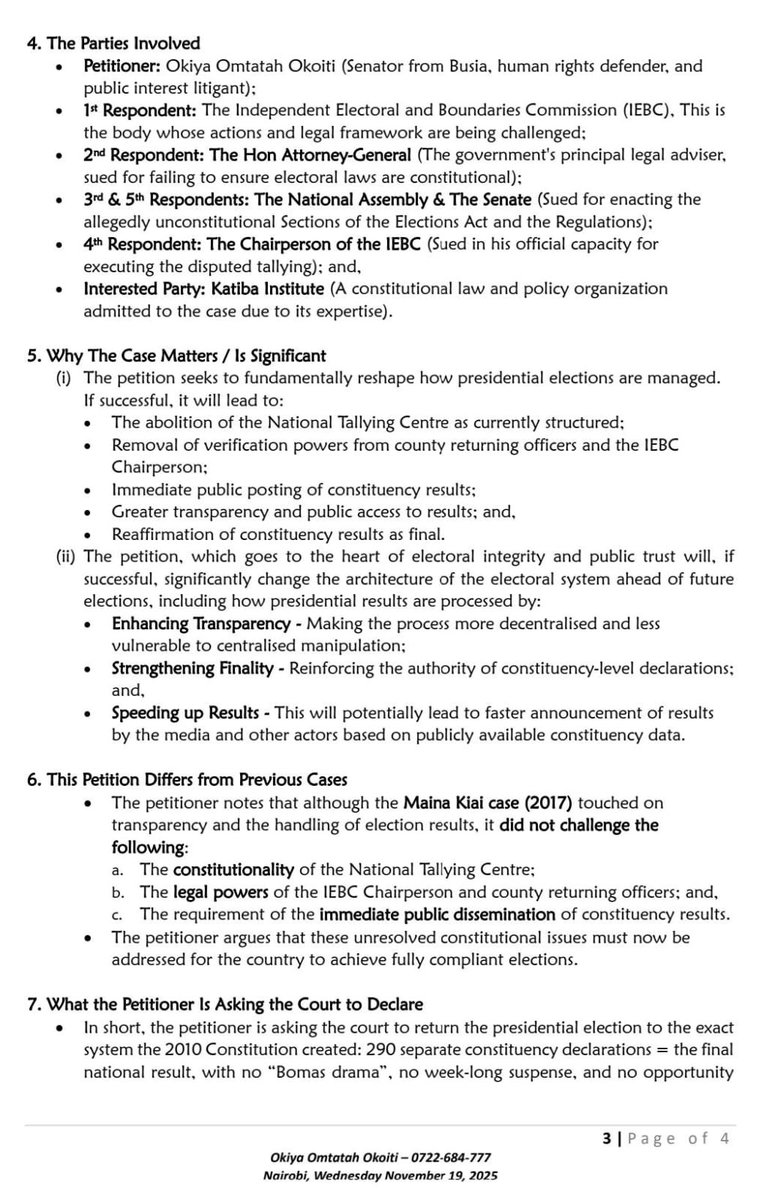
I have filed a Constitutional Petition No. E757 of 2025 in the High Court to defend the integrity of Kenya’s presidential election process and to uphold the Constitution of Kenya, 2010.
This petition challenges the unconstitutional establishment and operation of the National Tallying Centre during presidential elections, as well as Sections 39, 39(1C), 39(1G) of the Elections Act and Regulation 83(2) of the Elections (General) Regulations.
The Constitution is clear:
✔️ Presidential results are tallied, verified, and declared at the 290 constituencies, and those results are final and binding.
✔️ The role of the @IEBCKenya Chairperson under Article 138(10) is strictly clerical; to add up constituency results and declare the winner.
❌ The Chairperson cannot verify, re-tally, alter, or overturn any constituency result.
❌ No law or regulation may introduce a second layer of verification at county or national level.
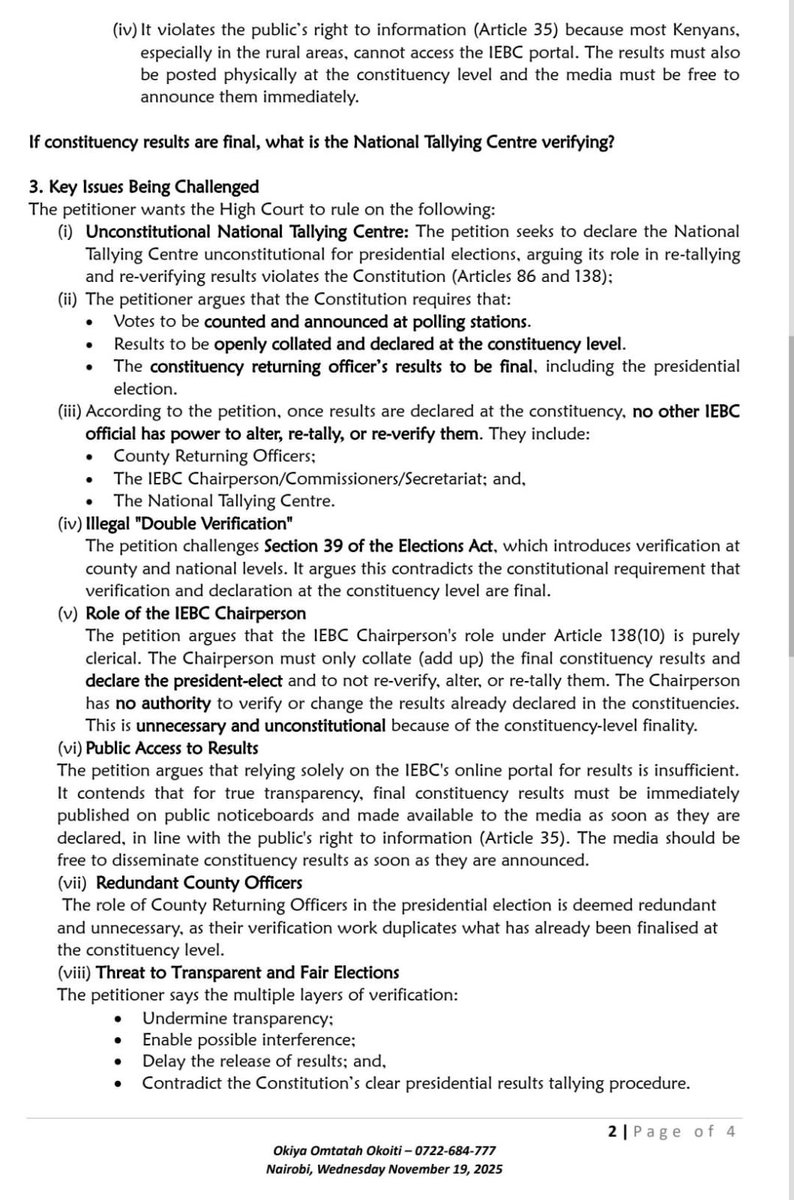
Yet, current laws and @IEBCKenya practice unlawfully create a parallel system of verification at the National Tallying Centre, which:
• Treats final constituency results as provisional;
• Enables interference, manipulation, and delays;
• Undermines transparency and fuels mistrust;
• Violates the people’s sovereign will as expressed at the constituency level.
This petition seeks, among other declarations:
🔹 Abolition of the National Tallying Centre as currently constituted;
🔹 Quashing of unconstitutional provisions in the Elections Act and Regulations;
🔹 Immediate public posting of final constituency results at each constituency;
🔹 Removal of illegal verification powers from County Returning Officers and the IEBC Chairperson;
🔹 Restoration of strict compliance with Articles 86 and 138 of the Constitution.
If successful, this petition will fundamentally transform the management of presidential elections from 2027 onwards, ensuring a transparent, decentralised, and constitutionally faithful process with no “Bomas drama” and no ambiguity.
Our democracy must be anchored not on improvised systems, but on the letter and spirit of our Constitution. This petition is part of my continued commitment to defend the rule of law, protect the sovereign will of the people, and secure free, fair, and credible elections.
Can we get an explanation as to why salaried Kenyans are compelled to contribute to the Housing Levy to construct houses on public land; land held in trust for all citizens , only to be required to purchase these same houses from intermediaries who profit from public contributions despite adding no value? What legal or policy justification exists for taxing citizens to build public housing, then selling those same houses back to them at a profit?
Why is there no clearly defined end date or sunset clause for the Housing Levy? At what point will the government declare that it has collected enough?
How much money has been collected so far, how much has been spent, and where is the independently audited, project-by-project account of those funds?
If workers are financing the construction, why are they not granted an equitable ownership interest or priority rights proportionate to their contributions?
Why should Kenyans continue making mandatory monthly contributions if there is no guarantee they will ever own one of the houses they are helping finance?
Why should citizens pay for houses built on public land while also bearing the cost of the land through their taxes?
How are the profits made by intermediaries justified where the land is public and the construction is financed through compulsory public contributions?
If the programme is intended to serve the public interest, why are all contracts, procurement decisions, and financial statements not published proactively for public scrutiny?
Most importantly, how does a compulsory levy that requires citizens to finance construction and then purchase the finished product satisfy the constitutional principles of transparency, accountability, equity, and prudent use of public resources?
Taxpayers deserve more than assurances. They deserve clear, evidence-based answers to these questions.
PUBLIC MONEY IS NOT EXECUTIVE PROPERTY: THE CONSTITUTIONAL TRUTH ABOUT CHAPTER TWELVE
Fellow Kenyans,
The bottom line of Chapter Twelve is simple: the Executive DOES NOT own public money, THE PEOPLE do.
Our 2010 Constitution intentionally strips the President and Cabinet of unchecked power over your taxes through six strict principles:
1) People Own the Funds: Government only administers public money; it never owns it.
2) Parliament Approves Spending: The Executive cannot spend a single shilling without explicit parliamentary authority.
3) The Treasury is Independent: Under Article 225, the Treasury is an autonomous custodian, not a political department subordinate to the Executive.
4) Independent Oversight: The CRA, Controller of Budget, and Auditor-General ensure no single entity controls the financial chain.
5) Personal Liability for Looting: Under Article 226(5), any official who directs unlawful spending must pay it back from their own pocket, even after leaving office.
6) No Free-For-All Borrowing: Debt is strictly tied to legitimate budget deficits, not executive whims.
The power of the purse belongs to the people, not the Executive. We must defend our Constitution! #ReKe #GetitDone #KnowYourConstitution #ConstitutionKe2010
https://t.co/THmleX3KBq
Abolish the reading of budget because we don’t follow it. Where did Ol Kalou get 10B from? Not budgeted or approved by the parliaments. Successful countries read budget and do follow it
~Kinuthia
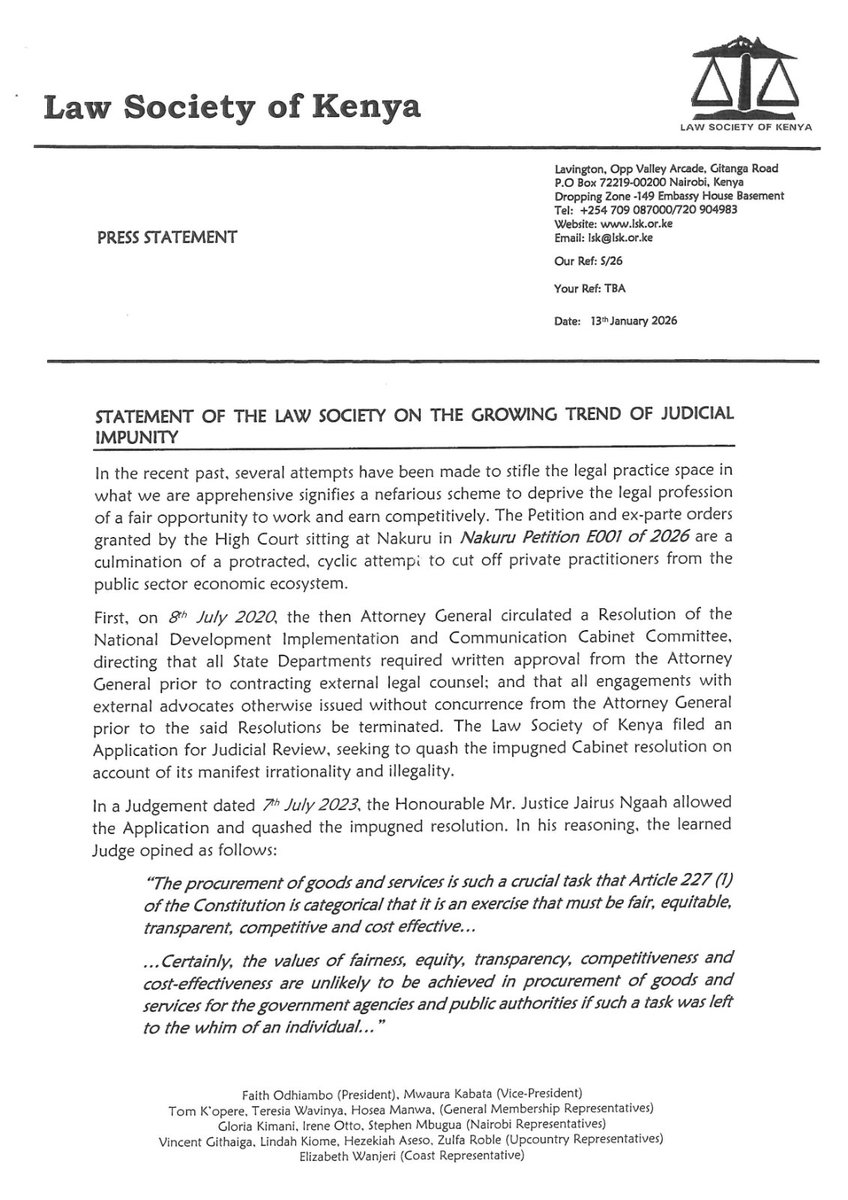
@LawSocietyofKe We should not kill a profession over a few incidents of inflated legal fees. That is sensational and ill informed. Investigate, create strategies. You will need the same lawyers you are destroying to defend your rights, but they will have moved on to animal husbandry.
@KCBInKenya This is PR. After you add that vague risk element applied per customer, the interest rates will likely be over 15%!! So mwananchi still not benefitting from lower CBR. The elephant in the room remains those other things that you add to CBR or is Kesonia.
OUR COUNTRY HATES FARMERS.
This is what other countries do for their farmers:
- provide easy and cheap credit access to invest in production
- promote agri-innovation and sustainable production practices
- offer farmers minimum guaranteed prices for their produce
- offer subsidised insurance schemes
- enforce import tariffs on farm items to protect local farmers
- offer farmers financial incentives and tax breaks
- subsidizing inputs such as farm equipment, seedlings, fertilizer, AI
- provide free extension services
- build markets and facilitate trade
In Kenya, parliamentarians are competing on who will advance the most backward legal provisions to stifle farming. Ghasia.